
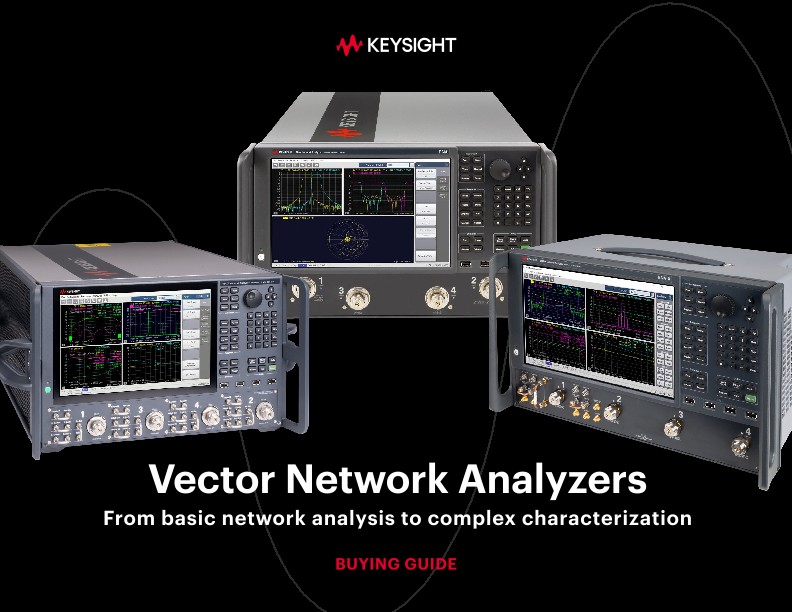
Vector Network Analyzers Buying Guide
Buying Guides
Selecting the right vector network analyzer (VNA) depends on the frequency range, number of internal sources, dynamic range, and measurement precision your application requires. Keysight offers three performance grades of VNAs – Essential, Expert, and Pro – each designed to support varying levels of RF, microwave, and millimeter‑wave characterization from basic S‑parameters to advanced active‑device modeling. This guide compares these grades to help you determine which VNA meets your validation, characterization, or research needs.
Keysight’s VNA lineup is structured into three main performance grades with varying core features:
- Essential vector network analyzers come in one class, the XN3-class, and include the E5063A and E5061B ENA. They have 1 source and support passive device characterization, cable and filter testing, and S-parameter analysis for frequencies up to 18 GHz. Get fast insights with automated tests and optional software for impedance and pulsed RF measurements.
- Expert vector network analyzers come in two classes. The XN5-class includes the ENA-X, PNA-L, and E5080B ENA. The XN7-class includes the PNA and N5264B PNA-X. For labs that need sophisticated features for testing active devices, our metrology-grade Expert vector network analyzers support vector signal analysis for nonlinear devices with modulated signals, up to two internal sources, and expanded frequency support up to 67 GHz. They support spectrum analysis, error vector magnitude (EVM), and adjacent channel power ratio (ACPR) measurements. You can also select direct digital synthesis (DDS) sources, which deliver up to 10 times faster phase and group delay measurements compared to Essential vector network analyzers.
- Pro vector network analyzers come in one class, the XN8-class, and include the N5241B-N5249B PNA-X and PNA-X Pro. Pro VNAs combine mixers, ultra-low noise floors, and up to four internal sources, along with elevated measurement software, to support the most complex active device R&D applications at frequencies up to 67 GHz. They expand on our Expert capabilities, offering additional built-in measurements for complete active device test, plus a configurable architecture you can customize for your lab requirements.
Typical use cases further illustrate how each VNA grade supports different engineering needs:
- Essential VNAs are optimized for passive component testing. They are designed for essential S-parameter and time-domain tests and provide a solid foundation for fundamental RF measurements, cable characterization, passive validation, and testing devices such as DC-to-DC converters and EMI filters.
- Expert VNAs expand measurement capability with active device testing and available metrology-grade performance. They support more than 120 software options that enable fast, accurate characterization of nonlinear devices like RF amplifiers, mixers, and modulators. With a wider frequency range, enhanced dynamic range, and software-enabled features, Expert VNAs are well suited for active device characterization and protocol-layer insights.
- Pro VNAs are ideal for next-generation designs and complex active device development. They are designed to support multisource testing, enhanced automation, and ultra-low noise for R&D teams working on next-generation RF systems and active circuits. Pro models expand on Expert capabilities, offering additional built-in measurements that enable complete active device test.
Modular vector network analyzers provide you with Essential benchtop grade performance in a compact, flexible form factor, helping you scale your multiport and multidevice testing needs. While the dynamic range of conventional switch-based systems limits measurement speed, modular VNAs allow wider intermediate frequency bandwidths to test faster. These VNAs deliver maximum frequency ranges from 4.5 GHz to 53 GHz and support up to 50 ports in a single chassis.
USB vector network analyzers come in one class, the XN4-class, and include the Streamline Series VNAs. They provide high performance in a lightweight, portable form factor — ideal for labs with limited space. Unlike benchtop vector network analyzers, which are standalone instruments, USB VNAs connect to a host PC to handle data processing and analysis. Transfer your component characterization data across the workflow easily using the same user interface, measurement capabilities, and automation code as our benchtop and modular vector network analyzers. Get the same measurement reliability as our Essential benchtop VNAs in a portable unit offering up to 53 GHz of frequency coverage and up to 6 ports.
Handheld network analyzers combine spectrum analysis, vector network analysis, and power measurements in a rugged, portable unit with frequency coverage up to 54 GHz. Designed for field engineers, they include features like over-the-air testing, USB power sensor compatibility, and pulse signal generation for field-ready performance. You can upgrade your analyzer remotely with more than 25 license key-activated software options, including spectrum analysis, cable and antenna testing, 5G / LTE field testing, power measurements, and utilities.
Power your VNA with a wide range of specialty network analyzer software for real-time S-parameter measurements, time‑domain analysis, noise figure, modulation distortion, and more, as well as vector signal analysis software for wireless connectivity, radar analysis, LTE / LTE-A FDD modulation analysis, cellular communication analysis, and more.
Before finalizing a vector network analyzer purchase, it’s important to consider key selection factors:
- Maximum number of sources: Multiple sources enable intermodulation distortion (IMD), gain compression, and wideband tests for active devices. Choose Essential for one source in passive component tests, Expert for two-source mid-tier setups, and Pro for three to four sources in high-performance, multiport measurements. If you need more than four ports, check out our modular VNAs.
- Frequency range: Frequency range determines the analyzer’s spectrum band capabilities. Choose Essential (up to 18 GHz) for passive component testing or narrowband RF applications, and Expert or Pro (up to 67 GHz) for broadband, mmWave, or S-parameter testing, including harmonics.
- Integrated low-noise receiver: A low-noise receiver ensures accurate measurements of weak signals. Choose Essential for non-critical tasks like connector or cable loss tests. Use Expert for antenna tuning or filter characterization requiring moderate precision, and Pro for multiport or MIMO testing requiring low-noise, simultaneous signal analysis.
- Number of built-in ports: Port configuration impacts accuracy and efficiency, with additional port hardware required for advanced active device measurements. Choose Essential for simple 2-port configuration S-parameter tests, Expert for flexible 2- to 4-port setups for moderate multiport testing, and Pro for 4-port MIMO, differential, or remote head testing with extended configurability for external equipment support.
Keysight vector network analyzers offer high accuracy and precision, fast insights, flexible connectivity, and active device characterization. They are backed by Keysight Support Services, including calibration, repair, KeysightCare, educational resources, and Keysight Support to reduce your learning curve, enhance your uptime, and ensure the accuracy of your testing equipment. With scalable performance, wide frequency coverage, and advanced analysis capabilities, Keysight VNAs support RF engineers performing fundamental RF measurements and passive component validation to R&D teams working on next-generation RF systems and active circuits.