


Why Use Human Workflow & Virtual Product Integration Simulation
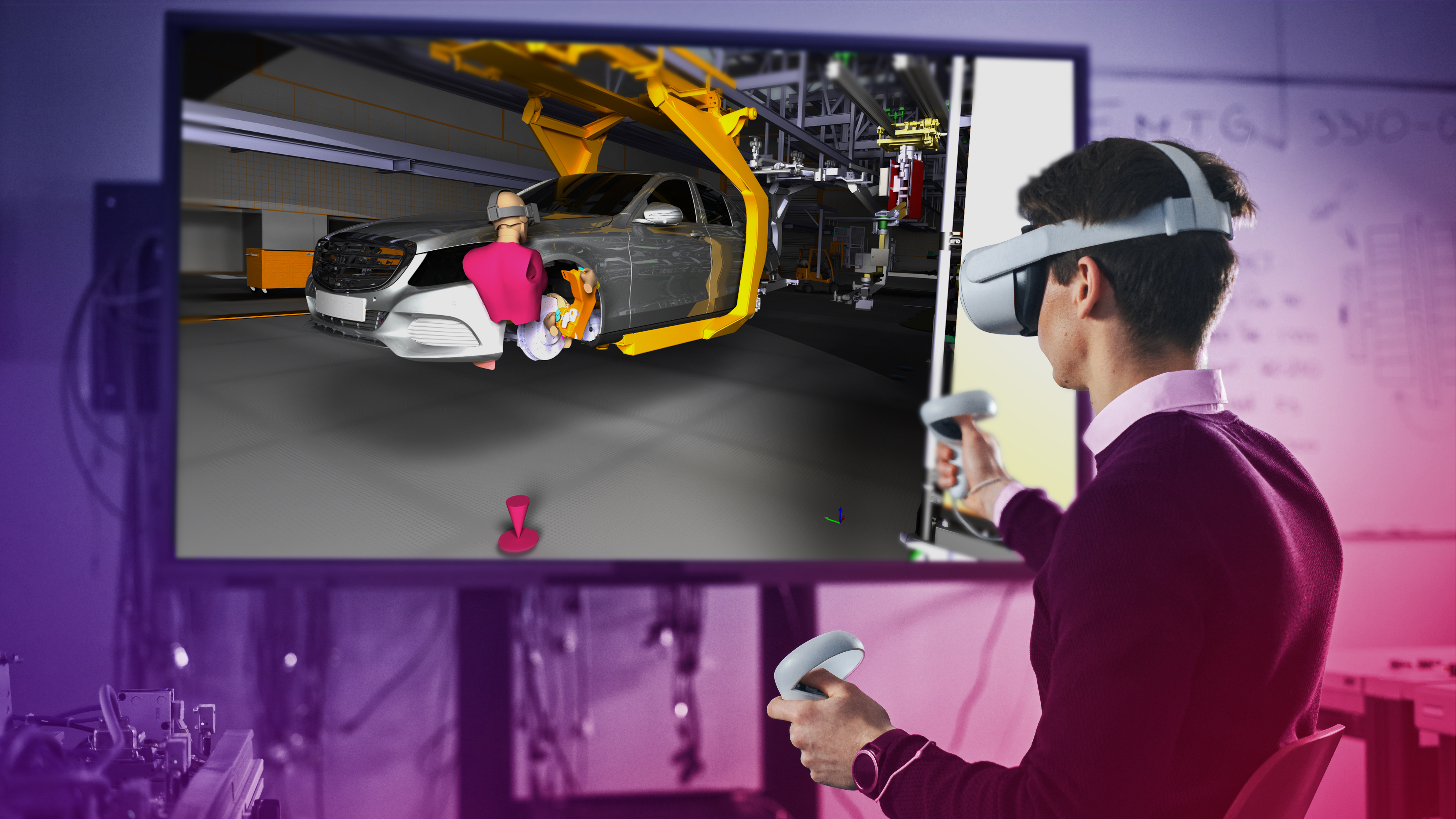
Human Workflow (IC.IDO) is a virtual product integration and human workflow process solution that equips program managers, engineers and process planners with advanced Virtual Reality (VR) capabilities for realistic virtual experiences and real-time simulations of assembly, operation, and maintenance tasks. It reduces need for physical mock-ups or prototypes, accelerates product development, and shortens time to market—with enhanced collaboration to minimize risk and streamline production.


Key Features

Test packaging, clearances, and system fit in real time with immersive visualization and interactive exeriences.

Interact with flexible components through accurate, real-time physics simulations.

Assess reachability, accessibility, and posture in first-hand experiences and deliver manikin-based analytical evidence.

Simulate component installation, removal, and tool interactions to identify and resolve challenges early.

Enable distributed teams to simultaneously experience build & maintenance together in real time.

Capture human–product interactions and seamlessly share data across upstream and downstream teams.
- Product Integration and Process Validation
Customers, assemblers, and technicians experience designs early in a true-to-life digital environment. This minimizes waiting, limits costly physical prototypes, supporting better, more successful production launch and sustainable maintenance.
- Streamline Product Development with Enhanced Human Factors Evaluation
Enable early assessment of human factors like reachability and accessibility. Through first-hand experiences, virtual, extended, and mixed reality capabilities determine factors like visibility, reachability, accessibility, and installability before construction of physical assets.
- Optimize Cross-Functional Reviews: Product & Process
Enable real-time collaboration, uniting engineering, manufacturing, and service teams to validate complex designs and process plans-ensuring requirements are met before production.
Resources to Get You Started
Using VR to Optimize Products and Processes from the Operator's Perspective.


Brochures
Overcoming Challenges in Process Validation & Product Integration

eBooks
Experience Your Future Aerospace Products Today to Validate Human Centric Processes
Videos
Explainer Video Human Workflow
Videos
Key benefits to Human Centric Real Time, Process / People & Product Validation
Have Questions? We've Got Answers
It is purpose-built for engineering and manufacturing, offering physics-backed interaction, process validation, exchange of PLM/PDM data, creation and sharing of issues/change notcies, and enterprise collaboration—not just visualization.
While it doesn’t eliminate all physical builds, it significantly reduces reliance on physical mock-ups and prototype cycles to catches issues and evaluate resolutions far earlier; long before investing in physical builds or waiting until production ramp-up.
Yes—the software integrates with OpenXR compatible devices, enabling supportable features like pass through with advanced depth sensing for immersive human factors evaluation. When possible, OpenXR implemented devices should work with IC.IDO to the extent of the devices’ capabilities.
Immersive experiences provide immediate first-person qualitative feedback to partcipating uses in VR. It also provides manikin-based analytics and real-time body-tracking interaction so teams can quantify posture, reach, accessibility, and operator risks early for wide ranges of body types or anthropometries.
Absolutely—multi-user sessions allow global and local teams to collaborate in the same virtual workspace concurrently, connecting users virutally across buildings, locations, nations, and continents.
The solution integrates three product offers: IC.IDO Integrate, IC.IDO Build & Maintain, and IC.IDO Weave, offering scalable capabilities for product and process validation. Deployments can be localized, floating, and tokenized for flexible access to specific capabilities and user profile needs.