What are you looking for?
W1725EP Ray Tracing Design Kit for SystemVue Element



- Overview and Features
- Post-Purchase Upgrades
- Resources
HIGHLIGHTS
 The W1725EP Ray Tracing Design Kit for SystemVue Element consists of a separate GUI software which is called from SystemVue and a Ray Tracing Engine embedded in SystemVue. For automotive radar complex scenario modeling applications.
The benefit to the user is the ability to model automotive radar scenarios with greater accuracy than previously possible. With the advent of imaging radars, this enhanced accuracy is essential to verifying mission critical functionality and performance.
The demand for autonomous vehicles (AVs) and advanced driver assistance systems (ADAS) is causing rapid growth in automotive radar solutions. New frequency ranges and new types of radar signals are changing the capabilities of this safety technology and challenging developers to handle increasingly complicated radar processing. Testing designs with many different complex scenarios is necessary to validate radar algorithm performance. Companies are turning to simulation to help validate their designs earlier in the design cycle to offset complex and costly real-world testing.

Solution Details
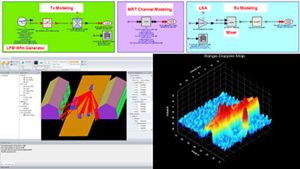
Ray Tracing is a technique that applies ray optics to radar reflection. This approach can model the reflections of many objects to represent real-world scenarios. A simple user interface allows designers to create an environment scenario by placing models from an existing library including vehicles, pedestrians, and stationary roadside objects. Once the location of the radar emitter is defined, the engine will calculate the reflections from all the objects in the scenario and provide a solution which can be passed to SystemVue for inclusion in a target analysis simulation.
 Figure 1. PathWave System Design Ray Tracing Design Kit.
The Automotive Radar Library in PathWave System Design (SystemVue) is used with SystemVue’s other comprehensive system simulation capabilities to develop mission-critical, safety-conscious and complicated scenarios which can be used to validate leading-edge of automotive radar designs. It provides a solution to automotive architects, under cost and time constraints, to design and verify algorithms such as direction of angle (DOA) and phase comparison.
Multi-scatter target parameterized simulation models are also available in the Automotive Radar Library, to realize and visualize the micro-Doppler effects on the target. This library can also import antenna pattern files for ground clutter simulation.
To accelerate the product development cycle from simulation to pilot and prototyping, SystemVue’s connectivity to test and measurement instrumentation enables import and export of IQ data files by adding input and/or output ports in the schematic workspace.
Benefits to Designers Throughout the Automotive Ecosystem
- Chip designers can prove design performance in complex reference scenarios.
- Equipment vendors can evaluate chipset offerings from multiple companies.
- Baseband designers can test algorithm performance in real-world configurations.
- Car manufacturers and OEMs can perform ‘deep dive’ analysis of specific scenarios used in sensor fusion/ virtual test drive simulations.
 Figure 2. PathWave System Design Automotive Radar Library.
Product Information
This ray tracing technology is new to the 2020 release of Pathwave System Design (SystemVue). Used in conjunction with the existing Automotive Radar library and the RF system modeling capabilities of SystemVue, it provides a complete system design and verification platform for Automotive Radar designers.
- W1464BP/BT – SystemVue RF Architect
- W1467BP/BT – SystemVue Array Architect
- W1725EP/ET – SystemVue Ray Tracing Design Kit
- W1908EP/ET – Automotive Radar Library