How to Characterize Qubit Coherence Times

Measure Qubit Coherence Over Time
Qubit coherence characterization requires precise control, repeatable pulse sequencing, synchronized timing, and reliable qubit-state readout across a controlled range of delays. In a T₁ relaxation measurement, a calibrated control pulse drives the qubit from its ground state to its excited state. The system then waits for a selected interval before measuring the qubit state. Repeating this sequence at progressively longer delays reveals how the excited-state population falls over time. Researchers average repeated measurements at each delay and fit the resulting decay to estimate the T₁ relaxation time. Consistent pulse amplitude, accurate timing, and dependable discrimination between measured states are essential for a trustworthy result. This measurement helps reveal energy loss in the qubit and provides a baseline for evaluating device performance, calibration changes, and conditions.
A Ramsey measurement probes phase coherence using two phase-sensitive control pulses separated by a variable free-evolution interval. The first pulse prepares a superposition, allowing the qubit to accumulate phase as it evolves; the second converts that phase difference into a measurable change in qubit-state probability. Sweeping the interval produces Ramsey fringes, whose decaying envelope yields the coherence time commonly called T₂*. Researchers repeat and average the sequence at each delay before fitting the oscillations and comparing results over time. Stable control and readout signals, precise synchronization, and careful calibration help ensure that the observed decay reflects qubit behavior. Timing errors, calibration drift, readout noise, and limited signal-to-noise ratio can otherwise obscure the fringes or make apparent T₂ dephasing difficult to interpret for the tested device.

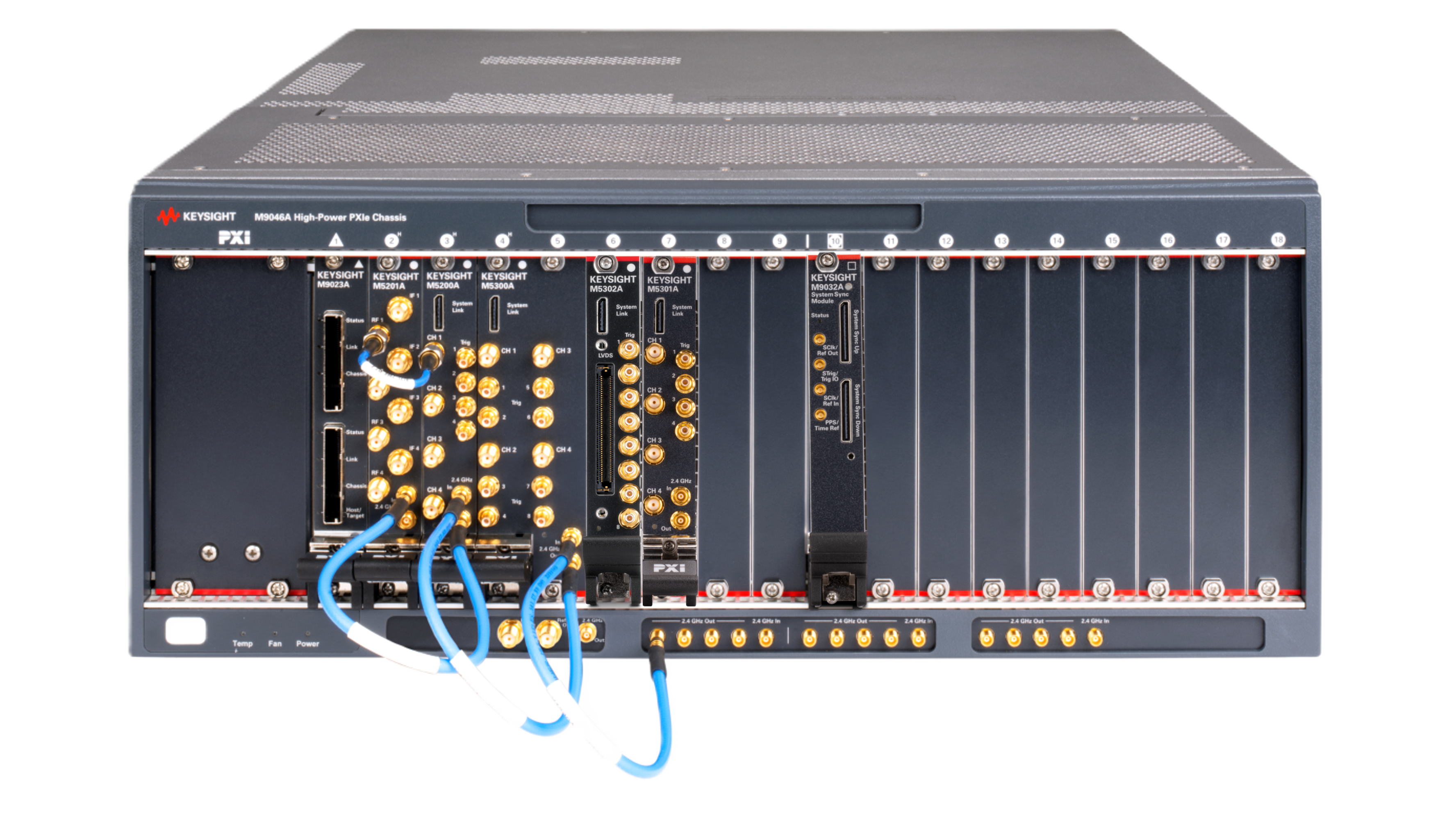
Qubit Coherence Characterization Solution
See Block Diagram of Qubit Coherence Characterization Solution


Explore Products in Our Qubit Coherence Characterization Solution
-

![]()
M5301A PXIe Precision AWG: 4 Channels, 400 MHz
-

![]()
Q5401A 2 Qubit and 5 Qubit Quantum Control System
-
![]()
M9033A PXIe System Sync Module, 5 Port


Discover Resources and Insights
Additional Resources for Qubit Coherence Characterization
Related Use Cases


-
![]()
Learn More
How to Control and Read Out Qubits
Generate microwave qubit control signals, execute programmable pulse sequences, and perform synchronized qubit readout and measurement acquisition.
Learn More

-
![]()
Learn More
How to Characterize Nitrogen-Vacancy Center Ensembles
Characterize nitrogen-vacancy center ensembles using ODMR, T₁, Rabi, Ramsey, spin echo, and dynamical decoupling measurements.
Learn More
-
![]()
Learn More
How to Evaluate Electromagnetic Leakage in Secure Chips
Capture and analyze electromagnetic emissions from secure chips to identify leakage hotspots during cryptographic operation.
Learn More

Get in Touch with One of Our Experts
Need help finding the right solution for you?