What are you looking for?
What Is Ray Tracing?
Definition of Ray Tracing
In photonics/optical engineering software, ray tracing is a technique used to represent the propagation of electromagnetic (optical) wavefronts through a system. Rays are lines constructed using discrete points on surfaces representing the local wavefront position as it propagates through an optical system.
These rays, which are perpendicular to the local wavefront, travel in straight lines through homogenous media. The rays will change direction at refractive boundaries per Snell’s Law and reflect at boundaries per the Law of Reflection. They will change direction at diffractive interfaces according to the vector grating diffraction equation and within inhomogeneous media via equations that govern gradient index materials.
When rays interact with scattering surfaces, they will be modified according to equations that govern scatter. Additional properties can be associated with rays, such as intensity, polarization properties, and "optical path" (the physical path multiplied by the refractive index of the medium), and these can be appropriately modified at interfaces as well.


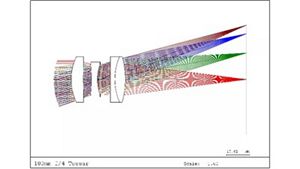

Figures 1 and 2. Examples of tracing rays through an optical system.
Table of Contents
What Problem Does Ray Tracing Solve?
With ray tracing, it is possible to simulate the behavior of optical wavefronts through various media. Ray tracing makes it possible to determine the quality of the rendered image for image-forming systems, the distribution of light for illuminations systems, and much more. Ray tracing, combined with optimization of the optical system parameters, can automatically improve the imaging or illumination performance, to achieve desired goals.
You can use ray tracing results for many diagnostic and analysis purposes. For example, you can estimate the size of the image quality for a microscope objective by tracing rays through it in reverse, to see how well the light focuses.
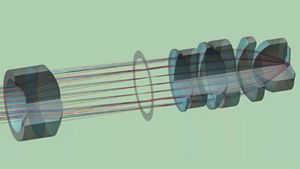

Figure 3. Cutaway view of a microscope objective, focusing rays at points under a cover glass.
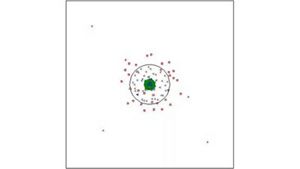

Figure 4. Light on axis comes to a tight focus for rays traced through the microscope objective.
The circle in the drawing denotes the diffraction limited spot size. The points show intersections of rays traced to focus for different wavelengths (colors) of light, in this case red, green, and blue. This type of intercept plot — commonly called a spot diagram — is a common diagnostic tool used in optical design.
You can also optimize the behavior of traced rays to achieve a desired light distribution or spot size. A benefit of ray tracing within software is that you can heavily parallelize the process (and speed it up via other methods), allowing much faster simulations than would otherwise be possible.
In imaging software, a relatively small number of rays are needed for an accurate simulation (10 – 1000 rays). The goal of designing imaging systems is to get the best image possible. Typical performance metrics are modulation transfer function (MTF), point spread function, and spot size.
For illumination software, you are trying to control the distribution of light and are typically not concerned with forming an image. In this case, you’ll need many more rays, which you typically trace (1000 to millions) with a process called a Monte Carlo simulation. You define a light source, trace millions of rays, and optimize the system to make a desired illumination pattern.
Why Is Ray Tracing Important for Optical Simulation?
Ray tracing is an important simulation technique based on its relative accuracy (for many situations) combined with its general computational efficiency, compared to more rigorous methods of propagating electromagnetic waves. You can combine ray tracing with other computational algorithms to more accurately simulate physical phenomenon.
For example, you can trace a grid of rays to the exit pupil of an optical system with the intensity (amplitude**2) and phase (optical path) for each ray tracked. A Fourier Transform of the complex field (amplitude and phase) will simulate the intensity of the image structure, including diffraction.
Which Keysight Ray Tracing Solution Is Right for Me?
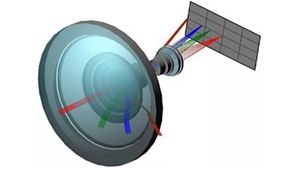

Figure 5. 3D View of a wide angle receiver, simulated in CODE V.
CODE V
When designing optical systems, engineers need powerful and robust software to achieve fast and accurate results. Reliable optical designs optimized in less time saves time, money, and sustains your company’s bottom line. Keysight’s portfolio of ray tracing software is developed with this in mind and addresses the need for superior optical designs. Choosing the right software depends on your application.
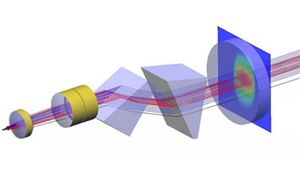

Figure 6. LiDAR optical system, simulated in LightTools
LightTools
For designing general lighting, backlit displays, LEDs, and vehicle interior lighting, Keysight LightTools illumination design software models and optimizes illumination system designs.
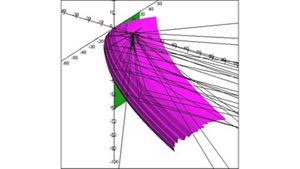

Figure 7. Deep FFD Reflector, simulated in LucidShape
LucidShape
For modeling the design and real-time simulation of automotive forward, rear, and signal lighting, Keysight LucidShape software provides a complete set of design, simulation, and analysis tools.


RSoft Photonic Device Tools
If you need to simulate your lens system using ray tracing techniques and the geometry size scale is smaller, passing field data between simulators, or hybrid simulation, may be ideal. RSoft photonic device tools contain an interface to convert the output from CODE V, and vice versa.
Going Beyond Ray Tracing
Additional modules, features, and tools allow for all aspects of ray tracing for even the most challenging of designs. Keysight software has the flexibility and additional features that engineers need to optimize designs:
- Extensive built-in libraries
- Non-sequential surface modeling for unusual systems
- Fast 2D image simulation to visualize optical system performance
- Stray light analysis
- Enhanced backlight pattern optimization
- Freeform design capabilities to provide more granular control over light spread
- Enhanced visualization and accurate photorealistic computer-generated images
Explore Keysight Optical Solutions Software
Use powerful ray tracing software to model, simulate, and visualize optical designs.


Access Additional Resources



Want help or have questions?