
Meet Keysight EDA’s Master Software Architect: Q&A with Tom De Muer
Article Reprints
Meet Keysight EDA’s Master Software Architect: Q&A with Tom De Muer
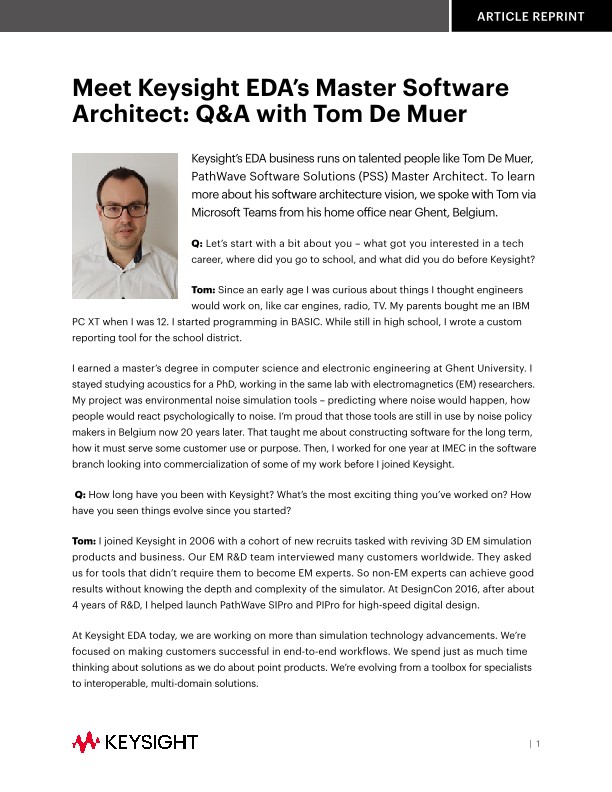
Keysight’s EDA business runs on talented people like Tom De Muer, PathWave Software Solutions (PSS) Master Architect. To learn more about his software architecture vision, we spoke with Tom via Microsoft Teams from his home office near Ghent, Belgium.
Q: Let’s start with a bit about you – what got you interested in a tech career, where did you go to school, and what did you do before Keysight?
Tom: Since an early age I was curious about things I thought engineers would work on, like car engines, radio, TV. My parents bought me an IBM PC XT when I was 12. I started programming in BASIC. While still in high school, I wrote a custom reporting tool for the school district.
I earned a master’s degree in computer science and electronic engineering at Ghent University. I stayed studying acoustics for a PhD, working in the same lab with electromagnetics (EM) researchers. My project was environmental noise simulation tools – predicting where noise would happen, how people would react psychologically to noise. I’m proud that those tools are still in use by noise policy makers in Belgium now 20 years later. That taught me about constructing software for the long term, how it must serve some customer use or purpose. Then, I worked for one year at IMEC in the software branch looking into commercialization of some of my work before I joined Keysight.
Q: How long have you been with Keysight? What’s the most exciting thing you’ve worked on? How have you seen things evolve since you started?
Tom: I joined Keysight in 2006 with a cohort of new recruits tasked with reviving 3D EM simulation products and business. Our EM R&D team interviewed many customers worldwide. They asked us for tools that didn’t require them to become EM experts. So non-EM experts can achieve good results without knowing the depth and complexity of the simulator. At DesignCon 2016, after about 4 years of R&D, I helped launch PathWave SIPro and PIPro for high-speed digital design.
At Keysight EDA today, we are working on more than simulation technology advancements. We’re focused on making customers successful in end-to-end workflows. We spend just as much time thinking about solutions as we do about point products. We’re evolving from a toolbox for specialists to interoperable, multi-domain solutions.
Q: Tell us about your role as Master Architect for PSS, and how your efforts connect to the business
Tom: It’s a mix of operational and strategic work, setting a consistent course for PSS. Day to day, I connect our broad product portfolio marketing and development teams together and with customers. I offer guidance and options for them to decide what to work on and how to architect it.
On a strategic front, I look out farther. We’re creating opportunities in adjacent markets. What’s the landscape look like in future years? Do we do individual solutions or platforms? How do we use cloud data? How do we continue sustaining our products with the right architecture for the next decade?
Q: Help us understand why software architecture should be important to Keysight’s customers. Why do they choose Keysight EDA technologies for solving their problems?
Tom: Software architecture is largely about the customer experience. Fundamental choices define how customers and systems interact with our product portfolio. One example is choosing browserbased delivery. Another is partitioning the user interface from the simulation back end, developing each separately for support of automation.
Defining the right software architecture helps Keysight products fit into a customer workflow. It reduces time to market, for us and them. It makes our software adaptable for adjacent markets.
Designers choose us for performance and accuracy in reaching fast, accurate answers. They want an easier to use workflow that doesn’t demand they be simulation experts. They get flexible solutions giving them more capability to adapt to their flow.