
What's New in CODE V Version 2025.03
Flyers
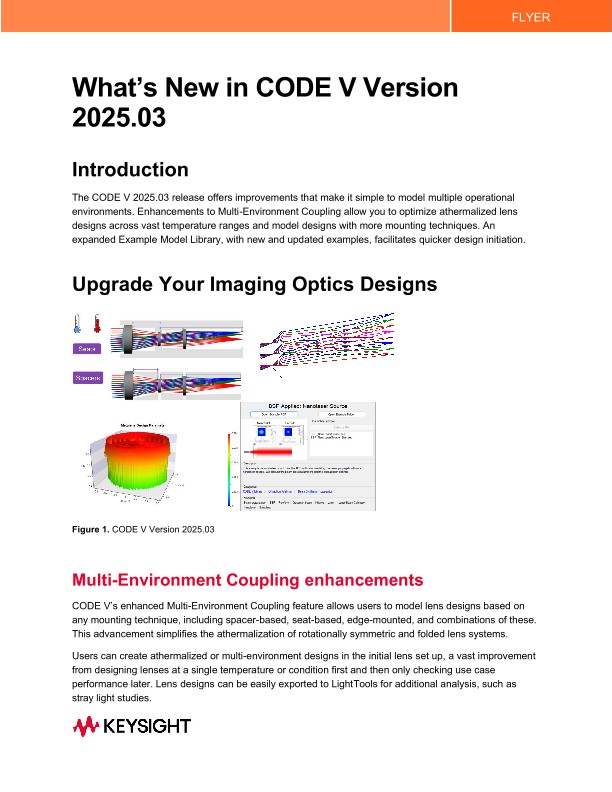
The CODE V 2024.03 release introduces powerful new features that further streamline the design of imaging optics. With the new Multi-Environment Coupling capability, engineers can model and optimize athermalized lens systems across varying environmental conditions, accounting for temperature- and pressure-dependent changes in materials and mountings. A new visualization tool for athermalization in the V3D view helps users better understand the interaction between lens elements and housings—without needing detailed mechanical computer-aided design (CAD) data. This version also includes support for designing meta optical surfaces, allowing engineers to model diffractive properties of flat, thin optical components using a new add-on tool.
Performance and usability improvements are also included in this release. The 2D Image Simulation feature now runs significantly faster on multi-core machines, making it easier to simulate real-world imaging performance. Users can also take advantage of an expanded Example Model Library, which adds 11 new examples to support learning and experimentation with features like Global Synthesis, Beam Synthesis Propagation and SpecBuilder.