How to Characterize Supercapacitor Charging and Discharging

Measure Supercapacitor Charge and Discharge Behavior
Supercapacitor charge-discharge testing requires a two-quadrant direct current (DC) source, voltage and current acquisition, and a supercapacitor device under test (DUT) with defined voltage and current limits. Use a regenerative power supply sized for the selected operating window, including its low-voltage sinking capability. Configure voltage-priority operation with separate positive charging and negative discharging current limits. Begin from a defined lower voltage, then command the upper voltage setpoint. The source operates in constant current (CC) until the supercapacitor reaches that voltage, then in constant voltage (CV) while current decreases. Apply a specified current threshold or dwell time before commanding the lower voltage setpoint. Discharge at the negative current limit, then hold the lower voltage while the discharge current tapers. Record all four phases continuously.
For energy recovery measurement, define positive current as flowing into the DUT and negative current as flowing back into the source. Acquire voltage and current on a common time base and calculate instantaneous power as their product. Integrate positive power over charging to obtain delivered energy; integrate the magnitude of negative power over discharging to obtain recovered energy. Use the same measurement boundary and defined integration intervals for both quantities. Record the initial and final voltage, current limits, dwell times, and termination criteria with each cycle. Match initial and final stored-energy conditions before interpreting delivered minus recovered energy as cycle loss. Repeat the sequence at selected operating points. Report energy recovered from the DUT separately from energy returned to the grid by the regenerative power supply.

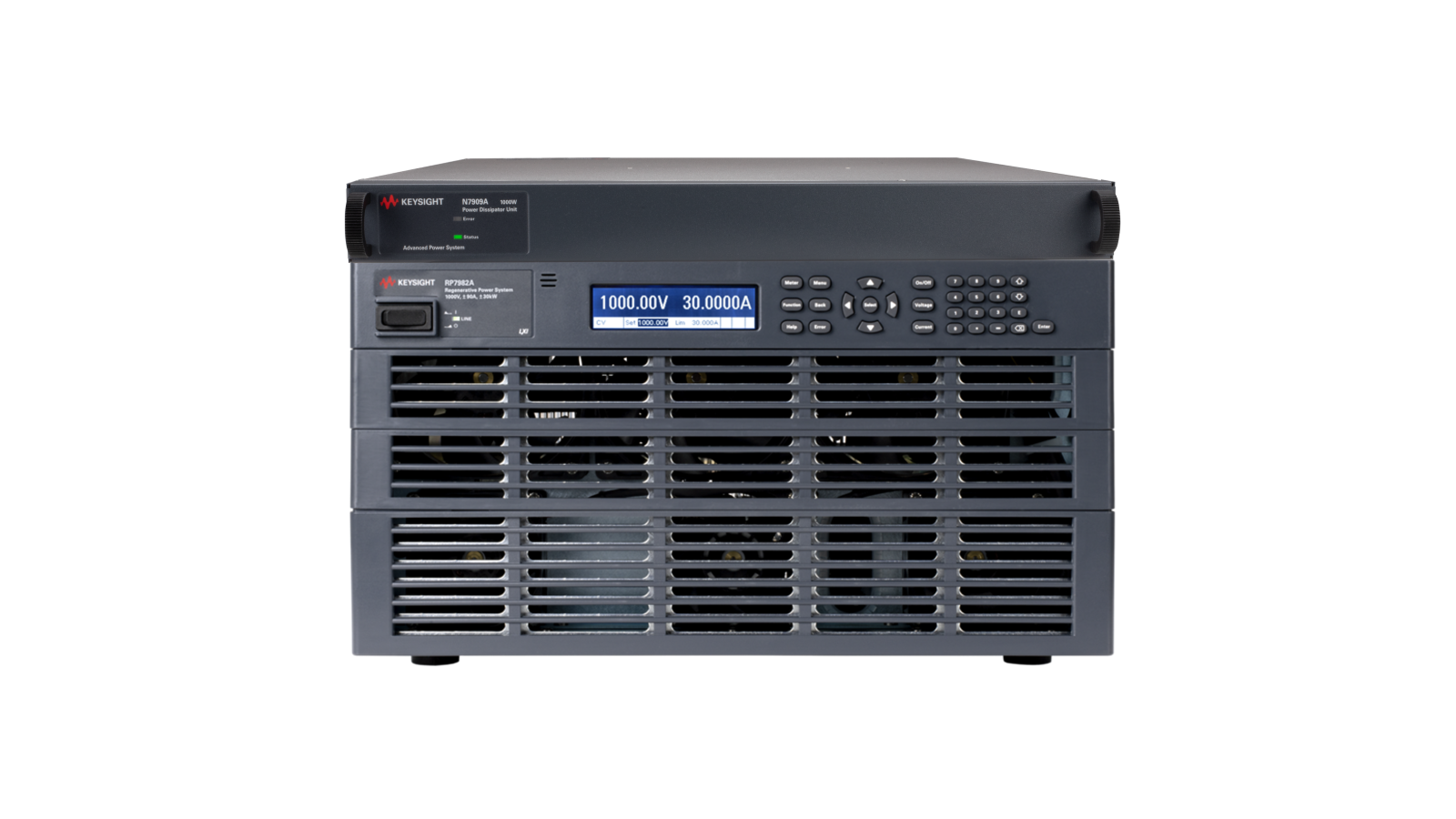
Supercapacitor Charge and Discharge Characterization Solution
See Block Diagram of Supercapacitor Charge and Discharge Characterization Solution


Explore Products in Our Supercapacitor Charge and Discharge Characterization Solution
-


![]()
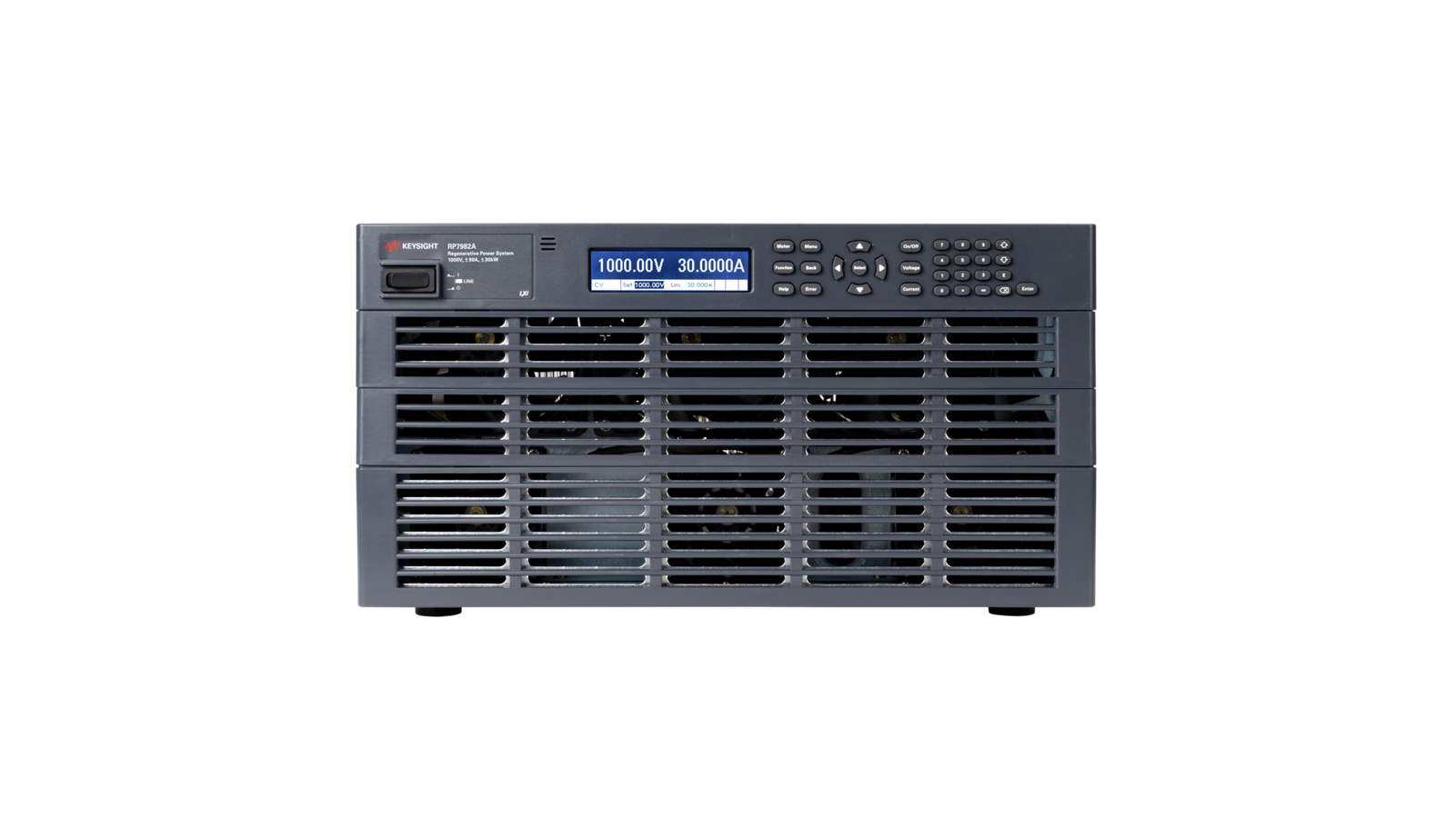
RP7982A Regenerative Power System 1000 V, ±90 A, 30 kW, 400/480 VAC
-

![]()
N7909A Advanced Power System — Power Dissipator Unit, 1,000 W


Discover Resources and Insights
Additional Resources for Supercapacitor Charge and Discharge Characterization
Related Use Cases

-
![]()
Learn More
How to Evaluate IV Characteristics of Solar Cells
Characterizing the IV properties of solar cells requires extensive current and voltage measurement capabilities across all four measurement quadrants. Learn how to evaluate solar cells by performing tests, such as short circuit current, open circuit voltage, and maximum power point measurements, with a source / measure unit.
Learn More

-
![]()
Learn More
How to Perform DC Load Mode Testing
Validate DC electronic load modes including constant current, voltage, and resistance for accurate power testing.
Learn More
-
![]()
Learn More
How to Validate DC Power Supply Load Regulation and Transient Response
Validate DC power supplies with precise load regulation and transient response testing using electronic loads.
Learn More

Get in Touch with One of Our Experts
Need help finding the right solution for you?