
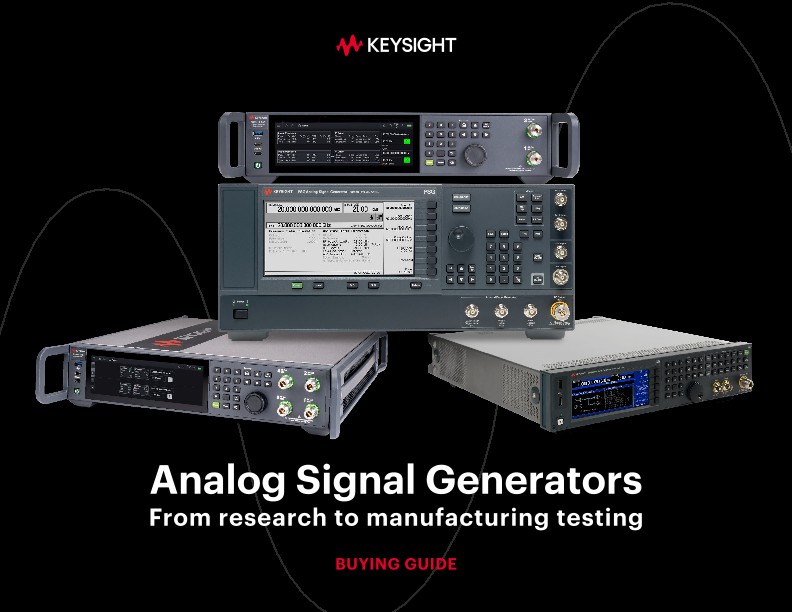
Analog Signal Generators Buying Guide
Buying Guides
Selecting the right analog signal generator depends on the purity, output power, switching speed, and maximum frequency your application requires. Keysight offers three performance grades of analog signal generators—Essential, Expert, and Pro—each offering a unique mix of spectral purity, speed, channel count, and power capability. This buying guide compares these grades to help you determine which generator aligns with your RF, microwave, and high‑precision test needs.
Keysight’s analog signal generator lineup is structured into three main performance grades with varying core features:
- Essential analog signal generators come in two classes. The XG1‑class includes AP5001A–AP5002A, and the XG2‑class includes AP5011A–AP5012A, N5171B, and N5173B signal generators. Essential models feature low phase noise, wide output power ranges, and switching speeds down to 20 μs. Supporting frequencies up to 40 GHz, they are ideal for general‑purpose RF testing across communication systems, wireless components, and multiport devices requiring up to four coherent outputs.
- Expert analog signal generators come in two classes. The XG5‑class includes N5185A and N5181B–N5183B, and the XG6‑class includes AP5031A–AP5032A signal generators. Expert models support frequencies up to 54 GHz, with ultra‑low phase noise, harmonics down to –60 dBc, and fast switching speeds down to 3 μs. Their enhanced spectral purity and stability make them well‑suited for cellular, radar, ADC testing, and blocking or interference‑sensitivity evaluations.
- Pro analog signal generators come in one class. The XG7‑class Pro generators include the E8257D–E8663D models. These deliver metrology‑grade purity with frequency coverage up to 67 GHz, extendable to 1.1 THz using external frequency extenders. Pro generators offer exceptional low phase noise, high output power up to +30 dBm, and precise waveform control, ideal for calibration labs, satellite communication tests, high‑end research, and mission‑critical aerospace/defense applications.
Typical use cases further illustrate how each signal generator grade supports different engineering needs:
- Essential analog signal generators support general‑purpose RF testing with low phase noise and fast switching, suitable for evaluating oscillators, amplifiers, and communication system components. Their support for multiple phase‑coherent channels makes them useful for multiport receiver testing, signal‑strength characterization, and frequency‑response verification across microwave bands.
- Expert analog signal generators extend performance for increasingly demanding applications such as radar system development, 5G or IoT receiver blocking tests, and high‑dynamic‑range device validation. Their ultra‑low noise floor and fast switching speed enable realistic simulation of dense signal environments and high‑performance frequency hopping. Typical uses include cellular base‑station testing, ADC linearity evaluations, multiport phase coherence, and fast RF device characterization.
- Pro analog signal generators are ideal for metrology labs and high‑performance research settings, supporting extremely pure RF and microwave signals. They enable precision testing for satellite payloads, high‑frequency receivers, mmWave sensing, and wideband radar systems. With optional high‑power extensions and traceability to national standards, Pro models deliver the accuracy, stability, and repeatability required for mission‑critical validation and advanced R&D.
Before finalizing an analog signal generator purchase, it’s important to consider key selection factors:
- Maximum frequency: This determines the highest output frequency a signal generator can produce. Choose Essential for ≤ 40 GHz, Expert for ≤ 54 GHz, and Pro for demanding applications requiring up to 67 GHz or THz‑range extensions.
- Number of channels: This defines the need for single or multiport, phase‑coherent outputs. Essential and Expert models offer up to four outputs, while Pro supports a single ultra‑precise channel optimized for high‑purity applications.
- Output power: This determines whether the signal can overcome cable losses or drive high‑power components. Essential and Expert offer up to +25 dBm, while Pro supports up to +30 dBm with optional high‑power extensions.
- Phase noise: This affects signal purity and the accuracy of modulation or close‑in testing. Essential models support general testing around –130 dBc/Hz, Expert enables ultra‑low noise near –150 dBc/Hz, and Pro provides metrology‑grade purity for the most demanding spectral analysis.
- Switching speed: This defines how quickly frequencies can change during automated testing. Essential supports down to 20 μs, Expert down to 3 μs, and Pro balances spectral purity with test stability for precision workflows.
Software extends the capability of analog signal generators with tools for automated testing, waveform creation, swept‑frequency control, and system‑level integration. Accessories such as attenuators, adapters, cables, and power sensors support accurate signal delivery and help ensure repeatable measurements across benchtop and automated test environments.
Keysight Support Services can reduce your learning curve, enhance your uptime, ensure the accuracy of your testing equipment, and provide the expertise you require, precisely when and where you need it. KeysightCare curated support plans bundle critical services with prioritized response and turnaround times, and high‑performance instruments include one year of KeysightCare Assured to maintain confidence in ongoing test performance.