How to Reduce Switching Transients in DAQ Measurements

Control Switching Transients
Sequential multichannel measurements require a data acquisition (DAQ) system to open and close relay paths as it moves from one input channel to the next. During data acquisition switching, low-impedance sources and stray capacitance in the measurement path can create short, high-current pulses when a relay closes. These DAQ switching transients may appear as temporary voltage errors, channel-to-channel carryover, disturbances on common ground paths, or unexpected behavior in circuitry connected to the device under test. In multichannel voltage measurement, the effect can be difficult to distinguish from an actual change in the measured signal because the disturbance occurs at the same time the measurement path changes. The magnitude and duration of the transient depend on source impedance, stored charge, wiring, channel configuration, and the electrical conditions present when the relay switches.
Repeated switching transients can also place electrical stress on mechanical relay contacts, making contact protection a consideration when evaluating unexpected behavior. A previously selected channel may leave residual charge in the measurement path that affects the next channel after its relay closes, producing an apparent voltage that is not representative of the new input. Engineers may observe inconsistent readings, extended settling behavior, disturbances on adjacent channels, intermittent system responses, or measurement results that change with scan order. These effects can be more noticeable when measurements move between channels with different voltage levels or source impedances. Understanding the relationship between relay transitions, stray capacitance, source impedance, and observed measurement artifacts defines the underlying problem that must be characterized before evaluating a DAQ transient reduction approach.


Reduced Switching Transient Data Acquisition Solution
See Demo of Reduced Switching Transient Data Acquisition Solution
Explore Products in Our Reduced Switching Transient DAQ Solution
-

![]()
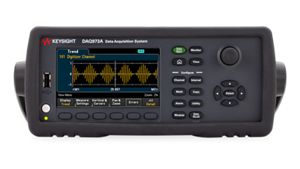
DAQ973A Data Acquisition System
-
![]()
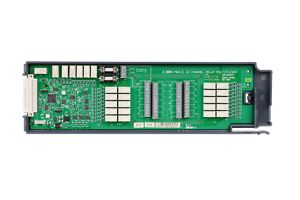
DAQM901A 20 Channel Multiplexer (2/4-wire) Module for DAQ970A and DAQ973A


Discover Resources and Insights
Additional Resources for Reducing Switching Transients
Related Use Cases

-
![]()
Learn More
How to Measure Compressor Vibration and Noise
Measure compressor vibration noise to locate sources and improve damping.
Learn More

-
![]()
Learn More
How to Protect DAQ Measurements from Overvoltage
Protect low-voltage data acquisition measurement paths from unintended overvoltage conditions using automatic voltage safety monitoring. The DAQ973A data acquisition system with the DAQM910A low-voltage multiplexer supports multichannel measurements while isolating the module from the backplane when its high-voltage protection circuit detects an overvoltage condition.
Learn More
-
![]()
Learn More
How to Test Battery Management Systems
Validating battery management system (BMS) circuits requires measuring the BMS system behavior under a wide range of operating conditions. Learn how to use a battery emulator to conduct precise, safe, and reproducible tests to verify the accuracy, functionality, and safety tests of your BMS.
Learn More

Get in Touch with One of Our Experts
Need help finding the right solution for you?