


Why Use Quantum Circuit Simulation
Build confidence in nonlinear quantum circuits—before the cooldown.
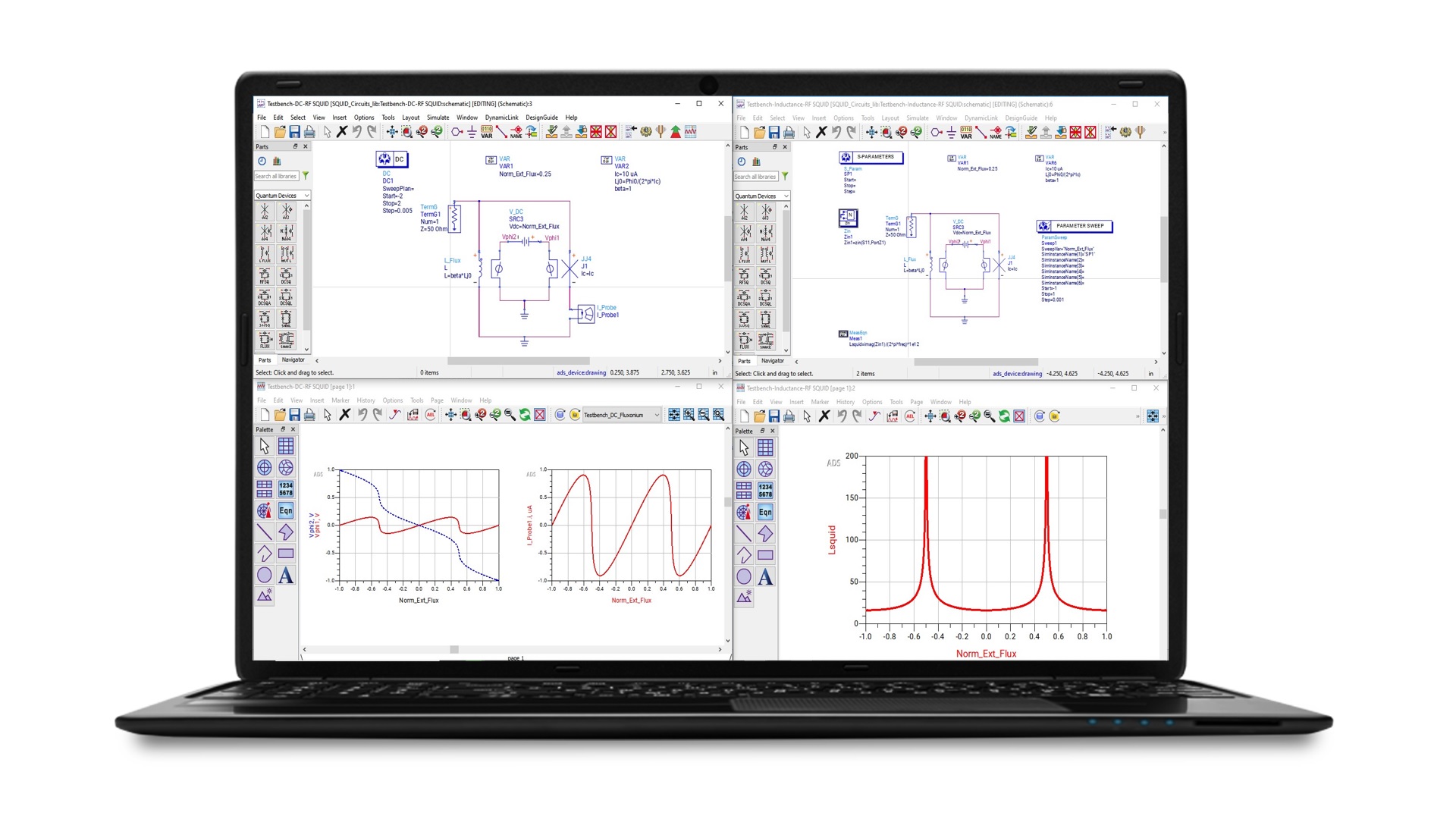
Quantum Circuit Simulation provides a simulation environment for analyzing complex superconducting circuits. Its harmonic balance solver supports nonlinear, frequency-domain analysis with flux quantization, helping engineers understand power-dependent and operating-point behavior in quantum circuits and identify circuit-design issues earlier in development.
- ADS CoreAn integrated foundation for design and simulation.
- EM DesignElectromagnetic (EM) simulation brings you insight before physical prototyping.
- Quantum LayoutEffortlessly design your quantum chip using our extensive library of quantum artwork components.
- Quantum Circuit SimulatorAn extended library of quantum devices that support flux quantization in the frequency domain.
Key Capabilities
Quantum Circuit Sim comes with an extended library of quantum devices that support flux quantization in the frequency domain. Quantum Ckt Sim includes the following solvers:

Parametric quantum circuits including quantum amplifiers.

Harmonic balance, Transient / convolution, Circuit envelope, and X- parameters.

Encompassing RF/DC SQUIDs, SNAILs, FLUXONIUMs, and SNAKEs.

Harmonic balance nonlinear circuit simulator in the frequency domain.

Transient / convolution nonlinear circuit simulator in the time domain.

Circuit envelope nonlinear circuit simulator in the modulation domain.
* X-parameters is a trademark and registered trademark of Keysight Technologies in the US, EU, JP, and elsewhere. The X-parameters format and underlying equations are open and documented. More information.
Resources to Get You Started
The increasing complexity of high-frequency and high-speed electronic systems demands advanced design tools that can accurately model device behavior, predict system performance, and accelerate product development.


Demos
Quantum Circuit Simulation

Videos
Quantum EDA Circuit Simulation using Hamiltonian Analysis
How-To Videos
Quantum Amplifiers Design
How-To Videos
Nonlinear Co-simulation Capability
Application Notes
Quantum Circuit Design of Josephson Traveling Wave Parametric Amplifiers
Application Notes
Designing for Superconducting Qubit Circuits
Application Notes
Modeling Kinetic Inductance in Superconductors: A Practical Guide
Article Reprints
Modeling Flux-Quantizing Josephson Junction Circuits in Keysight ADS
Explore Quantum Circuit Sim Bundles
ADS software bundles provide designers with pre-configured combinations targeted to a specific design workflow.


Quantum Ckt Sim
Quantum circuit simulation is a comprehensive circuit environment for analyzing quantum circuits.
Quantum circuit simulation is a comprehensive circuit environment for analyzing quantum circuits.
Have Questions? We've Got Answers
Quantum circuit simulation is the process of modeling the electrical and quantum behavior of superconducting circuits before fabrication. It enables engineers to analyze qubits, resonators, couplers, Josephson junctions, and quantum amplifiers while predicting key performance metrics such as energy levels, frequencies, anharmonicity, and coupling strengths. By identifying potential design issues early, quantum circuit simulation helps reduce development costs, shorten design cycles, and improve first-pass design success.
Modern quantum circuit simulation tools support a wide range of superconducting quantum devices, including transmon qubits, flux qubits, fluxonium qubits, SQUIDs, resonators, couplers, and Josephson Traveling Wave Parametric Amplifiers (JTWPAs). These tools are designed to analyze both individual components and larger interconnected quantum circuits, allowing engineers to explore complex system behavior before hardware is built.
Unlike conventional electronic circuits, superconducting quantum circuits contain highly nonlinear elements such as Josephson junctions. Quantum circuit simulators model these nonlinear effects using Hamiltonian-based analysis and quantum mechanical techniques that capture the behavior of quantized energy states. This enables accurate prediction of phenomena such as qubit anharmonicity, state transitions, flux quantization, and power-dependent performance that are critical for quantum computing applications.
Quantum circuit simulation tools can calculate a variety of metrics that are essential for quantum hardware design, including energy spectra, transition frequencies, eigenmodes, coupling strengths, coherence-related parameters, matrix elements, decay rates, and dephasing characteristics. These insights help engineers evaluate design tradeoffs, optimize qubit performance, and better understand how a circuit will behave under real operating conditions.
Simulation significantly reduces the need for costly fabrication and testing iterations by allowing engineers to evaluate thousands of design variations virtually. Designers can optimize circuit parameters, validate operating frequencies, investigate crosstalk mechanisms, and assess the impact of design changes before manufacturing. This simulation-driven approach enables faster innovation, improves device performance, and helps accelerate the path toward scalable quantum computing systems.