What are you looking for?
Modulation Accuracy-EVM
Definition
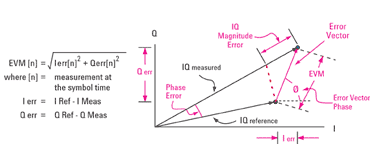
EVM is the root mean square (RMS) of the error vectors, computed and expressed as a percentage of the square root of the mean power of the ideal signal. The error vector is the magnitude of the vector at the detected symbol location. This connects the I/Q reference-signal phasor to the I/Q measured-signal phasor, and is computed as follows (refer to the phasor diagram shown below).
Standards
- IEEE Std 802.11b-1999 16 September 1999 Paragraph 18.4.7.8 Transmit modulation accuracy
- IEEE Std 802.11a-1999 16 September 1999 Paragraph 17.3.9.7 Transmit modulation accuracy test
- ANSI/IEEE Std. 802.11 First Edition 1999-00-00 Paragraph 15.4.7.9 Transmit modulation accuracy
Measurement Subtleties
There are measurement trade-offs when using the digitizing oscilloscopes instead of the 89600 (or combination of PSA or ESA and 89600). It is highly recommended that you read the application note Keysight Infiniium Oscilloscope Performance Guide Using 89601A Vector Signal Analysis Software, publication number 5988-4096EN. This application note explains the benefits and trade-offs in using the oscilloscope as a front end for the 89601A software.
Note: In the 89600, EVM is calculated only at the symbol times (the instant in time when symbols are detected). The computation does not include points between symbols. Therefore points/symbol setting does not affect the value.
Test Tools
EVM is computed by comparing the measured signal with an ideal reference signal to determine the error vector. The 89601A software displays the computed results as both a percentage, and logarithmic value (in dB). You can also display the normalized EVM value that is called out in the 802.11B specification.
You can use the 89600 Series vector signal analyzer standalone, in conjunction with the ESA-E and PSA series Spectrum analyzers, and with several of Keysight's Infiniium family of oscilloscopes. You can use the ESA or PSA Series spectrum analyzers as down-converting front ends for the 89600 (with specific options). This provides vector signal analysis capabilities up to 50 GHz. You can also use 89600 hardware as standalone. This provides vector signal analysis up to 6 GHz, with one or two channel inputs, for IQ, IF, and RF measurements.
You can also use specific Infiniium oscilloscopes as a front end, for both IQ, IF, and RF inputs. In this case the Infiniium acts as a digitizer, and is capable of very large informational bandwidths-up to 6 GHz wide. You can install the 89601A software directly onto the operating system of Keysight's new 6 GHz Infiniium oscilloscopes, providing a one-box measurement solution for certain applications.
For your design and analysis needs, you can use Keysight's Advanced Design Software (ADS) and the 89601A software. Once your design is complete, you can simulate it and directly link the simulation results to the 89601A software for analysis.
Related Measurements
- Eye diagram
- Constellation