


Title
Typically 2 or 4
Buying Guide
Mixed Signal Oscilloscope Buying Guide
Specs, Models, and Used vs New

Introduction
You need to watch an analog rail and a handful of serial buses at the same time, the deadline is close, and the quotes for a new instrument keep climbing.
Choosing a mixed signal oscilloscope (MSO) can feel risky when every vendor sounds similar and the used market feels uncertain. This guide helps you compare the specs that matter, match an MSO to your work, and decide whether used or new makes more sense for your budget.
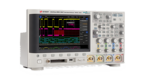
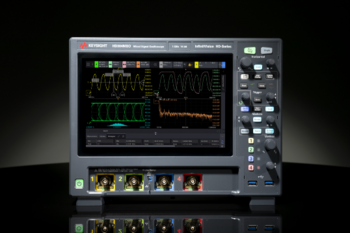
You will also see where the Keysight InfiniiVision HD3 (HD304MSO) fits: a native 14-bit MSO with 4 analog and 16 digital channels built for power-integrity and dense serial-bus work.
As the OEM behind the instruments, the Official Keysight Used Equipment Store helps you compare MSO specs, understand your used and new options, and choose with more confidence.
Summary: Buying a Mixed Signal Oscilloscope
- An MSO combines 2 to 4 analog channels with 8 to 16 digital channels in one time-correlated view, so you debug serial buses against the analog waveform on a single screen.
- Four specs decide most buys: bandwidth (about 5x your fastest digital clock), sample rate (about 4 to 5x bandwidth), and channel count plus memory depth.
- An MSO adds digital channels to a scope. An MDO adds an RF spectrum domain. A logic analyzer has no analog channels.
- Certified used instruments can save 40 to 90% versus new, with up to 5 years warranty options; Keysight Premium Used units also pass a final 101-point quality inspection.
- Keysight Premium Used is remanufactured by Keysight to the same final test, firmware, and warranty as new. All the same, except for the price.
- The recommended instrument is the Keysight InfiniiVision HD3 (HD304MSO): a native 14-bit MSO with 4 analog and 16 digital channels, built for power-integrity, automotive, and dense serial-bus debug.
What Is a Mixed Signal Oscilloscope?
A mixed signal oscilloscope adds digital, or logic, channels to the usual analog channels and displays both on one synchronized timebase. The analog channels measure the shape, amplitude, and timing of analog signals. The digital channels show the high or low logic state of each digital signal on buses and control lines. Together, they let you see cause and effect across the analog and digital parts of an embedded design.
The practical payoff is time correlation. You can trigger on an SPI transaction and watch the analog power rail react in the same acquisition. Most MSOs offer 2 or 4 analog channels and 8 or 16 digital channels. For background on the building blocks, see the Keysight glossary entries for what is a mixed signal oscilloscope, digital channels, and analog channels.
Here is what that looks like in practice. Say a microcontroller fails to boot intermittently. With an MSO, you watch the 3.3 volt rail on an analog channel and the SPI flash read on the digital channels in the same capture. Then you can line up the brown-out dip against the exact byte that fails. A plain scope would show the dip but not the bus, and a logic analyzer would show the bus but not the rail. The MSO shows both, so you find the cause in one acquisition instead of guessing across two instruments.
| MSO at a Glance | Detail |
|---|---|
| Analog channels | Typically 2 or 4 |
| Digital channels | Typically 8 or 16 |
| Key strength | Time-correlated analog and digital view |
| Common use | Embedded and serial-bus debug |
MSO at a Glance
Detail
Analog channels
Digital channels
Title
Typically 8 or 16
Typically 8 or 16
Key strength
Title
Time-correlated analog and digital view
Time-correlated analog and digital view
Common use
Title
Embedded and serial-bus debug
Embedded and serial-bus debug
MSO vs DSO vs MDO vs Logic Analyzer: Which Do You Need?
These four instruments overlap, so it is easy to compare the wrong features. Here is the clean distinction. A digital storage oscilloscope (DSO) captures analog channels only. A mixed signal oscilloscope adds digital channels for logic and serial-bus work. A mixed domain oscilloscope (MDO) adds a separate radio-frequency spectrum domain. A logic analyzer has many digital channels but does not measure analog waveform shape.
Choose an MSO when you need analog plus digital on one timebase. Choose an MDO only when you also need frequency-domain analysis. For that path, see the mixed domain oscilloscope buying guide. The MSO and MDO are frequently conflated, and that mistake can add cost you may not need. For the foundations, compare the digital storage oscilloscope definition, the analog vs digital oscilloscope guide, and the types of oscilloscope overview.
| Instrument | Analog | Digital/Logic | RF Spectrum | Choose When |
|---|---|---|---|---|
| DSO | Yes | No | No | Analog-only measurement |
| MSO | Yes | Yes (8 to 16) | No | Analog plus serial-bus debug |
| MDO | Yes | Often | Yes | You also need spectrum analysis |
| Logic analyzer | No | Many | No | Pure digital timing/state |
Instrument
Analog
Digital/Logic
RF Spectrum
Choose When
DSO
Title
Yes
Yes
Title
No
No
Title
No
No
Title
Analog-only measurement
Analog-only measurement
MSO
Title
Yes
Yes
Title
Yes (8 to 16)
Yes (8 to 16)
Title
No
No
Title
Analog plus serial-bus debug
Analog plus serial-bus debug
MDO
Title
Yes
Yes
Title
Often
Often
Title
Yes
Yes
Title
You also need spectrum analysis
You also need spectrum analysis
Logic analyzer
Title
No
No
Title
Many
Many
Title
No
No
Title
Pure digital timing/state
Pure digital timing/state
What Specs Matter When Buying a Mixed Signal Oscilloscope?
Four specs drive most MSO buying decisions: bandwidth, sample rate, channel count, and memory depth. Get these right, and the rest of the choice becomes easier.
Bandwidth and Sample Rate
Bandwidth determines the fastest signal the scope can measure accurately. Keysight's bandwidth application note recommends choosing bandwidth at least 5 times your fastest digital clock, so the scope captures the fifth harmonic that defines your signal's edges. For analog-only work, about 3 times the highest frequency is often enough.
Sample rate affects how faithfully the scope reconstructs that signal. Nyquist’s 2 samples per cycle is only a floor. For accurate sin(x)/x reconstruction, a real-time scope needs about 2.5 samples per highest-frequency component. A practical target is a sample rate near 4 to 5 times the scope bandwidth. See Keysight Application Note 1288, Evaluating Oscilloscope Sample Rates vs. Sampling Fidelity, for the full treatment. The Keysight bandwidth calculator and the oscilloscope performance primer help you size both, and the bandwidth limits page explains the tradeoffs.
Channels and Memory Depth
Channel count, or the number of analog and digital input channels, determines how much you can watch at once. For multi-bus embedded work, 16 digital channels gives you room to capture several buses plus control lines without re-probing. Memory depth, or record length, determines how long you can capture at the maximum sample rate. Deeper memory holds more time on screen before the sample rate drops, which matters for long serial frames and intermittent faults. Two related specs also matter here. Waveform update rate determines how often the scope refreshes, which affects how quickly you catch a rare glitch. Segmented memory stores many short, triggered events instead of one long capture, so you keep full sample rate across many serial frames without filling memory with idle time.
Protocol Decode and Probing
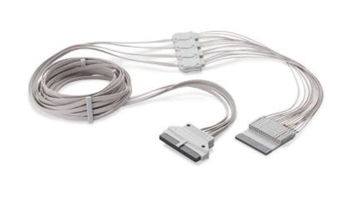
Serial trigger and decode for I2C, SPI, UART, CAN, and USB turn raw edges into readable bus traffic. The protocol decoder reads the bus and lines each packet up with the analog waveform, so you do not have to count edges manually. These are often software-license options, not always included, so confirm them for the exact model. Probing also matters: passive 10x probes are the usual starting point, and your probes should meet or exceed the scope's bandwidth. An external trigger input can also help because it lets you sync the capture to an event elsewhere in the device under test. See the guides on how to select oscilloscope probes, trigger types, and current probes.
| Spec | What It Controls | How to Size It |
|---|---|---|
| Bandwidth | Fastest signal measured | About 5x fastest digital clock |
| Sample rate | Reconstruction fidelity | About 4 to 5x bandwidth |
| Analog channels | Simultaneous analog views | 2 for basic, 4 for power/multi-rail |
| Digital channels | Buses watched at once | 16 for multi-bus embedded work |
| Memory depth | Capture time at full rate | Deeper for long frames, rare faults |
| Serial decode | Bus readability | Confirm I2C/SPI/CAN/USB options |
Spec
What It Controls
How to Size It
Bandwidth
Title
Fastest signal measured
Fastest signal measured
Title
About 5x fastest digital clock
About 5x fastest digital clock
Sample rate
Title
Reconstruction fidelity
Reconstruction fidelity
Title
About 4 to 5x bandwidth
About 4 to 5x bandwidth
Analog channels
Title
Simultaneous analog views
Simultaneous analog views
Title
2 for basic, 4 for power/multi-rail
2 for basic, 4 for power/multi-rail
Digital channels
Title
Buses watched at once
Buses watched at once
Title
16 for multi-bus embedded work
16 for multi-bus embedded work
Memory depth
Title
Capture time at full rate
Capture time at full rate
Title
Deeper for long frames, rare faults
Deeper for long frames, rare faults
Serial decode
Title
Bus readability
Bus readability
Title
Confirm I2C/SPI/CAN/USB options
Confirm I2C/SPI/CAN/USB options
How Do You Size a Mixed Signal Oscilloscope to Your Application?
Match the instrument to the job, not the brochure. Start with the fastest signal and the buses you actually need to probe, then focus on the specs that the job requires.
In automotive and EV work, CAN FD bus debug needs the 16 digital channels and CAN FD decode, while LIN and SENT sensor work may require additional decode options. Automotive Ethernet and EV inverter gate-drive analysis can push you toward higher bandwidth and 4 analog channels for phase-current correlation. For worked examples, see the guide to automotive oscilloscopes and Keysight automotive oscilloscope models. For a deeper application walk-through, see the planned automotive diagnostic oscilloscope guide once it is available.
In aerospace and defense, MIL-STD-1553 and ARINC 429 monitoring may require the matching decode options, plus deep memory for longer captures such as DO-160 power-rail pre-checks. Redundant-bus failover and multi-rail sequencing checks often rely on the digital channels to capture multiple discrete lines at once. Two related guides are planned: a DO-160 pre-compliance guide and a MIL-STD-1553 bus debug guide.
In embedded and power electronics, DDR command timing, multi-rail sequencing, and GaN or SiC switching-node analysis can require digital channels, high vertical resolution, and a high sample rate. Deep memory matters here because intermittent faults and long serial frames may need longer capture time at a high sample rate.
Tell us your application and the Official Keysight Used Equipment Store will match an MSO to it. Browse certified used oscilloscopes and request a quote on any listing.
Which Keysight Mixed Signal Oscilloscope Is Right for You?
Used InfiniiVision MSOX 2000/3000T models and the InfiniiVision HD3 sit in the Essential class for mainstream embedded, automotive, and education work at a lower price than new; the HD3 stands out within that class for its native 14-bit resolution. The MSOX 4000 X-Series sits in the Advanced class for faster edges and multi-bus work. Infiniium models such as the MSOS-series sit above both classes for higher bandwidth and deeper analysis. Confirm exact specs on each product page before you order, since options and bandwidth vary by unit. Start with the used oscilloscope category, then compare specific listings like the MSOX4154A with 4 analog and 16 digital channels, the InfiniiVision MSOX 3000T X-Series, and the Infiniium MSOS804A.
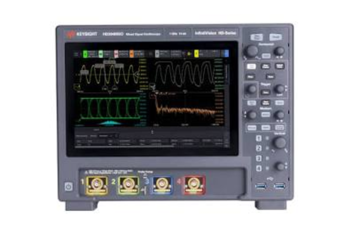
For the highest vertical resolution in the Essential class, look at the Keysight InfiniiVision HD3 (HD304MSO).
The HD3 pairs 4 analog channels with 16 digital channels and a native 14-bit ADC, which suits power-integrity, automotive, and dense serial-bus debug where small signal detail matters. That 14-bit resolution is the HD3's core differentiator. For more detail see the planned 14-bit oscilloscope buying guide once it is available. Buying it used or OEM-remanufactured can put that capability within reach at a lower cost, with warranty options and KeysightCare support available. Confirm the exact bandwidth, memory, and decode options on the product page before you order.
The HD3's native 14-bit ADC resolves 16,384 vertical levels, four times a 12-bit scope, and its low-noise front end reaches a 50 µVRMS noise floor. That helps keep millivolt-level ripple visible where an 8-bit scope would bury it in noise. A 1.3 million waveforms per second update rate and up to 100 Mpts of memory help you catch rare glitches and capture long serial frames, while Fault Hunter can run unattended for up to 48 hours to log intermittent anomalies. A built-in FFT adds frequency-domain screening without a separate analyzer.
Before you order an HD3, confirm these on the product page:
- Bandwidth: the HD3 spans 200 MHz to 1 GHz, so check the exact bandwidth and any upgrade path on the listing.
- Decode licenses: CAN, CAN FD, CAN XL, LIN, and SENT decode come with the HD300AUTA package, while ARINC 429 and MIL-STD-1553 come with HD300AERA.
- Memory and accessories: confirm the memory option, calibration status, and which probes and accessories ship with the specific unit.
| Tier | Example Used Models | Channels | Suits |
|---|---|---|---|
| Essential | InfiniiVision MSOX 2000/3000T X-Series, InfiniiVision HD3 | 2 to 4 analog + 8-16 digital | Embedded, automotive, education, HD3 adds 14-bit resolution |
| Advanced | InfiniiVision MSOX 4000 X-Series | 4 analog + 16 digital | Multi-bus debug, faster edges |
| Expert | Infiniium MXR-Series; also the prior-generation Infiniium MSOS-series in used inventory | 4 to 8 analog + 16 digital | High resolution, higher bandwidth |
Tier
Example Used Models
Channels
Suits
Essential
Title
InfiniiVision MSOX 2000/3000T X-Series, InfiniiVision HD3
InfiniiVision MSOX 2000/3000T X-Series, InfiniiVision HD3
Title
2 to 4 analog + 8-16 digital
2 to 4 analog + 8-16 digital
Title
Embedded, automotive, education, HD3 adds 14-bit resolution
Embedded, automotive, education, HD3 adds 14-bit resolution
Advanced
Title
InfiniiVision MSOX 4000 X-Series
InfiniiVision MSOX 4000 X-Series
Title
4 analog + 16 digital
4 analog + 16 digital
Title
Multi-bus debug, faster edges
Multi-bus debug, faster edges
Expert
Title
Infiniium MXR-Series; also the prior-generation Infiniium MSOS-series in used inventory
Infiniium MXR-Series; also the prior-generation Infiniium MSOS-series in used inventory
Title
4 to 8 analog + 16 digital
4 to 8 analog + 16 digital
Title
High resolution, higher bandwidth
High resolution, higher bandwidth
What If the Used Model You Want Is Not in Stock?
Used inventory rotates, so a close configuration can often be upgraded to meet the requirement. Availability changes as instruments are purchased and new units are listed. If the exact model is unavailable, check whether a nearby configuration supports the capability you need:
- Some DSOX models can be upgraded with MSO capability after purchase through a software license plus the matching digital-channel probe kit.
- Bandwidth on many MSOX and DSOX models can be upgraded after purchase, within the limits of the specific platform.
- An MSOX model generally includes the analog capabilities of the corresponding DSOX model and adds digital channels, so it can be a practical alternative when the DSOX configuration you wanted is unavailable.
These paths can help you meet the measurement requirement without waiting for the same configuration to return. Supported options vary by model, current configuration, bandwidth, and platform, and the required software license or probe kit may be separate from the listed instrument. Check model-specific details, including the installed options and supported upgrade ceiling, rather than relying on a series name alone.
Confirm the upgrade path on the product page before you order, create an account for price alerts, or tell us your application and we will match an available MSO when you request a quote.
What Are the Most Common Mistakes When Buying an MSO?
A few common buying mistakes can cost engineers time and budget. Avoid these, and the rest of the buying process gets easier.
- Under-buying bandwidth: a scope sized to your current clock leaves no margin for the next project, so size bandwidth to about 5x the fastest clock you expect to see.
- Ignoring memory depth: a high sample rate can drop quickly on a long capture if the memory is shallow, which hides intermittent faults.
- Forgetting decode licenses: serial decode for CAN, I2C, SPI, and USB is often a separate option, so confirm it is enabled on the exact unit.
- Mismatched probes: a probe with less bandwidth than the scope limits the bandwidth you paid for, so match probes to the instrument.
- Buying an MDO when an MSO fits: the RF domain adds cost you may not use, so choose it only when you need spectrum analysis.
Should You Buy a Used Mixed Signal Oscilloscope?
It is reasonable to question a used instrument purchase, so let’s answer the concern directly. The concern is usually about reliability, calibration, and support, not price. The price case is strong: certified used instruments can save 40 to 90% versus new. The risk side is what you should weigh next.
Consider the cost of getting it wrong. A Keysight-commissioned survey of 305 test engineers found that more than 90% of companies reported revenue loss because of preventable equipment-related delays and 53% reported $100,000 or more of waste per day while waiting to resolve critical issues. Electronic Specifier's independent industry coverage also reported the survey findings. That reframes the decision: paying less up front can quickly cost much more if the instrument fails on a deadline or lacks support. Used equipment also has a sustainability case. The UN's 2024 Global E-waste Monitor reports a record 62 million tonnes of e-waste in 2022, with only 22.3% formally recycled, so Keysight-recertified used gear extends equipment life and cuts waste. Before you compare on price alone, read why a low-priced scope can cost more.
| Used vs New (one MSO tier) | Used (Certified) | New |
|---|---|---|
| Acquisition cost | 40 to 90% lower | Full list price |
| Warranty | Up to 5 years warranty options | Standard warranty |
| Calibration | Used & Tested; calibration as listed | Factory calibrated |
| Support | KeysightCare access | KeysightCare access |
| Lead time | Often shorter (in stock) | Can be longer |
Used vs New (one MSO tier)
Used (Certified)
New
Acquisition cost
Title
40 to 90% lower
40 to 90% lower
Title
Full list price
Full list price
Warranty
Title
Up to 5 years warranty options
Up to 5 years warranty options
Title
Standard warranty
Standard warranty
Calibration
Title
Used & Tested; calibration as listed
Used & Tested; calibration as listed
Title
Factory calibrated
Factory calibrated
Support
Title
KeysightCare access
KeysightCare access
Title
KeysightCare access
KeysightCare access
Lead time
Title
Often shorter (in stock)
Often shorter (in stock)
Title
Can be longer
Can be longer
What Does “Certified Used” Actually Include?
Not all "used" equipment is equal, and the source matters. Keysight certified used instruments are inspected and tested by the OEM before sale. Calibration is as listed on each unit, with a fresh Keysight calibration option where offered. Up to 5 years warranty options and KeysightCare technical support are available as options, and software and hardware customization is available on request.
Keysight Premium Used is the higher tier. Each instrument is OEM-refurbished (at the same site where new Keysight equipment is manufactured), passes a final 101-point quality inspection covering function, performance, and condition, and ships with the same firmware, software, accessories, customization options, and warranty as new. The difference from broker refurbishment is the OEM behind the work.
Calibration should mean more than a sticker on the instrument. NIST defines metrological traceability as a result linked to a reference through a documented, unbroken chain of calibrations, each contributing to the measurement uncertainty. That is the kind of traceable calibration record a credible certified-used instrument should provide. For the full picture, see the used oscilloscope buying guide hub.
How Does Buying Direct From Keysight Remove the Risk?
Buying direct from Keysight changes the math. You get the instrument's service history, Keysight calibration and customization, warranty options, and a support team you can reach, instead of a broker and a hope. For procurement, that also means a known supplier path, clearer lifecycle and end-of-support information, and in-stock equipment that may ship faster than a new-build order. For the engineer, it means the model arrives ready for the job, with decode and software options confirmed rather than assumed. Used test equipment bought direct from the OEM does not have to be a compromise. It keeps the savings and removes the parts of "used" that engineers and procurement actually fear: the stigma, the broker roulette, and the missing support. Second-Hand. First-Class.
Conclusion and Next Steps
Choose your MSO in four steps: confirm you need digital channels (MSO, not just a DSO), size bandwidth and sample rate to your fastest clock, choose channel count and memory depth for your buses, and compare used versus new based on total cost. Buying used direct from the OEM gives you OEM quality, warranty options, and support at a used price. Browse certified used inventory and request a quote.
Select up to 3 instruments to compare
Select another instrument to compare
![]()
Starting at
Select another instrument to compare
![]()
Starting at
Select another instrument to compare
![]()
Starting at
Whenever You’re Ready, Here Are
5 Ways We Can Help You
1
2
Call tech support US: +1 800 829-4444
Press #, then 2. Hours: 7am – 5pm MT, Mon– Fri
3
Contact our sales support team
4
Create an account to get price alerts and access to exclusive waitlists
5
Talk to your account manager about your specific needs
Frequently Asked Questions
A mixed signal oscilloscope shows analog and digital signals together: 2 to 4 analog channels, 8 to 16 digital channels, and one synchronized timebase. This lets you debug a serial bus against the analog waveform on one screen.
A DSO captures analog signals only. An MSO adds digital, or logic, channels and correlates analog and digital signals in time. That makes an MSO useful for embedded and serial-bus work that a DSO cannot fully show.
Analog channels are typically 2 or 4. Digital channels are typically 8 or 16. For multi-bus embedded work, 16 digital channels gives you more headroom.
An MSO adds digital channels to a scope. An MDO adds an RF spectrum domain. Choose an MDO only if you need frequency-domain analysis; otherwise an MSO fits.
Certified used instruments can save 40 to 90% versus new, and extra online or education discounts may apply. Warranty options protect the savings. A low up-front price without support can cost more if the instrument fails on a deadline.
Certified used instruments are tested before sale, with calibration as listed on each unit; Keysight Premium Used instruments also pass a final 101-point quality inspection. KeysightCare support is available as an option. Confirm the exact calibration status and included accessories on the listing before you order.
Warranty depends on the line and model, with up to 5 years of warranty options available. Keysight Premium Used matches new-instrument warranty terms. Check the warranty shown on each product page.
All instruments from the Official Keysight Used Equipment Store are OEM-certified, used and tested. Keysight Premium Used goes further: these instruments are OEM-remanufactured, pass a final 101-point quality inspection, and come with the same firmware, accessories, customization options, and warranty as new.
Size bandwidth to about 5 times your fastest digital clock and about 3 times your highest analog frequency. Then choose a sample rate near 4 to 5 times that bandwidth. The bandwidth calculator linked above helps you confirm the number.
Embedded and power work benefits from 16 digital channels, high vertical resolution, and deep memory. Used InfiniiVision MSOX models cover mainstream needs, the InfiniiVision HD3 adds 14-bit vertical resolution within the same class, and Infiniium models add higher bandwidth and deeper analysis. Confirm specs on each listing.
Serial decode is usually a software license, so many used instruments can add CAN, I2C, SPI, UART, or USB decode after purchase. Confirm which options the model supports and which are already enabled before you order.
Used MSO inventory rotates as instruments are purchased and new units are listed. Some models can be upgraded after purchase with software licenses, digital-channel kits, or bandwidth upgrades within the limits of the specific platform, so a close configuration may meet the need. Set a price alert or request a quote, and we will match an available instrument.