










- Overview
- All Models
- Support
Highest-performance oscilloscopes
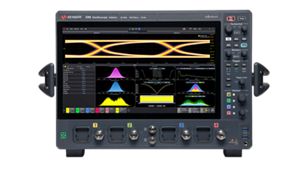
Pro oscilloscopes are our highest-performance models, ideal for next-generation research and development, high-speed compliance testing, photonic device testing, and more. Conquer your most difficult measurement challenges with our highest bandwidth and low noise floor oscilloscopes. Choose one of our popular configurations or configure one specific to your application. Need help selecting? Check out the resources below.
Ultra-wide bandwidth
Develop next-generation technologies with bandwidths up to 110 GHz, enabling precise signal capture and analysis for cutting-edge applications.
Fast sample rate
Capture and analyze high-speed signals with our highest sampling rate up to 256 GSa/s, providing detailed insights into transients, jitter, and noise.
High signal integrity
Display signals accurately with low noise and jitter, high ENOB, and up to 12-bit vertical resolution.
Compliance test software
Test compliance for research and development of next-generation standards like PCIe®, DDR, MIPI®, and more.
-
Maximum bandwidth
10 GHz to 110 GHz
-
Analog channels
2 to 4
-
Maximum sample rate
128 GSa/s to 256 GSa/s
-
Maximum memory depth
2 Gpts to 8 Gpts
-
Display size
15.4 inch to 15.6 inch
-
ADC resolution
10 bits to 12 bits
-
Front-end connector size
1 mm to 3.5 mm
-
Brands included
UXR Series
Most popular configurations


XR8-class Oscilloscope
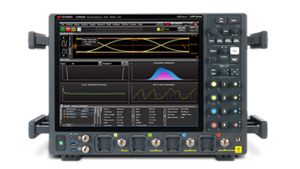

XR9-class Oscilloscope
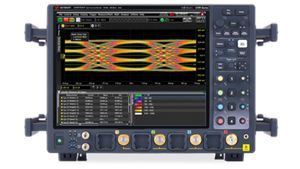
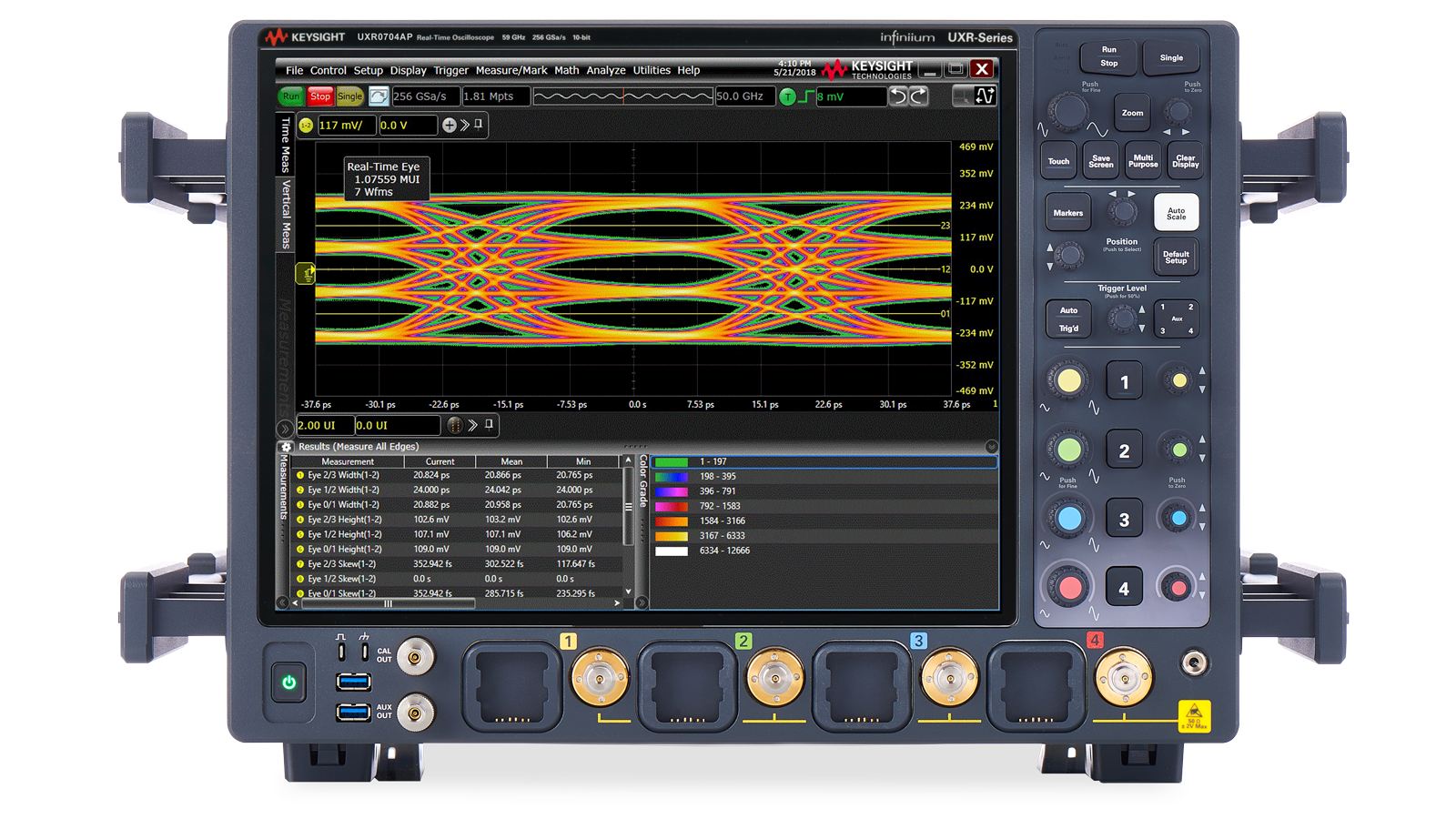
XR9-class Oscilloscope, 1 mm Inputs
Services and support
Innovate at speed with curated support plans and prioritized response and turn-around times.
Get predictable, lease-based subscriptions and full lifecycle management solutions—so you reach your business goals faster.
Experience elevated service as a KeysightCare subscriber to get committed technical response and more.
Ensure your test system performs to specification and meets local and global standards.
Make measurements quickly with in-house, instructor-led training, and eLearning.
Download Keysight software or update your software to the newest version.
Frequently asked questions
To check for signal integrity issues, like signal degradation (amplitude loss), noise, or distortion, choose a high-performance oscilloscope with the following advanced features:
Averaging
When high-frequency noise or random fluctuations are the issue, use the averaging feature on an oscilloscope to smooth out random noise by averaging multiple signal captures.
Persistence Mode
Visualize the history of a waveform over time by displaying previous traces, highlighting transient events, glitches, and signal anomalies. This oscilloscope feature is especially useful for capturing and analyzing signal issues that might be missed in a single capture.
Mask Testing
Detecting signal glitches, ringing, or overshoots is possible by using a pre-defined mask or boundary that the measured signal is expected to stay within. The oscilloscope will help to identify distortions or degradation, sending an alert for any deviations from the set mask.
Edge Triggering
Transient signal issues like jitter or glitches can be captured using the edge triggering feature of an oscilloscope. Edge triggering captures events at specific points of the waveform, like rising or falling edges, to focus on transient issues like jitter or glitches.
Crosstalk Analysis
Signal integrity issues could come from crosstalk or electromagnetic interference from other signals. Crosstalk analysis features in oscilloscope software can help detect and quantify sources of interference from adjacent traces or signal sources.
Channel Simulation
Oscilloscope software can help diagnose signal integrity and degradation issues sourced from impairments in the channel with simulation. This software can both simulate potential impairments to test performance against real-world issues that may arise, or use equalization to compensate for channel impairments.
Ensuring product compliance to industry standards specifications is required for reliable, safe, and regulated performance. Oscilloscopes can help ensure device compliance to industry standards with the following features:
Automated compliance test software
Integrated into modern high-performance oscilloscopes, automated compliance test software simplifies the process of ensuring that products meet industry standards. The software automates the testing, analysis, and verification of products to industry standards like USB, Ethernet, PCIe, DDR, and more, comparing the captured waveforms against predefined performance thresholds. Automating time-consuming and precise compliance test procedures saves time and reduces the potential for human error. In addition to acting as a reference receiver during transmitter compliance testing, high-performance oscilloscopes can be used in receiver testing for receiver characterization and as an error detector alongside a bit error ratio tester.
Eye diagrams and time domain reflectometry (TDR)
Standards like USB, PCIe, Ethernet, DDR, and HDMI require that PHY transmitter performance meet specific signal parameters such as rise/fall times, voltage levels, and signal fidelity over long traces or cables. A high-performance oscilloscope enables you to visualize an eye diagram, which must be open in the center (both horizontally and vertically) to indicate that the signal is clean, with sufficient voltage margins and timing margins.
High-speed standards also often require that transmission lines be impedance-matched to minimize reflections. The oscilloscope with TDR probes can be used to verify impedance matching across the signal path.
Jitter measurement and timing compliance
Standards like 5G New Radio, Ethernet (IEEE 802.3 standards), DDR4/DDR5, and PCIe impose tight limits on jitter, or variations in signal timing. Oscilloscopes can measure total, random, and deterministic jitter as well as vertical noise, which are critical for ensuring that data signals remain synchronized within the specified tolerances. Built-in jitter analysis tools can automatically calculate jitter values and compare them to the limits set by the relevant standards as well as help identify root causes of jitter and noise affecting signal integrity with jitter decomposition.
While oscilloscopes are traditionally used for testing and analyzing analog and digital signals in wired systems, the latest high-performance oscilloscopes are capable of testing complex, high-frequency signals used in wireless communication systems to test and validate technologies like 5G and Wi-Fi 6. Here are some examples of how an oscilloscope can be used to test wireless communication systems:
5G frequency bands and bandwidths
Since 5G operates across a wide frequency spectrum, including sub-6 GHz (FR1) and millimeter-wave (FR2) bands, a high-performance oscilloscope with a high sample rate and bandwidth is required to capture the full frequency content of 5G signals. Since 5G signals are often transmitted over multiple input multiple output channels, a multi-channel oscilloscope is also required to analyze the signals simultaneously.
5G uses advanced modulation schemes like 256-QAM, Orthogonal Frequency Division Multiplexing (OFDM), and time division duplexing (TDD), which are much more complex than previous wireless generations. An oscilloscope that supports high bandwidth and sample rates and real-time signal capture is required to analyze high-frequency signals and fast transient events, where the signal's properties change rapidly over time, accurately in complex modulation schemes.
Wi-Fi 6 (802.11ax) signals
Wi-Fi 6, or 802.11ax, uses higher frequency bands, wider channel bandwidths (up to 160 MHz), and Orthogonal Frequency Division Multiple Access (OFDMA) complex modulation and multi-user multiple input multiple output (MU-MIMO), making it more complex than previous Wi-Fi generations. Modulation accuracy can be tested using an oscilloscope. Error vector magnitude (EVM) is a key metric used to evaluate the performance of the signal in terms of how much error or distortion occurred compared to the ideal signal. A lower EVM indicates that the transmitted signal closely matches the intended signal, ensuring better modulation accuracy. A multi-channel oscilloscope can measure and verify the efficient communication using OFDMA to ensure that frequency bands allocated to individual users are correctly allocated and do not overlap.
Modern high-bandwidth oscilloscopes, like Keysight Pro+ oscilloscopes, provide the necessary bandwidth, sample rate, and signal analysis capabilities to meet the rigorous testing demands of 5G and Wi-Fi 6, with additional support for millimeter-wave signal analysis and in-depth Vector Signal Analysis software features.
PCI-SIG®, PCIe® and PCI Express® are US registered trademarks and/or service marks of PCI-SIG.