How to Measure AI Workload Performance Isolation

Quantify Concurrent Workload Interference
AI performance isolation testing begins with two defined workload profiles and a network topology shared by their traffic paths. Configure a baseline workload with a specified number of emulated endpoints, message sizes, offered load, and communication pattern. Run it alone and record job completion time, throughput, and the latency statistics exposed by the available test configuration. Keep the fabric parameters and traffic generation settings unchanged for the initial comparison. Start the baseline workload again while introducing a second workload using a separate set of emulated endpoints. Configure its start time and traffic intensity so that the overlap period can be identified in the measurement record. Collect results separately for both workloads.
Compare baseline and concurrent-run measurements to quantify workload interference. For each traffic profile, calculate the change in job completion time, delivered bandwidth, and latency distribution between isolated and shared-fabric operation. Repeat with different overlap durations or aggressor loads, while holding the primary workload configuration constant. Monitor applicable network indicators, such as queuing behavior, congestion signals, and loss or retransmission statistics when these measurements are available from the platform. Keep the load model and tested fabric configuration alongside the results. AI fabric testing can then repeat the same workload pairing after a controlled change to scheduling, topology, or congestion-management settings. The output is a per-workload comparison of how resource sharing changes measured performance.

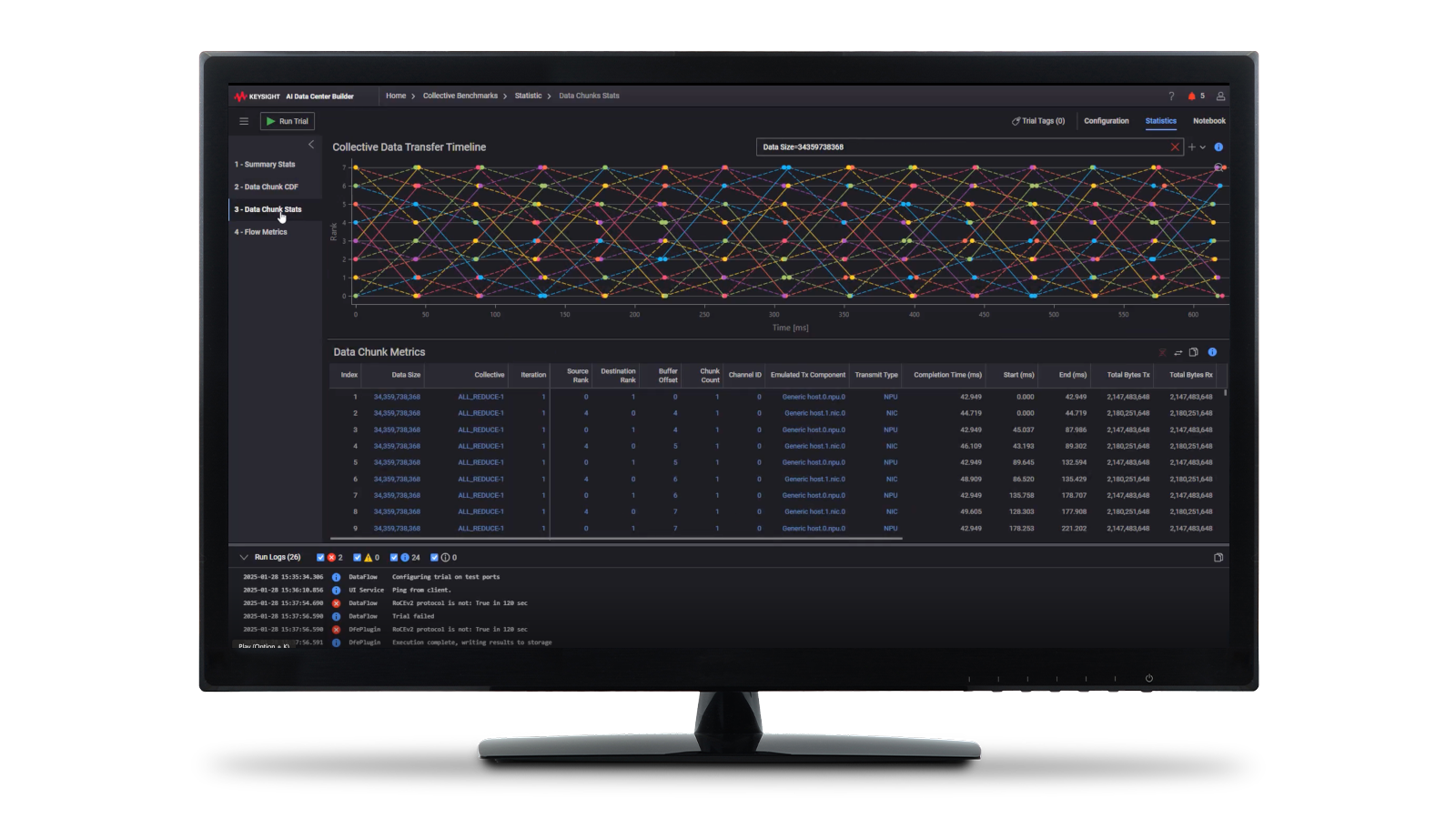
AI Workload Performance Isolation Testing Solution
See Demo Video of AI Workload Performance Isolation Testing Solution
Explore Products in Our AI Workload Performance Isolation Testing Solution
-

![]()
950-2001 KAI Data Center Builder Start Bundle with Collective Benchmarks Application


Discover Resources and Insights
Additional Resources for AI Workload Performance Isolation Testing
Related Use Cases


-
![]()
Learn More
How to Correlate Packet Events Across Test Ports
Correlate packet timestamps and traffic events across distributed Ethernet test ports using a shared precision timing reference.
Learn More

-
![]()
Learn More
How to Stress Test Ethernet Interconnects
Validate Ethernet Layer 1 links using BER, FEC, and stress-test measurements to detect bursty errors over time.
Learn More
-
![]()
Learn More
How to Debug Ethernet FEC Errors
Debug Ethernet FEC errors with lane-level symbol error density, burst tolerance, and margin analysis across multirate links.
Learn More

Get in Touch With One of Our Experts
Need help finding the right solution for you?