








- Overview
- All Models
- Support
Make noise figure measurements with precision and speed
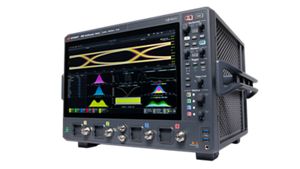
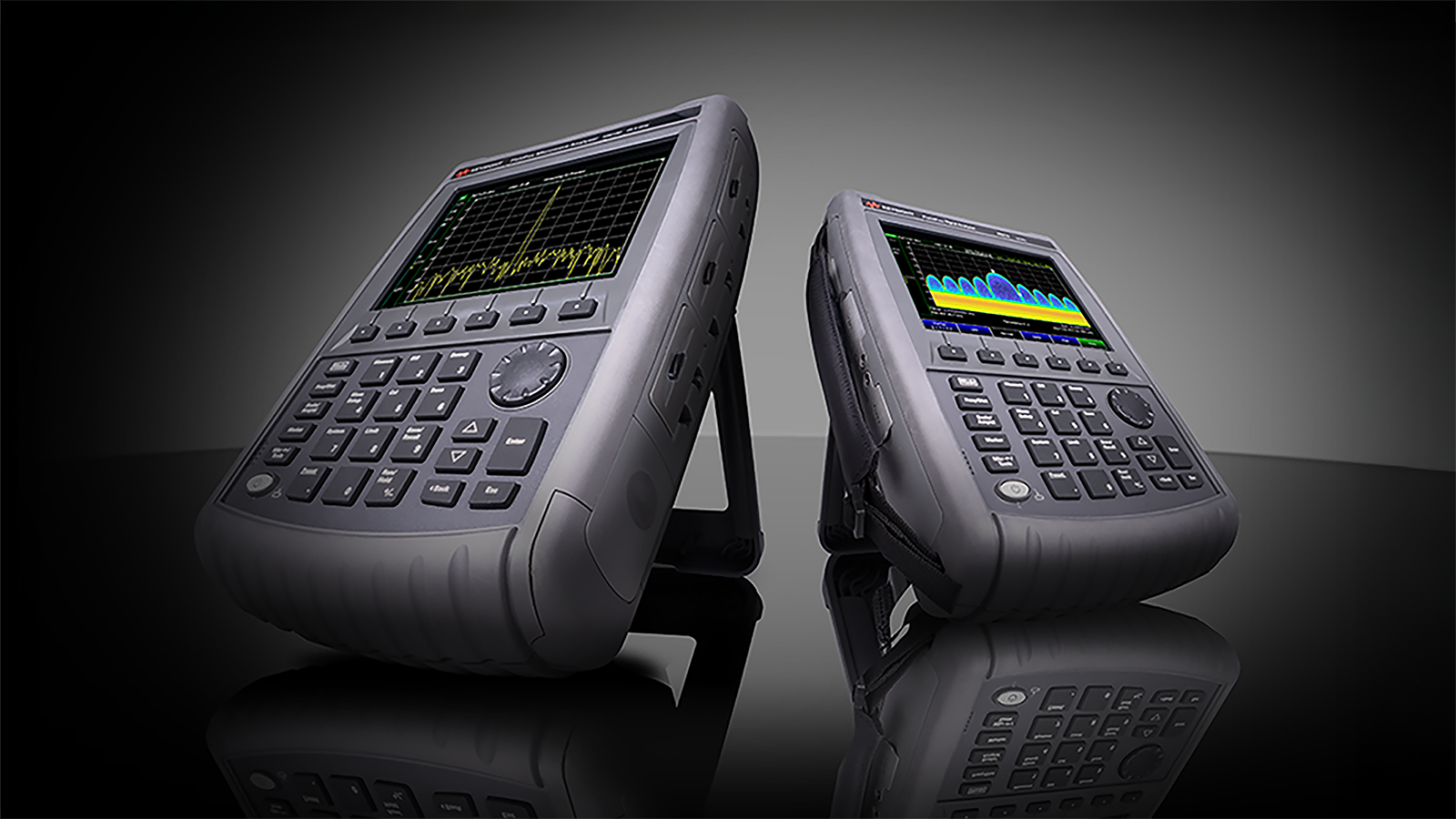
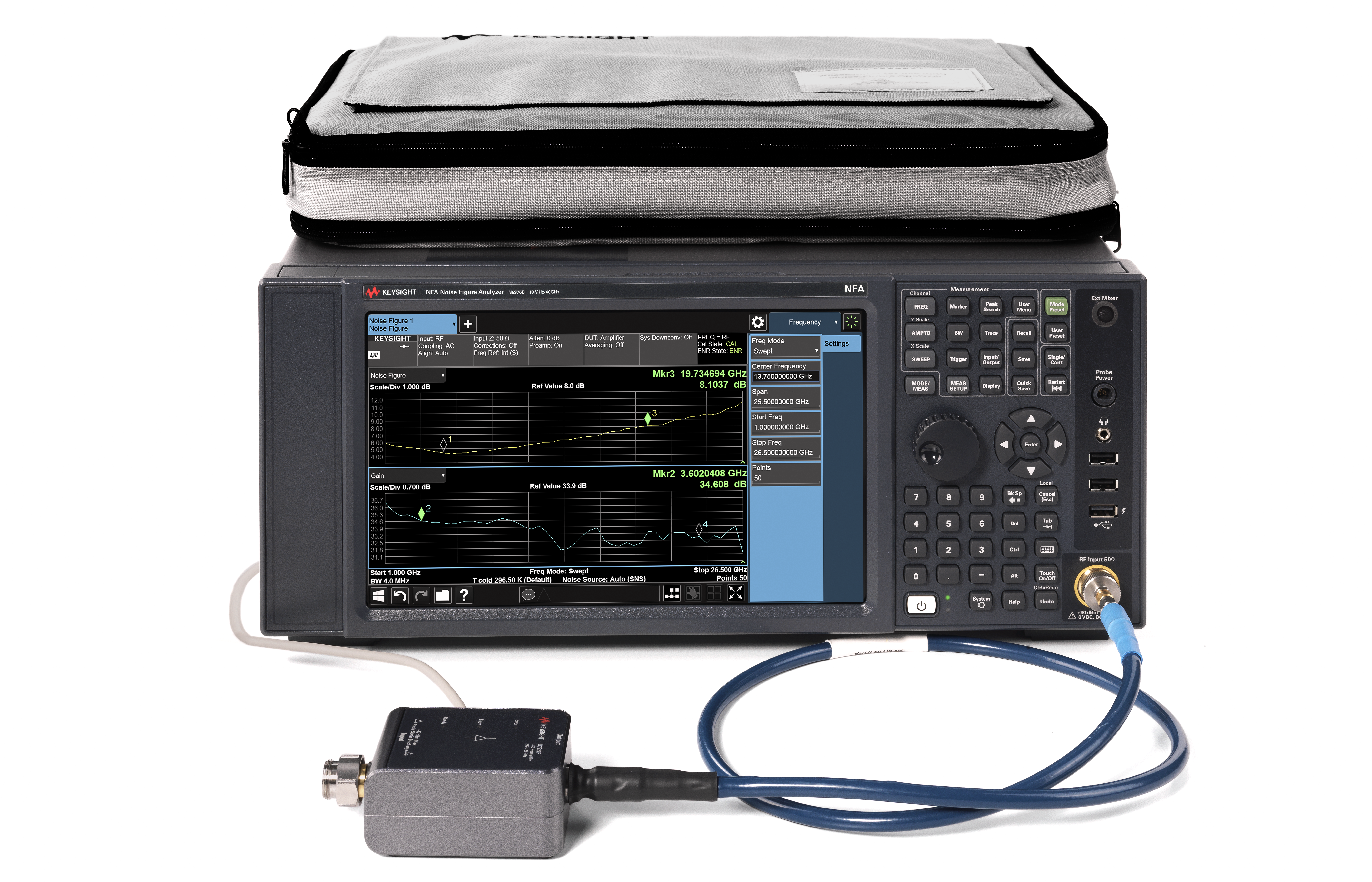
Keysight NF7-class noise figure analyzers include the N8973B-N8976B noise figure analyzers. They are designed to make fast, accurate, and repeatable noise figure measurements. When combined with our signal noise source (SNS) and the included USB preamplifier, the noise figure analyzer automatically downloads excess noise ratio (ENR) data, streamlining the measurement process. Our noise figure analyzers are easy to use with a multi-touch interface that enables stretch, pinch, and drag gestures. Choose one of our popular configurations or configure one specific to your application. Need help selecting? Check out the resources below.
Low instrument uncertainty
Designed to minimize internal circuitry errors, the low instrument uncertainty of ±0.02 dB ensures accurate, repeatable noise figure measurements.
Automated calibration
Streamlines Y-factor measurements by enabling automated calibration of up to 12 device-under-test (DUT) setups in a single step, significantly reducing test time.
Multimode signal analysis
Provides additional modes such as spectrum analyzer and IQ analyzer, enabling diverse signal analysis tasks within a single instrument.
Built-in uncertainty calculator
Computes noise figure uncertainty by auto-populating data from the SNS, USB preamplifier, and key instrument parameters like analyzer noise figure and match.
-
Maximum frequency
3.6 GHz to 40 GHz
-
Gain uncertainty
±0.15 dB
-
Instrument uncertainty
±0.02 dB using a 4-6 dB ENR Noise Source
-
Bandwidth
8 MHz
Most popular configurations

NF7-class Noise Figure Analyzer, multi-touch
NF7-class Noise Figure Analyzer, multi-touch
NF7-class Noise Figure Analyzer, multi-touch
Services and support
Innovate at speed with curated support plans and prioritized response and turn-around times.
Get predictable, lease-based subscriptions and full lifecycle management solutions—so you reach your business goals faster.
Experience elevated service as a KeysightCare subscriber to get committed technical response and more.
Ensure your test system performs to specification and meets local and global standards.
Make measurements quickly with in-house, instructor-led training, and eLearning.
Download Keysight software or update your software to the newest version.
Frequently asked questions
Modern receiving systems must often process very weak signals, but the noise added by the system components tends to obscure those very weak signals. Sensitivity, bit error ratio (BER), and noise figure are system parameters that characterize the ability to process low-level signals. Of these parameters, noise figure is unique in that it is suitable not only for characterizing the entire system but also the system components, such as the pre-amplifier, mixer, and IF amplifier that make up the system.
By controlling the noise figure and gain of system components, the designer directly controls the noise figure of the overall system. Once the noise figure is known, system sensitivity can be easily estimated from the system bandwidth. Noise figure is often the key parameter that differentiates one system from another, one amplifier from another, and one transistor from another.
The noise characterized by noise measurements consists of spontaneous fluctuations caused by ordinary phenomena in the electrical equipment. Thermal noise arises from vibrations of conduction electrons and holes due to their finite temperature. Some of the vibrations have spectral content within the frequency band of interest and contribute noise to the signals. The noise spectrum produced by thermal noise is nearly uniform over RF and microwave frequencies. The power delivered by a thermal source into an impedance-matched load is kTB watts, where k is Boltzmann’s constant (1.38 x 10⁻²³ joules/K), T is the temperature in K, and B is the system’s noise bandwidth. The available power is independent of the source impedance. The available power into a matched load is directly proportional to the bandwidth, so that twice the bandwidth would allow twice the power to be delivered to the load.
Shot noise arises from the quantized nature of current flow. Other random phenomena occur in nature that are quantized and produce noise in the manner of shot noise. Examples are the generation and recombination of hole/electron pairs in semiconductors (G-R noise), and the division of emitter current between the base and collector in transistors (partition noise). These noise-generating mechanisms have the characteristic that, like thermal noise, the frequency spectra are essentially uniform, producing equal power density across the entire RF and microwave frequency range.
There are many causes of random noise in electrical devices. Noise characterization usually refers to the combined effect of all the causes in a component. The combined effect is often referred to as if it were all caused by thermal noise. Referring to a device as having a certain noise temperature does not mean that the component is that physical temperature, but merely that its noise power is equivalent to a thermal source of that temperature. Although the noise temperature does not directly correspond with physical temperature, there may be a dependence on temperature. Some very low noise figures can be achieved when the device is cooled to a temperature below ambient.
The Y-factor method is the basis of most noise figure measurements, whether they are manual or automatically performed internally in a noise figure analyzer. Using a noise source, this method allows the determination of the internal noise in the DUT and, therefore, the noise figure or effective input noise temperature.
With a noise source connected to the DUT, the output power can be measured corresponding to the noise source on and the noise source off. The ratio of these two powers is called the Y-factor. The power detector used to make this measurement may be a power meter, spectrum analyzer, or a special internal power detector in the case of noise figure meters and analyzers. The relative level of accuracy is important. One of the advantages of modern noise figure analyzers is that the internal power detector is very linear and can very precisely measure level changes. The absolute power level accuracy of the measuring device is not important since a ratio is to be measured.