









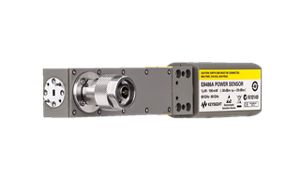

- Overview
- All Models
- Support
High-frequency power measurements
Keysight waveguide power sensors provide precise and reliable millimeter-wave measurements, covering a broad frequency range. Designed specifically for high-frequency applications, these sensors deliver accurate power readings with minimal signal degradation, ensuring the integrity of measurements in waveguide systems. By minimizing mismatch uncertainty and reflection loss, the sensors offer superior impedance matching. Additionally, the sensors feature a 50 MHz calibration port, reducing measurement uncertainties and ensuring traceability.
Wide frequency coverage
Measures power levels accurately across a broad frequency range, enabling millimeter-wave frequency applications.
Low insertion loss
Ensures minimal signal degradation, maintaining the integrity of the measured signal through low insertion loss.
Minimized mismatch
Reduces mismatch uncertainty and reflection loss, ensuring better impedance matching and more accurate power readings in waveguide systems.
50 MHz calibration port
Features a calibration port to reduce measurement uncertainties and ensure accurate calibration and traceability to national standards.
-
Frequency range
60 GHz to 90 GHz, 50 GHz to 75 GHz, 75 GHz to 110 GHz, 33 GHz to 50 GHz, 26.5 GHz to 40 GHz
-
Power range
-60 to +20 dBm, -30 to +20 dBm, -35 dBm (316.23 nW) to +20 dBm (100 mW)
-
Connector type
UG-387/U, EIA WR-12, UG-385/U, Waveguide
-
Measurement type
Average/CW only
Most popular configurations
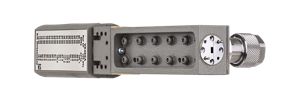

Waveguide Power Sensor
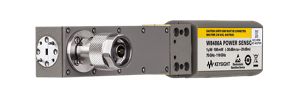
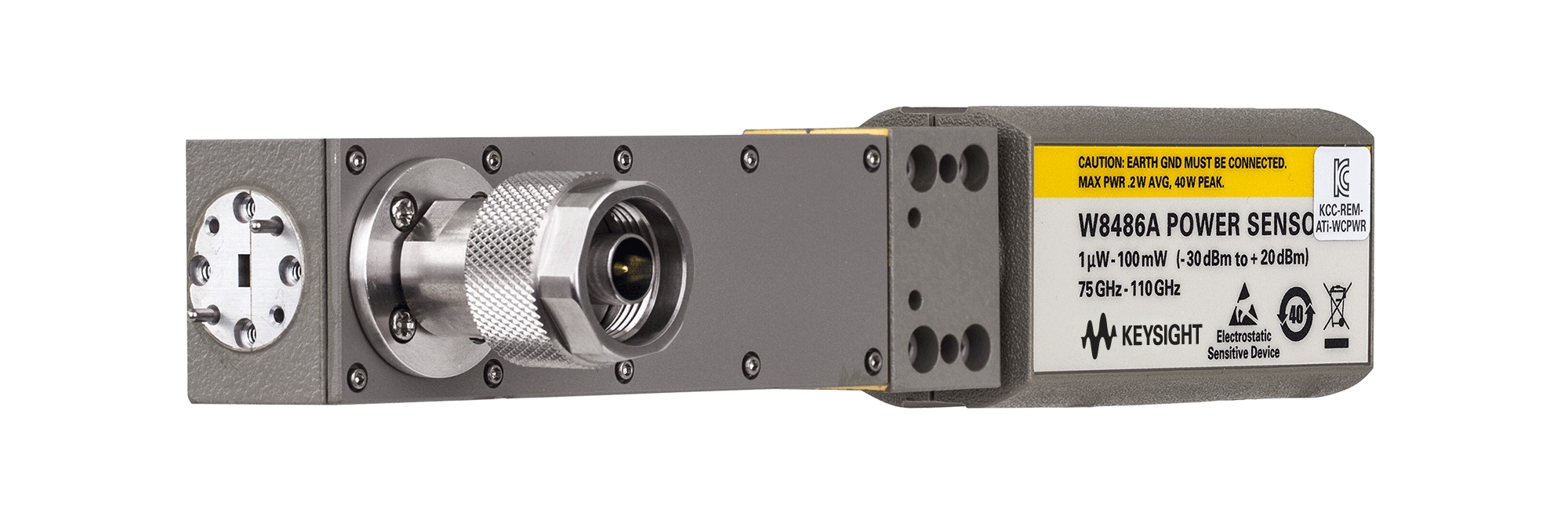
Waveguide Power Sensor
Waveguide Power Sensor
Services and support
Innovate at speed with curated support plans and prioritized response and turn-around times.
Get predictable, lease-based subscriptions and full lifecycle management solutions—so you reach your business goals faster.
Experience elevated service as a KeysightCare subscriber to get committed technical response and more.
Ensure your test system performs to specification and meets local and global standards.
Make measurements quickly with in-house, instructor-led training, and eLearning.
Download Keysight software or update your software to the newest version.
Frequently asked questions
A waveguide power sensor is a type of RF sensor specifically designed to measure power in waveguide transmission lines, rather than coaxial cables. These sensors are used in high-frequency and high-power applications, typically above 18 GHz, where waveguides are preferred due to their lower loss, higher power handling, and mode purity.
Waveguide power sensors are commonly used in radar, satellite communication, aerospace, and millimeter-wave test systems.
Waveguide power sensors operate similarly to coaxial sensors but are mechanically and electrically optimized for waveguide interfaces.
1. RF Signal Coupling via Waveguide Flange
The sensor connects directly to a standard waveguide flange, forming a seamless extension of the waveguide system.
The RF energy travels through the waveguide and is partially coupled into an absorptive load inside the sensor.
2. Power Detection via Thermocouple or Thermistor
The absorbed RF energy is converted into heat in a termination load.
A thermocouple or thermistor measures the temperature rise, producing a DC voltage proportional to the true average power.
This thermal sensing method provides modulation-independent, highly accurate power measurements, especially suited for continuous wave or complex signals at high frequencies.
3. Calibration and Corrections
Like coaxial sensors, waveguide sensors are calibrated for frequency response, linearity, and temperature effects.
Keysight waveguide sensors are typically traceable to national standards, making them suitable for high-precision applications.
Waveguide power sensors cover the R-band, Q-band, V-band, E-band, and W-band spectrums, providing precise and reliable measurements across these high-frequency ranges. These bands correspond to industry-standard waveguide sizes such as WR-42, WR-28, WR-15, WR-12, and WR-10.
Each waveguide band targets a specific frequency range:
- R-band (26.5–40 GHz, WR-28)
- Q-band (33–50 GHz, WR-22)
- V-band (50–75 GHz, WR-15)
- E-band (60–90 GHz, WR-12)
- W-band (75–110 GHz, WR-10)
These sensors use precision thermocouple-based detection to provide modulation-independent measurements for characterizing pulsed, modulated, or complex broadband signals at millimeter-wave frequencies.