The Future of AI Networking: 3.2T and Beyond




Why 448 Gbps?
448 Gbps per-lane signaling is a key enabler for building next-generation 3.2 Tbps Ethernet links. At this level, the 3.2T link aggregates eight lanes at 448 Gbps each, increasing the throughput required for high-performance AI and cloud data center networks.
This move to 448 Gbps per lane represents a major leap, doubling the per-lane speed of leading-edge 224 Gbps systems. It significantly increases the demands on SerDes design, equalization techniques, and channel modeling, while pushing modulation schemes such as PAM4, PAM6, and PAM8 to their practical limits.
Achieving stable 448 Gbps signaling also poses significant challenges to system design across optics, packaging, and testing. It marks a key step in enabling future 1.6T and 3.2T networks, as well as supporting the continued expansion of high-performance computing and AI infrastructure.
Watch 448 Gbps PAM4 Come to Life
Go inside one of the world’s first 448 Gbps transmission systems at PAM4 and find out how NTT Innovative Devices, Lumentum, and Keysight are laying the foundation for the next generation of AI innovation. Hear from the executives and engineers who made it happen, find out how it all came together, and discover what this means for 1.6T and 3.2T data center networks.


Engineering Challenge: Preparing for 3.2T Networks
Pushing PAM4 to 448 Gbps (224 GBaud) introduced new challenges. The team had to move quickly, align every component, and test at the limits of what today’s tools and materials can handle. Here’s what was needed for the demo to succeed:


Higher Symbol Rates
448 Gbps pushes symbol rates to 224 Gbaud — reaching the limits of signal integrity. In a high-speed demonstration, the quality of the signal had to be maintained by every component of the system.


High-Speed Performance
Components had to maintain high-speed electrical performance, including control of loss, reflection, and parasitics to ensure reliable signal integrity.


Precision at 224 GBaud
The setup required clean, repeatable signal generation and precise signal analysis with tools fast enough to keep up with the signal.


Global Collaboration
Teams across Japan, Germany, and the US worked around the clock, handing off progress in 24-hour cycles to meet a tight deadline for the live demonstration.

PAM4 vs. PAM6 / PAM8
Pulse Amplitude Modulation (PAM) increases data throughput by encoding multiple bits per symbol. It’s a key technique for scaling high-speed serial links.
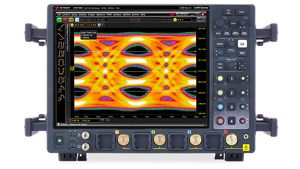
PAM4, or 4-level signaling, encodes 2 bits per symbol and is widely used in 400G and 800G Ethernet. It reduces the required bandwidth compared to NRZ but is more susceptible to noise and requires tighter signal integrity controls.
PAM6 and PAM8 extend this approach by using six or eight voltage levels to encode more bits per symbol—approximately 2.6 for PAM6 and 3 for PAM8. These schemes can support higher data rates but are more sensitive to noise and distortion, and require more complex receiver designs.
As signaling rates rise—toward 448 Gbps per lane and beyond—engineers must weigh the trade-offs of higher-order PAM formats against complexity, noise tolerance, and power requirements. PAM4 is established, but PAM6 and PAM8 are being evaluated for future systems that require greater efficiency.


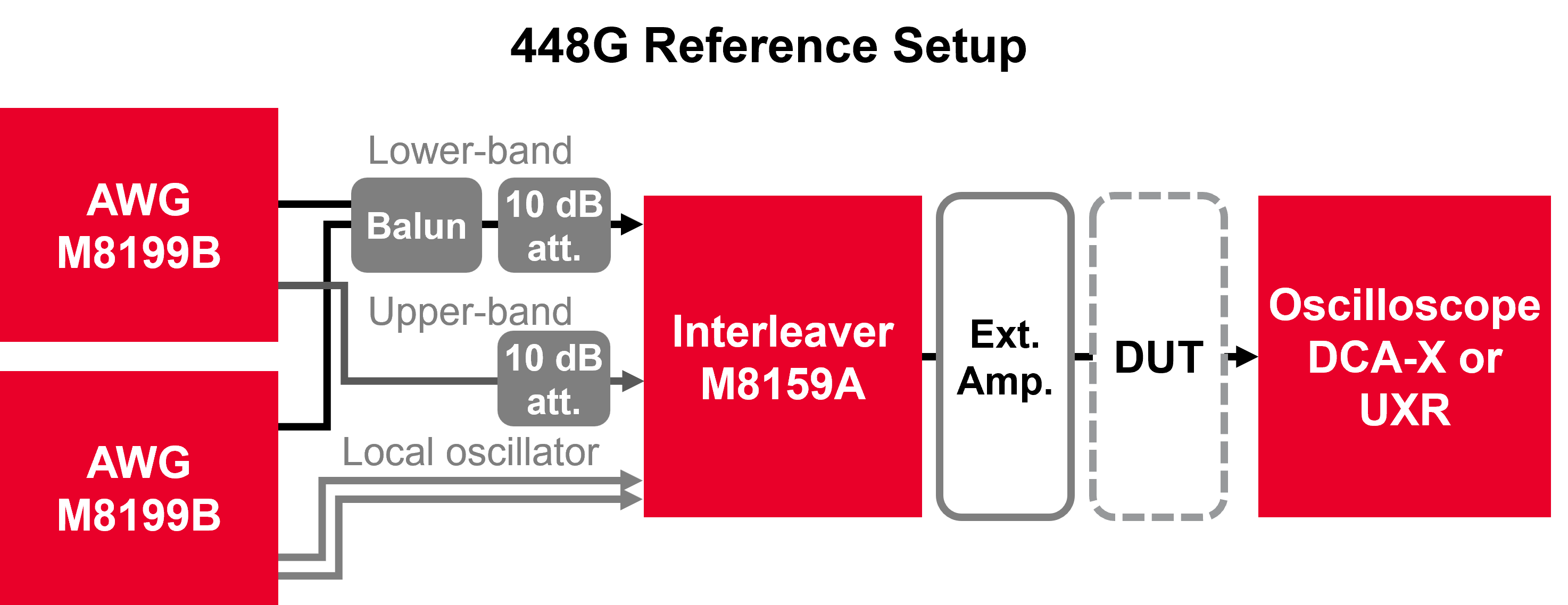
Inside the 448 Gbps Test Configuration
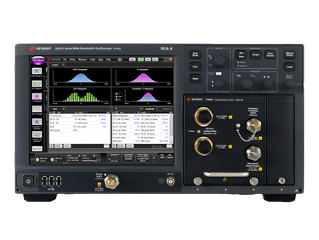
To generate and analyze 448 Gbps PAM4 signal, a dual-module arbitrary waveform generator (M8199B AWG) setup is used, along with a frequency-domain interleaver unit (M8159A FDIU). The configuration combines low-band and upper-band outputs, precisely delays signals, and delivers them to the device under test (DUT). On the measurement side, Keysight’s DCA-X or UXR series oscilloscopes enable high-fidelity signal capture and analysis at extreme speeds.
This reference architecture showcases a real-world test environment for next-generation optical interconnects in AI data centers.
NTT Innovative Devices and Keysight: Driving Photonics Breakthroughs
Discover the cutting-edge collaboration between NTT Innovative Devices and Keysight Technologies as they push the boundaries of photonic innovation. This video highlights their joint efforts to realize breakthroughs in next-generation optical communication—advancing ultra-high-speed, energy-efficient photonics technologies that are critical to powering AI, ML, and future data infrastructures.
Tools that Make 448 Gbps Possible

Explore 448 Gbps Resources
Learn how 448 Gbps PAM4 can shape the future of AI data centers

Get in Touch with One of Our Experts
Need help finding the right solution for you?