What are you looking for?
What Is Total Integrated Scattering?
Definition of Total Integrated Scattering
Total integrated scattering (TIS) describes how much light is deviated (or scattered) from the incident light direction by diffuse reflection and transmission from a surface or optical element. It is equal to the ratio of diffuse reflected and transmitted optical power to the incident optical power when light is incident upon a surface.
TIS = (diffuse reflectance radiant flux + diffuse transmittance radiant flux) / [(specular reflectance power + specular transmittance power) + (diffuse reflectance power + diffuse transmittance power)]
This implies that TIS is a unitless number with a value between 0 and 1.
The aim of TIS is to collect all scattered light in all directions without the specular beam.
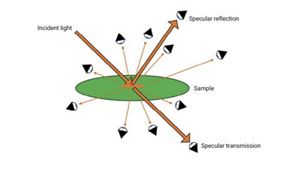

Table of Contents
Why Is TIS Important to an Optical Design?
TIS is essential to obtain the precise optical characteristics of a material. It’s one of several optical material performance metrics that make it possible to directly measure how light interacts with a material sample.
During an optical design process, accurate simulation results rely upon accurate optical property definitions (surface and bulk properties). Geometry alone often cannot determine the light distribution. Optical material and surface properties determine how the energy and direction of a ray changes. It is important to know with sufficient precision the optical characteristics of the materials you will be using. You can then export the results to optical design software.
Having accurate measurements is beneficial to:
- Optical design engineers, who need accurate optical properties for optical design software simulations
- R&D engineers, who need to design the right material that provides specific optical properties
- Quality control personnel, who check these properties as part of manufacturing quality assurance and control processes
In addition to TIS, typical optical material performance metrics measured include:
How Do You Measure TIS?
TIS measurements are notoriously difficult to perform, primarily because you must separate the specularly reflected and transmitted incident light from the scattered light. These radiation patterns normally overlap and you cannot easily separate them using the geometry of the measurement equipment.
The following paragraphs outline a couple of methods for measuring TIS:
Measuring TIS using integrating spheres
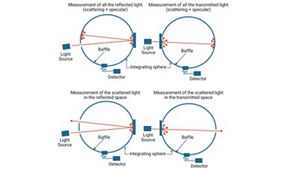
You can measure the TIS of a material sample or a surface using specially designed integrating spheres. Ideally the measurement setup should measure all of the scattered light signal (without the specular) into a hemisphere: the scattered light from the sample is integrated by a Lambertian reflective hemisphere, then normalized by the total reflected and transmitted power of the incident beam (also measured into a reflective hemisphere).
In practice, you will place the sample on the exit and then entrance port of an integrated sphere and illuminate them with a laser source to measure the (specular reflectance power + diffuse transmittance power) and the (diffuse reflectance power + specular transmittance power), respectively. Perform the same measurement again after opening a port that permits the specular beam out of the integrating sphere so that it is not included in the measurements of the diffuse transmittance power and diffuse reflectance power.

Measuring TIS from BSDF
You can also measure TIS using a goniometer with a detector that can be scanned in angular space to measure the BSDF of a sample or surface. You can calculate TIS directly from BSDF measurements as shown in the following formulas.


With θd and φd, respectively, the scattering angle and the azimuthal angle of the detector.
θi and φi, respectively, the scattering angle and the azimuthal angle of the source.
θd Specular max and θd Specular min are the limits of the specular part of the BSDF.
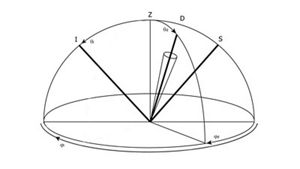

The TIS computation accuracy relies on the BSDF accuracy and BSDF sampling. The higher the resolution, the more accurate the TIS evaluation.
What Solutions Does Keysight Offer?
Keysight offers measurement services in a light- and temperature-controlled laboratory. We can measure TIS using the integrating spheres method outlined above.
In addition, Keysight offers high-end scattering measurement instruments for your lab to measure BSDF, which you can use for TIS computation. For example, the Keysight REFLET 180S is able to measure BSDF in order to extract/calculate TIS from these measurements. The accuracy depends on the resolution of the measurements. The different angular resolutions of these instruments will allow you to extract the specular part from BSDF measurements with varying degrees of accuracy.


Measure Total Integrated Scattering with Keysight
Whether you’re looking to rely on Keysight’s measurement services or you need high-end scattering measurement tools to perform TIS measurements yourself, Keysight can support you every step of the way.


Access Additional Resources




Explore Related Blogs




Want help or have questions?