What are you looking for?
What Is Machine Vision Optics?
Definition of Machine Vision Optics
Machine vision optics includes optics and optical elements such as illuminators, lenses, mirrors, and prisms that are designed and built to enable automated visual inspection by a machine. Almost every industrially produced product undergoes visual inspection, which consists of checks on various aspects of the condition or state of an object of interest.
Examples of inspected elements include:
- Shape, size, dimensional stability
- Correct position and orientation in space
- Optical properties, such as color and appearance
- Presence or absence of defect
- Presence or absence of expected component parts (for example, in a circuit board assembly
For more information on machine vision optics, see reference [1].
Table of Contents
How Does Machine Vision Optics Work and What Problem Does It Solve?
Using illumination, lenses, and sensors, machine vision optics captures information relevant to a computer-performed task. It has a wide variety of functions, such as detection of cancer, estimation of tumor volume, classification of fruits into different grades, inspection of pass/fail on a production line, determination of crop ripeness, and much more.
Additionally, industrial inspection uses machine vision to measure the specific size and dimension of test objects to check for product quality. This eliminates the need to measure each part manually, which is especially time consuming in mass production environments.


Figure 1. Robotic vision sensor camera system in a medicine factory
What Industries and Applications Would Machine Vision Optics Be Good for?
Machine vision and the provision of automatic inspection can support a wide range of industries, needs, and applications, so almost every manufacturer involved in production and delivery of goods to the market can benefit from visual inspection of product quality.
Recycling centers use spectroscopy to sort plastics according to type and to collect each type in different bins.
Agricultural supply chains can use machine vision to, for example, sort light green lettuce varieties from the dark green varieties moving on a conveyor belt, which are then packaged separately.
Industries such as medical distribution, pharmaceuticals, automotive hardware and electrical supply, consumer electronics mass production, aviation, avionics, and the supply chains supporting them use machine vision for production inspection tasks.


Figure 2. Barcode machine vision technology for sushi industrial production line conveyor belt in the food factory.
How Do You Develop and Model an Optical System for Machine Vision?
To develop and model an optical system for machine vision, the first step is to define the requirements, often for a specific focal plane used in the imaging system, and with a certain sensitivity. This affects the illumination system design, including the choice of light source, required power, and collection efficiency. In particular, the reflectivity of the inspected surface — how much light enters the imaging path — directly influences the illumination requirements.
On the imaging system side, key factors include:
- The feature size to be resolved on the inspected part
- The numerical aperture needed for resolution, depth of focus, and signal level
- The stand-off distance between the inspected part and the lens
- The area (field of view) of the inspected part to be image
- Polarization characteristics of the object
Also, there may be system-level metrics dealing with more general aspects of the system performance. For example:
- Requirements for high signal to noise ratio, including requirements for high speed camera function and exposure
- Hyper-centric imaging of parts with acceptable distortion and large viewing angles for sidewalls of units under test can create unique illumination requirements
- Unique requirements for very large (or narrow) part scales
- Detector array characteristics like pixel pitch and chief ray angle limitations (one input into telecentricity)
- Telecentricity requirements so that a change in focus does not change the object size
- Spectral range, sample wavelengths, and wavelength weights
- Magnification
- Permissible distortion
- Envelope constraints
- Weight constraints
- Production quantities
- Cost goal
Machine vision systems use image signal processing (ISP) to perform visual inspection. Design considerations for the ISP routines include:
- Prior knowledge of the object to be identified. This is beneficial for designing and training the system so that the detection algorithms are optimized for a particular object ensemble
- Knowledge of imaging system characteristics, such as resolution and field of view, and image sensor characteristics including pixel array dimensions and pixel size
- Illumination conditions of the scene
- Image processing techniques such as edge detection and segmentation
- Object or feature detection methods
For the overall system, other questions include the overall envelope and the cost.
It is crucial to design an optical system that captures as much information as possible that is relevant to the task, while being aware of how the image processing methods can modify or improve system performance. Design parameters may include structured illumination, coherence of the light sources, reflectivity, absorption, scattering, spectral response, phase contrast, polarization property, radiometry, and more.
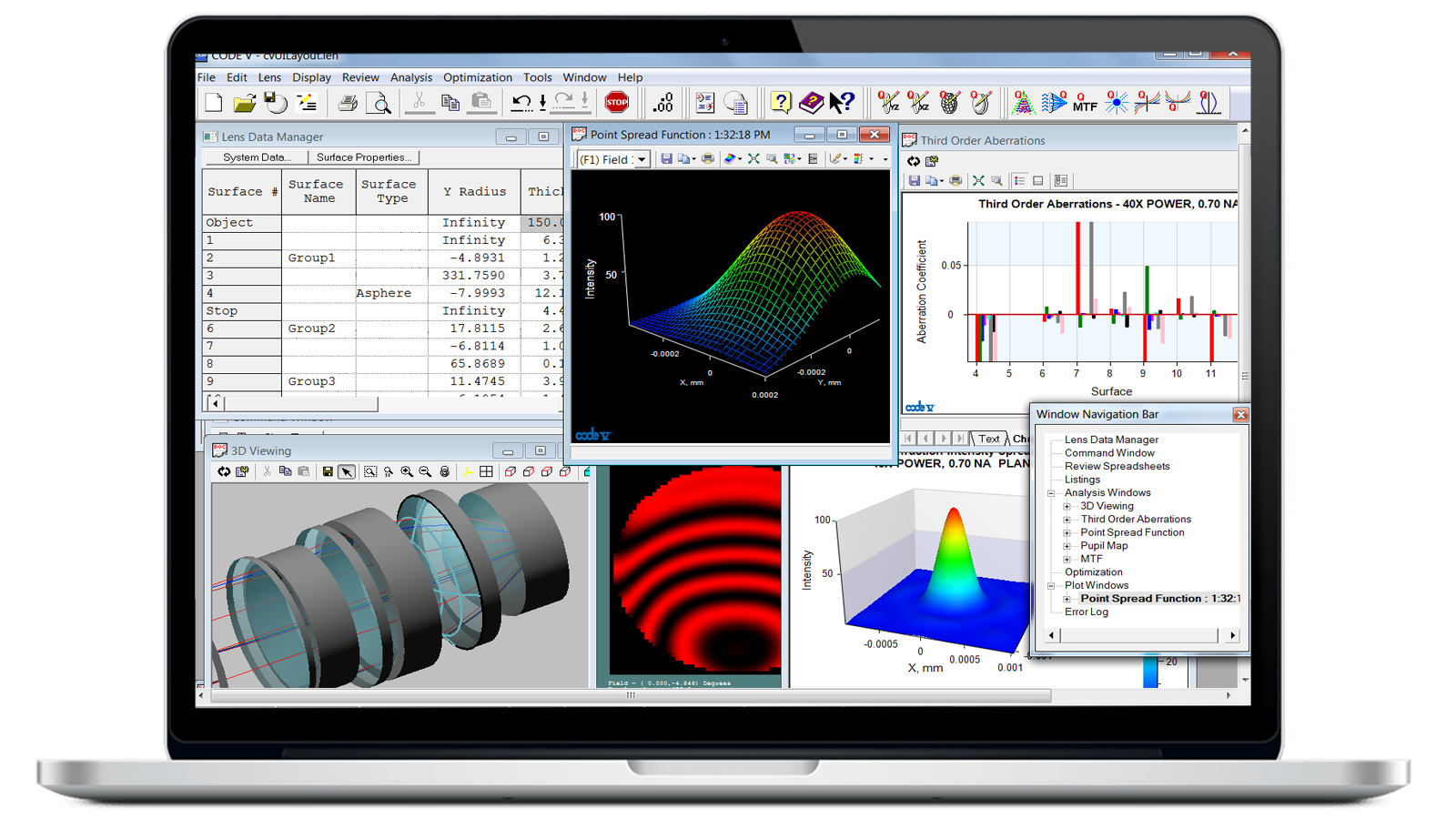
To aid the development of a machine vision system, Keysight offers LightTools for illumination design, CODE V for optical system design, and ImSym as the platform that provides and end-to-end model of the system including lens system, detector characteristics, and image signal processing methods.
Get Tools to Develop Your Machine Vision System
Create a machine vision system efficiently and correctly with all the tools you need for success, including illumination design tools, optical system design tools, and a platform that provides a full model of the entire system.

References
[1] "Machine Vision - Automated Visual Inspection: Theory, Practice and Applications", Beyerer, Puente Leon, Frese, Springer Verlag, 2016.
Explore related blogs






Want help or have questions?