












- Overview
- All Models
- Support
Precise and reliable passive component testing
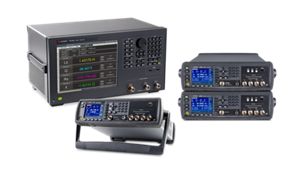
Keysight ZA2-class benchtop LCR meters include the E4980B Series which go far beyond fundamental impedance testing. They deliver highly precise and reliable measurements of passive components, supporting frequency ranges up to 3 GHz. Our benchtop LCR meters accurately measure a broad set of electrical parameters — including resistance, capacitance, inductance, and impedance — under a wide variety of test conditions, such as varying frequencies, signal levels, and bias voltages. Choose one of our popular configurations or configure one specific for your application. Need help selecting? Check out the resources below.
Precision measurements
Highly accurate, repeatable measurements with basic accuracy as low as 0.05% ensure dependable characterization of passive components.
Error compensation
Includes robust open, short, and load compensation methods to minimize measurement errors caused by test fixtures, cable effects, and stray impedances.
Flexible test signals
Enables precise control over signal voltage and current to match the operating conditions of your DUT for evaluating nonlinear or sensitive components.
Multiple interface options
Features standard LAN, USB, and GPIB interfaces for remote control and seamless integration into automated test systems, making it ideal for high-throughput production lines.
-
Maximum frequency
1 MHz to 3 GHz
-
Target DUT
Capacitors, General-purpose device, Material
-
Type
Benchtop
Most popular configurations
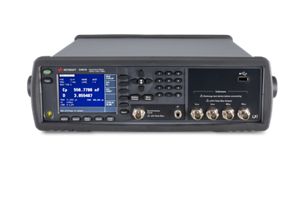

ZA2-class Capacitance Meter
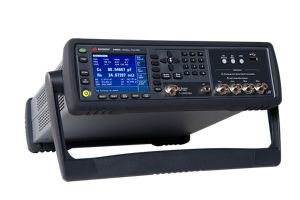

ZA2-class LCR Meter
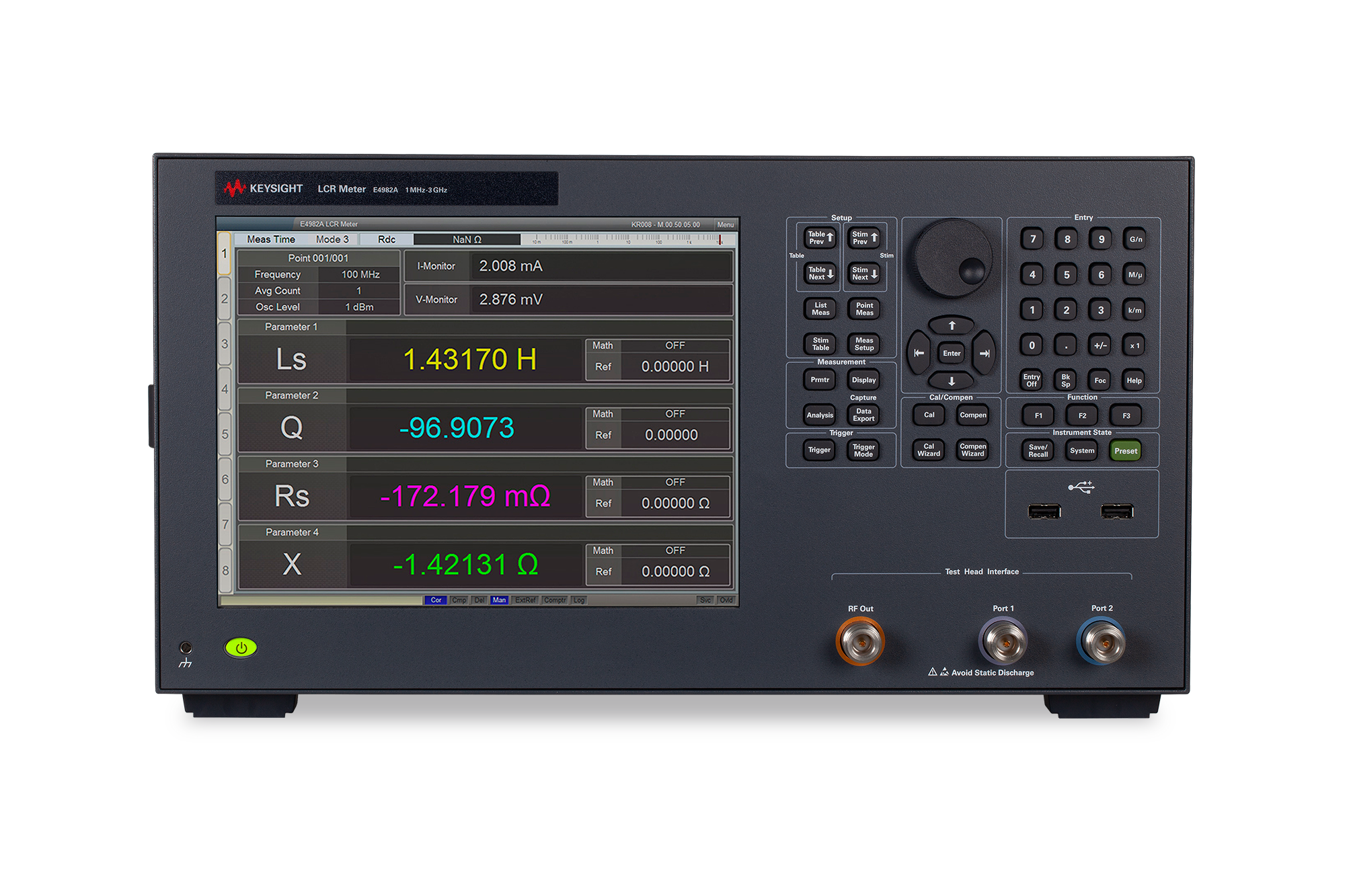
ZA2-class LCR Meter
- LCR Meters and Impedance Analyzer Catalog
- Efficient Measurements of Components
- Measuring Permittivity and Permeability
Services and support
Innovate at speed with curated support plans and prioritized response and turn-around times.
Get predictable, lease-based subscriptions and full lifecycle management solutions—so you reach your business goals faster.
Experience elevated service as a KeysightCare subscriber to get committed technical response and more.
Ensure your test system performs to specification and meets local and global standards.
Make measurements quickly with in-house, instructor-led training, and eLearning.
Download Keysight software or update your software to the newest version.
Frequently asked questions
LCR meters measure key parameters like impedance, capacitance, inductance, resistance, dissipation factor, and quality factor under defined frequency and voltage conditions. These parameters help determine how a component will perform in real-world circuits, especially over varying operating conditions. Parametric testing ensures that electronic components and systems perform as intended in real-world conditions, providing valuable data for design validation, quality assurance, and troubleshooting.
Parametric measurements are essential across various stages of the product lifecycle. During design, you can evaluate component parameters to verify that they meet the system specifications. In manufacturing, you can use LCR meters to ensure product quality and compliance. Once a system is deployed, LCR meters are used to verify functional behavior and diagnose performance degradation or damage.
Without precise measurements provided by LCR meters, designs would suffer from unchecked inefficiencies and risk catastrophic failure. Quantifying this opposition to electric current within materials or components accurately allows engineers to tailor designs for optimal performance.
Error compensation is important in an LCR meter because it ensures accurate and reliable measurements by correcting for systematic errors introduced by the test setup — especially those caused by cables, fixtures, and contact resistance.
When you're measuring small components, especially at higher frequencies, even minor sources of error like stray capacitance, lead inductance, or parasitic resistance from the test leads can significantly distort the actual measurement. These errors can make a capacitor look like it has more inductance than it should, or make an inductor appear to have more resistance.
By performing compensation, the LCR meter essentially “zeroes out” the influence of the test environment so that only the true characteristics of the device under test (DUT) are measured. This is especially critical in applications requiring high precision or where components have very small values, such as in RF, medical, or aerospace electronics.
For integration into a high-throughput production line, an LCR meter must deliver a combination of speed, accuracy, and seamless automation support. Fast measurement speed is essential to keep pace with rapid test cycles. High accuracy and repeatability are equally important to ensure consistent quality control, especially when testing to tight tolerances. Automation is another critical requirement. LCR meters used in production should support remote control capabilities via standard interfaces like USB, LAN, and GPIB. Support for reliable test fixtures is also essential for minimizing lead resistance and maximizing measurement precision. Additionally, open/short/load compensation is required to remove the effects of cables and fixtures from the measurement, ensuring accurate results across multiple stations or setups.