What are you looking for?
Post-Quantum Cryptography Validation for Embedded Systems
Validate PQC implementations with specialized testing solutions and expert services.
The shift to post-quantum cryptography (PQC) is already underway. For embedded and IoT devices, PQC is crucial for long-term security, yet implementing it on resource-constrained hardware with larger keys and new cryptographic primitives is challenging. Even mathematically sound algorithms can leak information through side channels or behave unexpectedly under fault conditions. As industry standards mature and regulatory requirements rise across sectors such as payments, automotive, and critical infrastructure, organizations need to validate their PQC implementations now to ensure security and interoperability, as well as timely market access.
Keysight helps teams deploy PQC securely and efficiently with dedicated testing solutions, compliance expertise, and practical integration guidance. By validating implementations from design to deployment, we help reduce risk, support certification, and enable secure, future-ready products.

Why Keysight for PQC Security?


Reduce Risk Across the Product Lifecycle
Catch PQC implementation issues early, from design through deployment.


Stay Compliant
Align with emerging standards and certifications such as Common Criteria and EUCC.


Accelerate PQC Adoption
Integrate validation into existing workflows with specialized tools, services, and training.
Frequently Asked Questions
The transition to post-quantum cryptography is moving from “optional” to expected as global standards and compliance timelines take shape. Government and high-assurance contracts are beginning to require quantum-safe roadmaps or concrete PQC adoption plans.
To maintain security, interoperability, and market access, organizations need to understand upcoming requirements, select appropriate quantum-safe algorithms, and plan for compliant, secure implementations rather than treating PQC as a future add-on.
Standardized PQC algorithms may be secure on paper, but their implementations can still be vulnerable to physical attacks. When PQC runs on real devices, it can leak information through side channels (e.g., power, timing, EM) or behave unexpectedly under fault injection.
By testing implementation security using methods such as Side-Channel Analysis (SCA) and Fault Injection (FI), you can uncover issues like key-dependent leakage or fault-based key recovery and design effective countermeasures.
Yes, especially if your products are long-lived, hard to update, or subject to strict regulation. Updating firmware, secure elements, or cryptographic modules after deployment is costly and sometimes impractical, particularly for embedded and remote systems. Designs that are not built with quantum-safe cryptography in mind may require full hardware replacement or complex patching later.
At the same time, testing practices must evolve: traditional approaches like classical TVLA were not designed for PQC’s larger states and more complex operations. Starting now gives you time to adapt your evaluation methods, plan migrations, and integrate PQC and its implementation security into your normal development lifecycle, instead of scrambling to retrofit when requirements become mandatory.
Build Your Next-Gen Device Security Test Lab
Validating post-quantum cryptography (PQC) on embedded systems requires both a robust hardware security testing setup and advanced analysis tools. Keysight provides a comprehensive portfolio to help you validate and harden your embedded system against side-channel and fault-injection attacks — from pre-silicon to post-silicon.
Our solutions support testing across a wide range of form factors and abstraction levels, from pure hardware to low-level software such as firmware and secure boot.
Capture the Signals That Matter
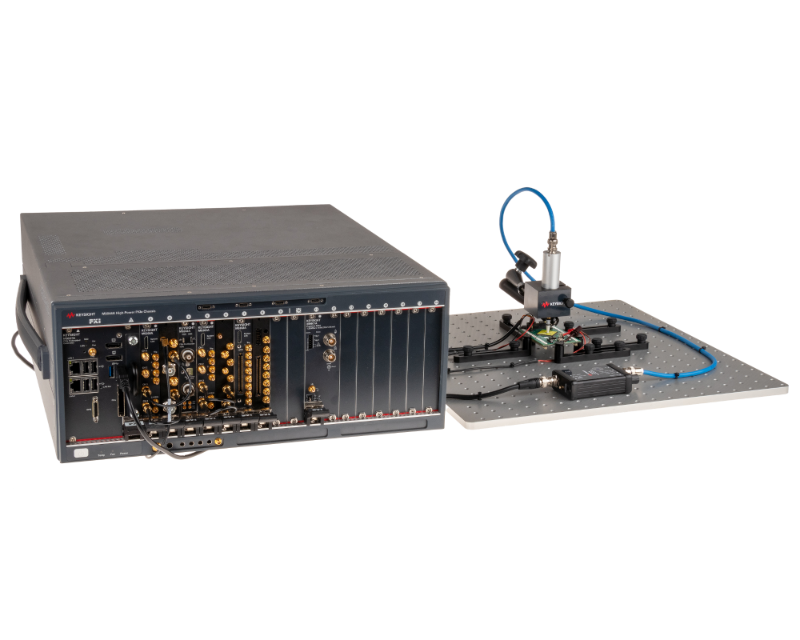
At the heart of your setup is the Embedded Security Testbench, a PXI-based solution that integrates seamlessly with your lab environment and scales with your needs. Depending on your security objectives, you can extend the setup with specialized modules:
- Power/Clock Solution
Enables precise control and monitoring of power and clock signals. Supports both fault injection — by inducing voltage or timing anomalies — and side-channel analysis by capturing power traces, even from noisy targets. - Electromagnetic Solution
Allows non-invasive probing of EM emissions for side-channel analysis and enables EM-based fault injection to assess device resilience. - Optical (Laser) Solution
Uses high-precision laser pulses to target specific regions of a chip, inducing localized disruptions or studying physical leakage paths relevant to side-channel vulnerabilities.

Inspector Software
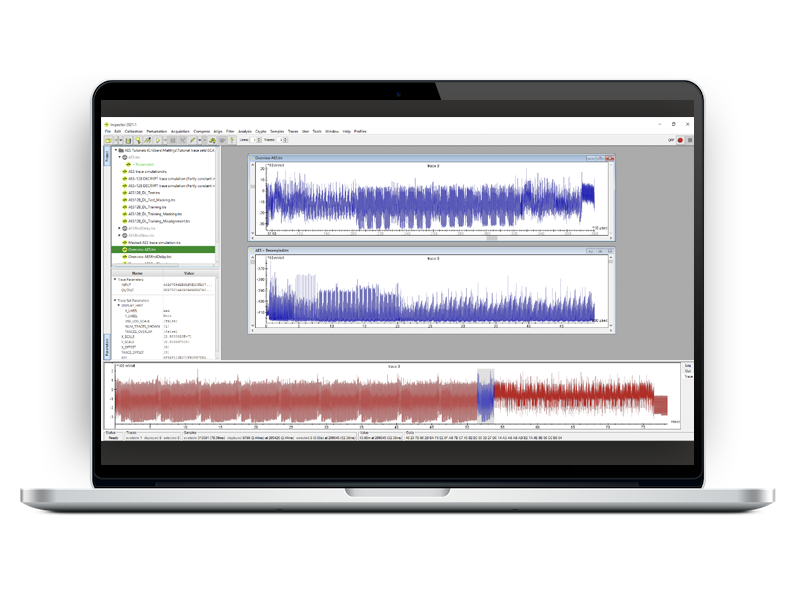
Keysight Inspector supports PQC validation through established Side-Channel Analysis (SCA) and Fault Injection (FI) workflows, with automation and extensibility for repeatable testing at scale. With over 20 years of device-security expertise and 100+ ready to use modules, Inspector continues to expand through regular releases — trusted by security engineers worldwide to secure next-generation products.
Built-in PQC support
ML-DSA (Module-Lattice Digital Signature Algorithm), a NIST-standard, lattice-based digital signature scheme, is supported as a ready-to-use module in Inspector for both pre-silicon and post-silicon testing. Pre-silicon, Inspector can analyze leakage as early as Register-Transfer Level (RTL) simulation to identify issues early in the design cycle, reducing rework costs and accelerating time-to-market. Post-silicon, Inspector can validate implementations on production devices to help confirm the algorithm is implemented securely.
ML-KEM (Module-Lattice-Based Key Encapsulation Mechanism) is the NIST-standardized post-quantum key exchange algorithm designed to protect communications against future quantum-computer threats. Inspector is now capable of helping customers evaluate the side-channel security of ML-KEM-512, 768, and 1024 implementations through dedicated Correlation Power Analysis (CPA) acquisition and analysis workflows. This enables customers identify hardware level vulnerabilities that could expose secret key.
Crypto 3 framework for adaptable PQC testing
Inspector’s Crypto 3 framework supports modular, reusable workflows for iterative security evaluation. For PQC testing, this enables:
- Faster experimentation: Prototype PQC ciphers and test strategies with less integration effort
- Efficient customization: Implement only the components needed for the use case, simplifying iteration
- Smarter analysis: Prioritize the most promising key candidates in large PQC key spaces to save time and resources

With You Every Step of the Way
From setup to day-to-day operations, Keysight provides:
- Comprehensive documentation
- Annual software updates
- Expert support and troubleshooting
- Real-world test cases to deepen your team’s expertise
Training That Evolves With You
Equip engineers and lab teams with the skills and knowledge to operate Keysight Inspector effectively. Our trainings focus on practical tool usage: setting up PQC targets, configuring and running side-channel and fault-injection campaigns, interpreting results, and integrating Inspector into existing pre-silicon and post-silicon workflows.
- Essential side-channel analysis and fault injection training for foundational knowledge
- Advanced programs tailored to your team’s experience and goals
All sessions are customized to your lab setup and threat landscape, ensuring your team stays ahead of evolving security challenges.




Partner with Keysight on PQC Validation and Compliance
Assess the real-world resilience of your PQC implementations with focused security evaluations. Our teams perform architecture and design reviews, implementation and code assessments, and targeted Side-Channel Analysis (SCA) and Fault Injection (FI) campaigns, tailored to your threat model and certification goals. Get practical guidance on selecting schemes, mapping PQC into constrained embedded architectures, and deploying countermeasures effectively. We help you interpret emerging standards, prioritize risks, and align your PQC roadmap with regulatory and certification requirements.
Customer collaboration highlights:
Keysight supports NXP Semiconductors on PQC Implementation Validation
Keysight supports PQShield with PQC Security Evaluation Services
EUCC and Post-Quantum Cryptography
Keysight is an accredited EUCC (EU Cybersecurity Certification) IT Security Evaluation Facility (ITSEF), ready to guide clients through complex certification processes. As cryptographic standards evolve, EUCC is aligning with next-generation requirements. The 2025 update of the Agreed Cryptographic Mechanisms (ACM) introduces Post-Quantum Cryptography (PQC) algorithms and emphasizes hybrid approaches for greater resilience. Keysight advises clients on hybrid cryptography strategies and validates implementations to enable secure, future-proof deployments in security-critical sectors.


Featured Resources




Want help or have questions?