Können wir Ihnen behilflich sein?
RSoft DiffractMOD RCWA
RCWA design and simulation tool for diffractive optical structures

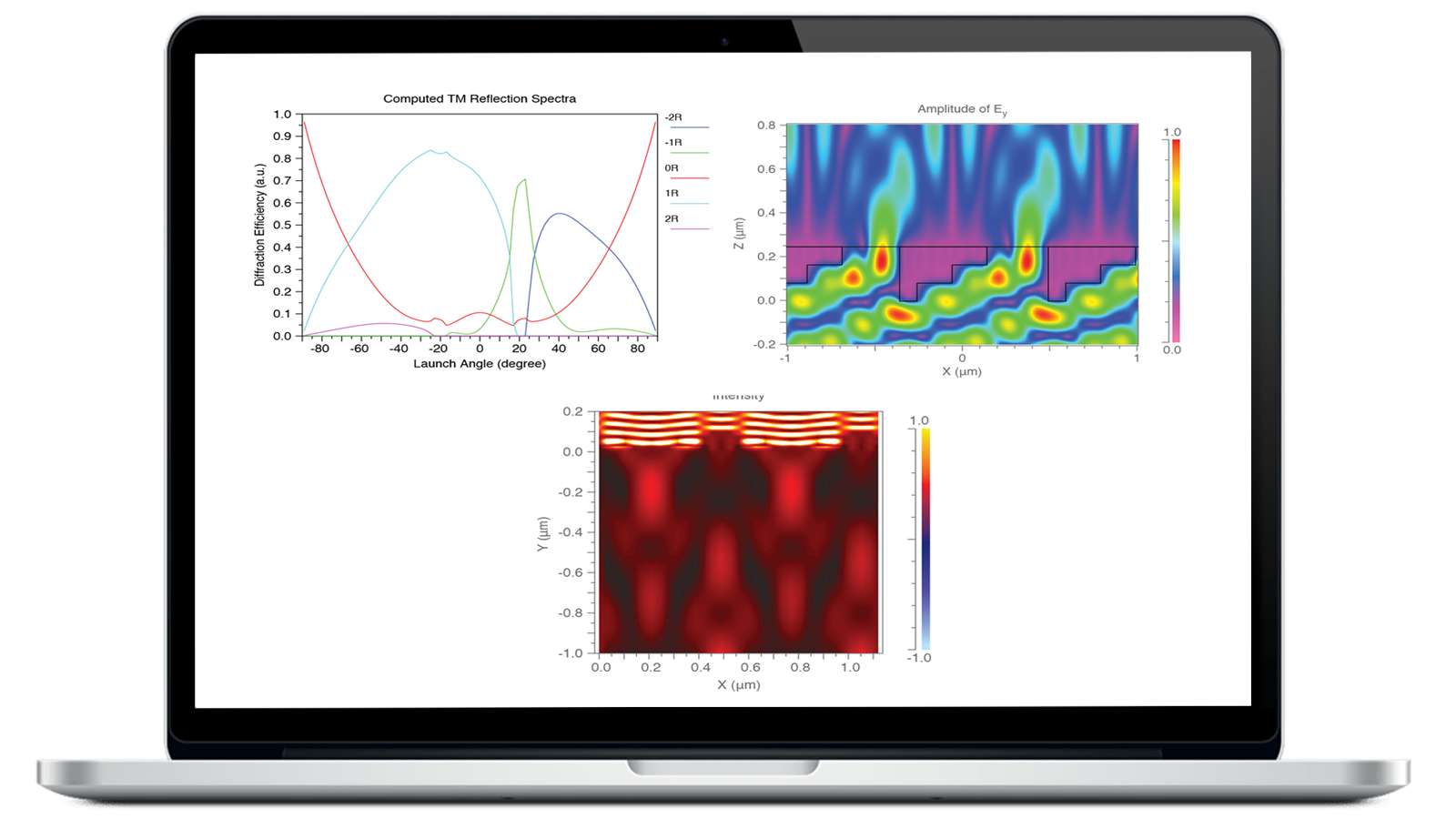
Design and Model Complex Periodic and Multi-Layered Structures
In fields such as semiconductor manufacturing, photonics, and wave optics, design and development teams count on RSoft DiffractMOD RCWA, or rigorous coupled wave analysis, to simulate and design diffractive optical structures. With DiffractMOD design tool, your team can quickly gain clear and comprehensive insights into the behavior of diffractive optical elements, waveguide resonance gratings, subwavelength periodic structures, photonic bandgap crystals, and more.
- Extend your RCWA with DiffractMOD’s advanced algorithms.
- Handle complicated periodic structures containing both dielectric and metallic components with lossy and dispersive materials.
Key Features of RSoft DiffractMOD RCWA


Advanced algorithms
DiffractMOD RCWA implements several advanced algorithms including fast Fourier factorization and generalized transmission line formulation.


RSoft CAD integration
DiffractMOD RCWA works seamlessly with RSoft’s other passive device simulation tools with full integration in the RSoft CAD Environment.


Precise, full-vector simulations
Rapidly model 2D and 3D geometries and simulate conical incidence scenarios. Account for material dispersion and complex refractive index for metals.


Accurate calculations
Calculate, display, and output electromagnetic wave diffractions in any order. Calculate total reflected power, transmitted power, and absorbed power.


Advanced computing
Get field profiles at any position and common metrology parameters directly. Compute spectra vs. wavelength, angle, and polarization for any diffraction efficiency.
Need Support for RSoft DiffractMOD RCWA?
Explore Blogs






Featured Resources
















RSoft DiffractMOD RCWA Design Tool – FAQ
Simulating electromagnetic wave diffraction from periodic structures, DiffractMOD RCWA is a design tool for diffractive optical structures such as surface normal gratings, photonic bandgap crystals, and subwavelength periodic structures.
The DiffractMOD RCWA design tool has applications across numerous device types including:
- Waveguide resonance gratings
- Diffractive optical elements (DOEs)
- Surface relief and volume index gratings
- Wavelength filters
- Optical metrology
- Nanolithography
- Polarization sensitive devices
- Artificial dielectric coatings
- Photovoltaic systems
- 3D displays
- Optical interconnections
- Optical data storage
- Spectroscopy
DiffractMOD is based on the rigorous coupled wave analysis, or RCWA, method and implements several advanced algorithms including a fast-converging formulation of Maxwell equations and a numerical stabilization scheme. Tailored for multilayer structures, it uses a unit cell concept to handle arbitrary geometry in both 2D and 3D periodic structures. The index distribution can consist of standard dielectric materials and dispersive or lossy materials such as metals. The input or incident plane wave can have arbitrary direction and polarization. Design teams can achieve various simulation results including diffraction efficiency, each vectorial field component, and both near and far fields.