










- Overview
- All Models
- Support
Real-time protocol analysis in an enhanced entry-level oscilloscope
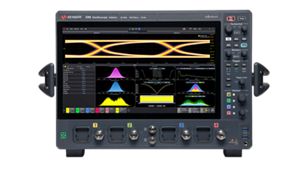
The Keysight XR4- and XR5-class Advanced oscilloscopes offer the same core features and capabilities as our Essential oscilloscopes, plus more. Discover enhanced features and performance such as hardware-based serial decoding, zone triggering, and seven instruments in one with the addition of mixed-signal oscilloscope (MSO) capability. Advanced oscilloscopes provide higher bandwidth, faster sample rates, segmented memory, and an enlarged touch screen display compared to our Essential grade. Advanced oscilloscopes are ideal for debugging designs that require jitter analysis, eye diagrams, and zone triggering. Choose one of our popular configurations or configure one specific to your application. Need help selecting? Check out the resources below.
7 instruments in 1
Integrates an oscilloscope, wavegen, protocol analyzer, digital voltmeter, frequency counter, frequency response analyzer, and digital channels in one instrument.
Real-time protocol analysis
Capture and decode a wide variety of waveforms simultaneously, providing real-time insights and minimizing potential errors.
Triggering and memory
Gain deeper insights with enhanced triggering capabilities that reveal complex timing and signal behaviors and isolate key signal events with segmented memory.
Large touch screen
Navigate intuitively with a 12.1-inch touch screen using gestures like scrolling, pinch-to-zoom, and dragging.
-
Maximum bandwidth
200 MHz to 1.5 GHz
-
Analog channels
2 to 4
-
Digital channels
0 to 16
-
Maximum sample rate
5 GSa/s to 20 GSa/s
-
Maximum memory depth
4 Mpts
-
Display size
12.1 inch
-
ADC resolution
8
-
Brands included
4000 Series, 6000 Series
Most popular configurations
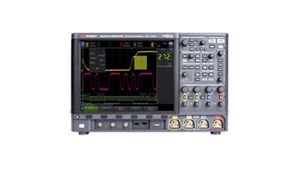

XR4-class Oscilloscope, with built-in waveform generator
XR4-class Oscilloscope, mixed signal with built-in waveform generator
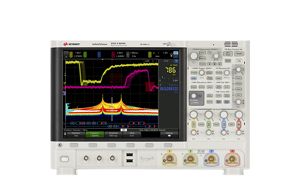

XR5-class Oscilloscope
Services and support
Innovate at speed with curated support plans and prioritized response and turn-around times.
Get predictable, lease-based subscriptions and full lifecycle management solutions—so you reach your business goals faster.
Experience elevated service as a KeysightCare subscriber to get committed technical response and more.
Ensure your test system performs to specification and meets local and global standards.
Make measurements quickly with in-house, instructor-led training, and eLearning.
Download Keysight software or update your software to the newest version.
Frequently asked questions
All modern oscilloscopes are digital storage oscilloscopes (DSOs), which use digital signal processing to capture and display an analog signal waveform into a digital representation displayed on a screen. If the oscilloscope also has the ability to accept digital signals, it is a mixed-signal oscilloscope (MSO).
The basic principle behind digital oscilloscopes is quite simple: an electronic circuit produces a voltage that varies with time, which is fed into the oscilloscope's input.
It converts the input signal voltage into a digital format using an analog-to-digital converter (ADC). The ADC runs much faster than the input signal, typically several MHz. The scope triggers an event and then captures a certain number of samples before and after the trigger event. It displays the voltage vs. time waveform on the screen.
The oscilloscope then uses this voltage to produce a corresponding electric current passed through a resistor. This current is converted back into a voltage proportional to the original signal. The voltage is amplified and used to drive the oscilloscope's display. By carefully controlling the amplification and other factors, the digital oscilloscope can accurately represent standard and complex waveforms.
The scope stores the waveform in memory so it can be recalled and analyzed later. In addition, the scope can perform mathematical operations on the waveform data, such as adding, subtracting, multiplying, and dividing, which allows the user to see the effects of these operations on the waveform.
Segmented memory in an oscilloscope refers to a feature that allows the instrument to capture waveform data in separate segments or "windows" of time, rather than continuously recording every sample. This method enables the oscilloscope to focus on specific events or intervals within a signal, optimizing memory usage. Instead of using up all available memory to record a long, continuous signal, segmented memory stores only the portions of the waveform that meet a defined trigger condition. This approach helps maintain high sampling rates while increasing the total amount of data that can be captured for events of interest.
One of the main benefits of segmented memory is that it allows for capturing long-duration signals or rare events without overwhelming the oscilloscope's memory. In traditional, continuous memory modes, high sampling rates limit the duration of signals that can be recorded. By using segmented memory, the oscilloscope can still sample at a high rate but only records portions of the signal that are triggered by a specific event, like a pulse or a waveform anomaly. This provides better resolution and more detail for those particular events, without wasting memory on non-essential signal data.
Segmented memory is particularly useful when analyzing signals with intermittent or infrequent occurrences, such as glitches, errors, or pulse bursts that occur irregularly. With segmented memory, the oscilloscope can capture these rare events in high detail while preserving memory for additional segments. Furthermore, some oscilloscopes allow you to trigger on multiple events and record several segments within one capture session, giving you a comprehensive view of complex signals. This makes it a powerful tool for troubleshooting, debugging, and analyzing systems where events are unpredictable or sparse in nature.
Automatic triggering, while convenient, may not always provide the level of precision engineers require. In contrast, normal triggering empowers engineers to specify the exact point at which they want to capture a waveform, offering a level of control and accuracy that can be crucial when troubleshooting problems. For instance, if you need to capture a specific pulse, normal triggering allows you to specify the precise time the pulse occurs. When you switch to the Single trigger mode, your oscilloscope will temporarily operate in normal trigger mode to prevent an automatic force trigger.
- In normal mode, the sweep starts only when the trigger settings are met. If the trigger is not met, the screen is not updated. This can be useful when capturing a transient event that may only happen once.
- In auto mode, the sweep is triggered automatically and continuously.
- In single mode, the sweep only occurs when the trigger is activated manually. This can be useful when you want to capture a particular single trigger event or signal condition.
Additionally, advanced triggering options allow users to capture specific events within a signal. Triggers can be set based on conditions like pulse width, logic patterns, runt pulses, and more. This helps in isolating and analyzing complex signal behaviors.