
BE-3 Battery Emulator with Battery Profiler Software
Data Sheets
Battery Emulation and Profiling with the Keysight E36731A
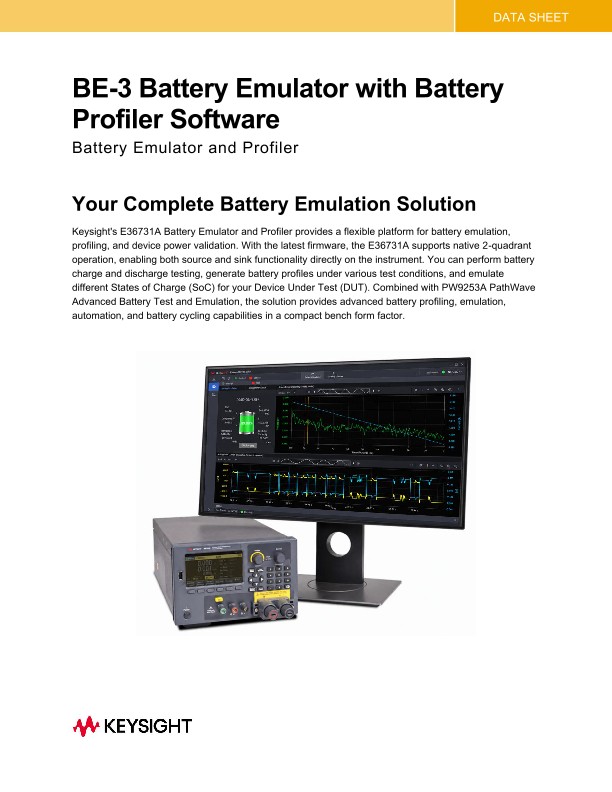
The Keysight E36731A Battery Emulator and Profiler, combined with PW9253A PathWave Advanced Battery Test and Emulation software, supports battery emulation, battery profiling, charge and discharge testing, and battery cycling. This compact bench solution helps engineers examine battery behavior and device power consumption under defined operating conditions. It combines programmable power sourcing, electronic load functionality, measurement, and software control to support device power validation and battery characterization.
The data sheet explains how to create battery models from physical batteries, import existing models, emulate different states of charge, and record test results. It also covers instrument ratings, measurement capabilities, connectivity, and software licensing options.
Native Two Quadrant Source and Sink Operation
With the latest firmware, the E36731A supports native two quadrant operation, providing source and sink functionality directly on the instrument. Engineers can use its power supply and electronic load functions for battery charging, discharging, and bidirectional power testing.
The power supply function provides up to 200 W, with voltage and current ranges of up to 30 V and 20 A. The electronic load function supports up to 250 W, with ranges of up to 60 V and 40 A. These ratings apply within the instrument’s operating power limits. Autoranging supports different voltage and current combinations for bench applications.
Battery Profiling and Custom Model Creation
PW9253A enables engineers to characterize physical batteries and build models for device testing. Profiling can use static current or dynamic loading conditions that reflect a device’s current demand. Supported discharge options also include constant power and constant resistance, giving engineers ways to examine battery behavior under different loads.
A battery model can contain up to 200 points, each describing open circuit voltage, series resistance, and state of charge. During profiling, the software captures voltage, current, time, capacity, and other battery parameters. Temperature monitoring is also available. Engineers can export graphed data while a test is running for further analysis.
Battery Emulation at Different States of Charge
Battery emulation lets engineers apply modeled battery conditions to a device under test without waiting for a physical battery to reach each charge level. PW9253A follows the selected model to emulate battery behavior while continuously measuring voltage and current and saving the results.
The setup uses four key parameters:
Battery capacity rating.
Current limit.
Initial state of charge.
Cutoff condition.
Engineers can change the emulated state of charge to examine device behavior at different battery levels. They can also load multiple battery models created at different temperatures to explore how those modeled conditions affect device operation.
Charge Discharge and Battery Cycle Testing
The battery cycling function supports custom sequences of charging, resting, and discharging under selected test conditions. PW9253A allows up to 1,000 cycle operations in a sequence, providing a workflow for investigating battery aging and changes in capacity over repeated use.
During cycling, the software records capacity, terminal voltage, current, and time. A capacity loss cutoff can stop the sequence when the defined percentage is reached. These functions help engineers examine battery performance over a test sequence and compare recorded behavior across cycles. Configurable stop conditions support test planning around the battery and the purpose of the evaluation.
Importing and Reusing Battery Models
PW9253A supports both models generated through its profiling workflow and external battery models. Engineers can import a CSV file containing state of charge, open circuit voltage, and series resistance data. This provides a way to use existing battery characterization work in subsequent emulation tests.
Reusing models helps engineers apply defined battery conditions across device evaluations. For example, a team can select a model and initial state of charge, observe the device’s response, and repeat the test with another battery profile. Model selection and test settings provide the basis for comparisons, while saved measurements support review and documentation.
Dynamic Loading and Device Power Measurements
The E36731A supports dynamic load profiles for examining a power source’s transient response. Its built-in scope function digitizes voltage and current and displays the results on the instrument. This supports direct observation of changing electrical behavior during load tests.
Additional measurement and control features include:
Simultaneous voltage and current data logging.
Programmable sampling periods for recorded measurements.
LIST mode for sequences of output changes.
Adjustable voltage slew rate.
CSV export for measurement analysis and documentation.
Together, these functions help engineers study device current demand and power behavior during operating transitions. They also provide recorded data for comparing test conditions and investigating unexpected responses.
Bench Operation Automation and Connectivity
The E36731A includes a 4.3-inch color display, front panel controls, and rear output terminals for bench and system wiring. Engineers can configure instrument settings locally or use computer control as part of a test workflow. LAN and USB connectivity are standard, with GPIB available as an option.
PW9253A adds software control, graphical views, measurement export, and API functions for integration into a programming environment. The software supports control of up to four instruments at a time. These capabilities support workflows that combine battery characterization, emulation, and recorded device measurements, with the configuration chosen to match the test requirements.
Supporting Battery and Device Evaluation
The combined hardware and software workflow connects battery characterization with device power testing. Engineers can profile a physical battery, use that model to emulate selected charge conditions, and examine how the device responds. They can then use charging, discharging, or cycling sequences to collect additional information about the battery itself.
The data sheet provides specifications, typical characteristics, ordering information, and licensing options for planning this work. For teams evaluating a battery emulator, battery profiler, programmable DC power supply, or electronic load, it describes how the E36731A and PW9253A bring these functions together. The result is a bench platform for exploring battery characteristics, device operating modes, and power consumption through configured tests and recorded measurements.