











- Overview
- All Models
- Support
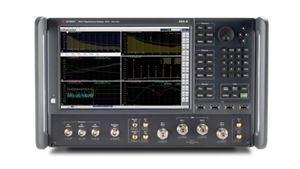
Precise phase noise measurements at the lowest signal levels
Keysight phase noise analyzers come in two classes. The
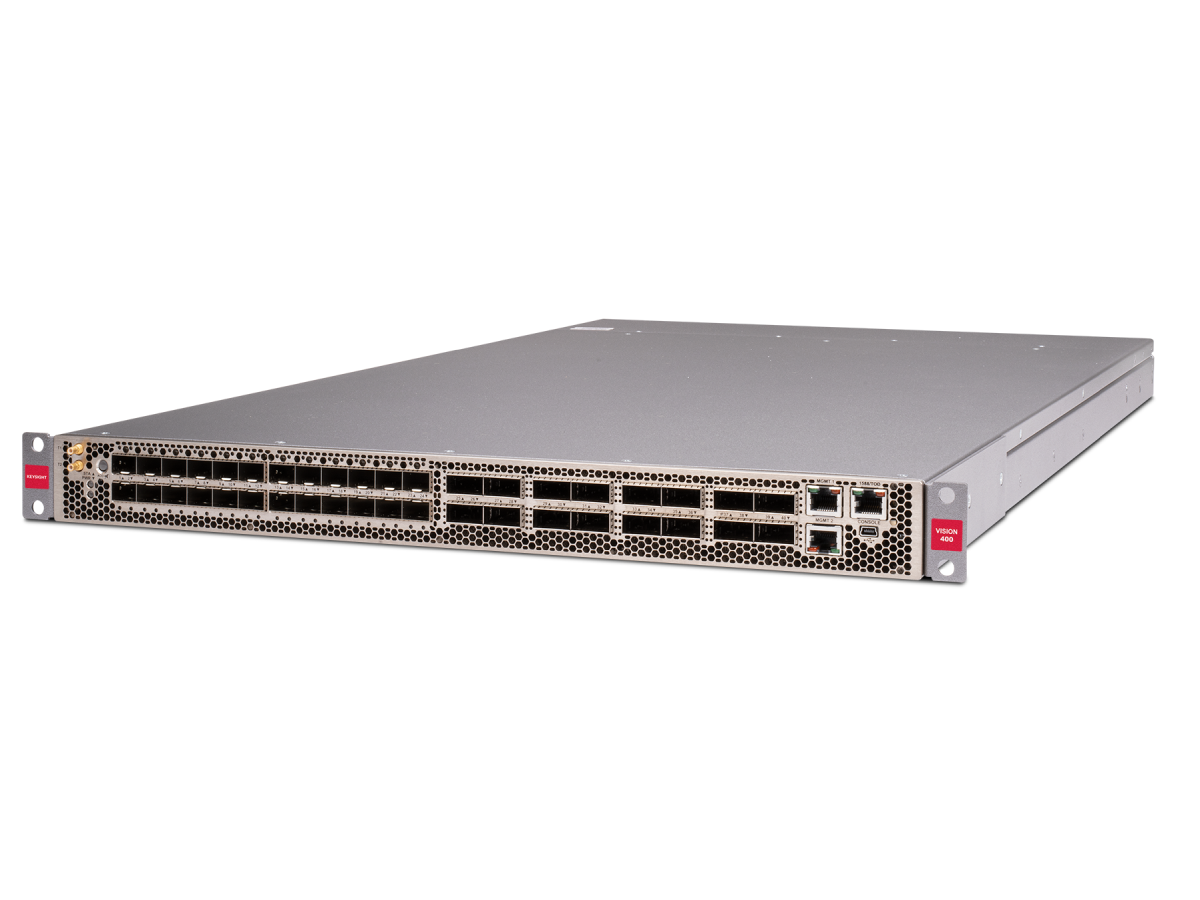
PN3-class includes the E5045A-E5047A signal source analyzers, and the PN7-class
includes the E5055A-E5058A signal source analyzers and the N5511A phase noise
test system. They deliver accurate, high-sensitivity measurements to detect the
lowest levels of phase noise and spurious signals. Enhanced cross-correlation
methodology suppresses internal noise and ensures accurate, repeatable results
— especially when measuring sources with minimal phase noise. Our high-end
models enable ultra-sensitive measurements, with readings down to the kT
thermal noise floor (-177 dBm/Hz), ensuring precise characterization of the
lowest possible signal levels. Choose one of our popular configurations or configure one specific to your application. Need help selecting? Check out the resources below.
High measurement sensitivity
Detects low-level phase noise and spurious signals with high sensitivity, enabling precise characterization of signal sources and reliable performance of DUTs.
Cross-correlation method
Uses dual independent channels to actively suppress internal noise through cross-correlation, enabling precise and reliable measurement of signal sources with minimal phase noise.
Dedicated phase noise analysis
Purpose-built to accurately measure absolute and residual phase noise of both pulsed and non-pulsed signals, enabling comprehensive evaluation of overall system and component-level performance.
AM / baseband performance
Measures amplitude modulation (AM) and baseband noise, both of which can degrade error vector magnitude (EVM) in digitally modulated signals and contribute to overall phase noise performance.
-
Maximum frequency
7 GHz to 54 GHz
-
Maximum offset frequency
8 GHz to 8 GHz
-
Absolute phase noise sensitivity (10 GHz @ 10 kHz offset, Xcorr=1)
-149 dBc/Hz to -153
-
Residual phase noise sensitivity 10 GHz @ 10 kHz offset Xcorr=1
-187 dBc/Hz to -150 dBc/Hz
Most popular models
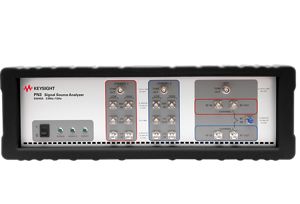
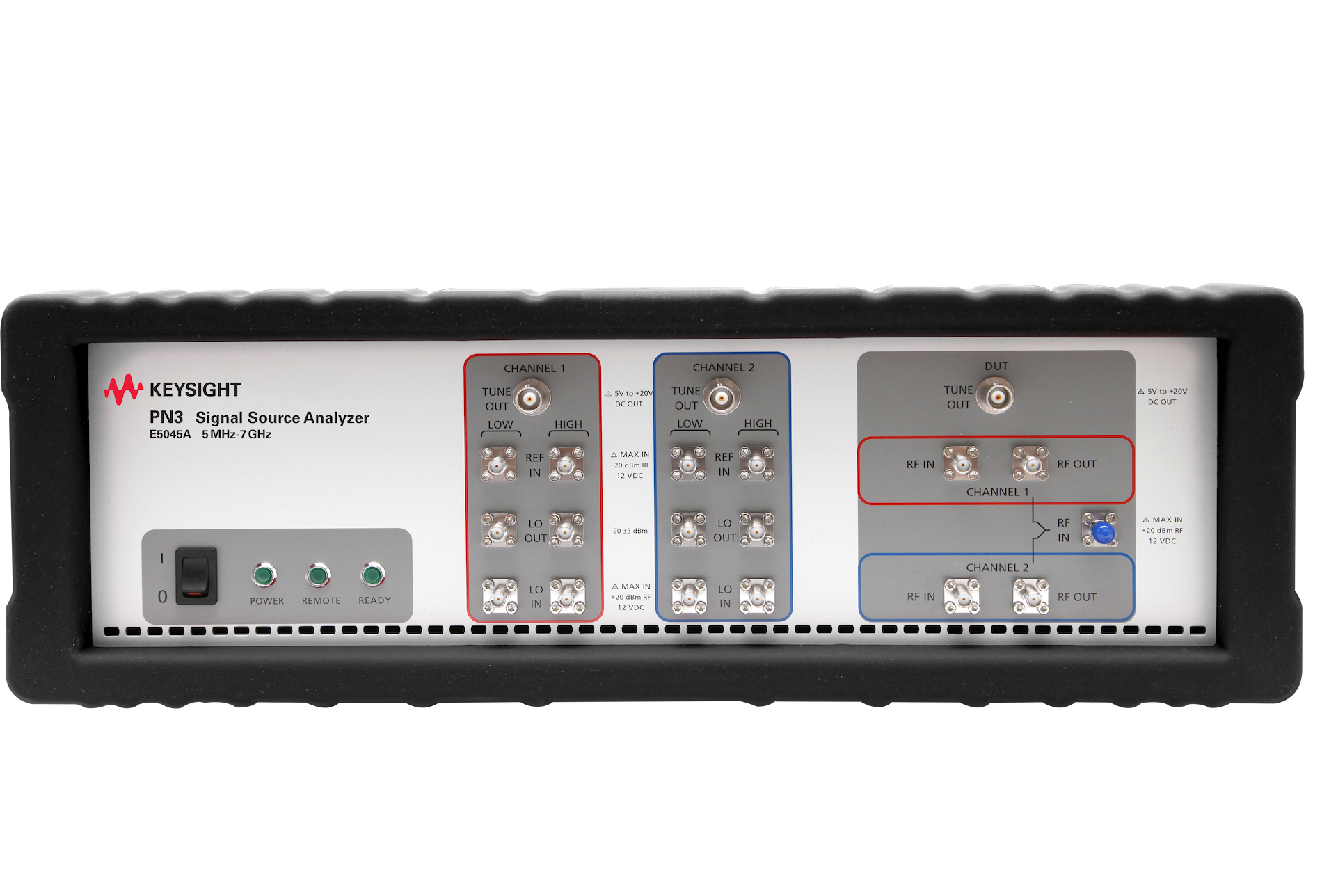
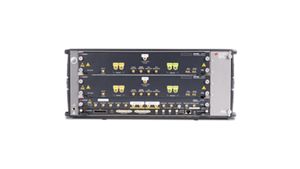
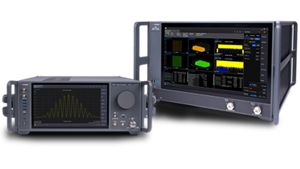
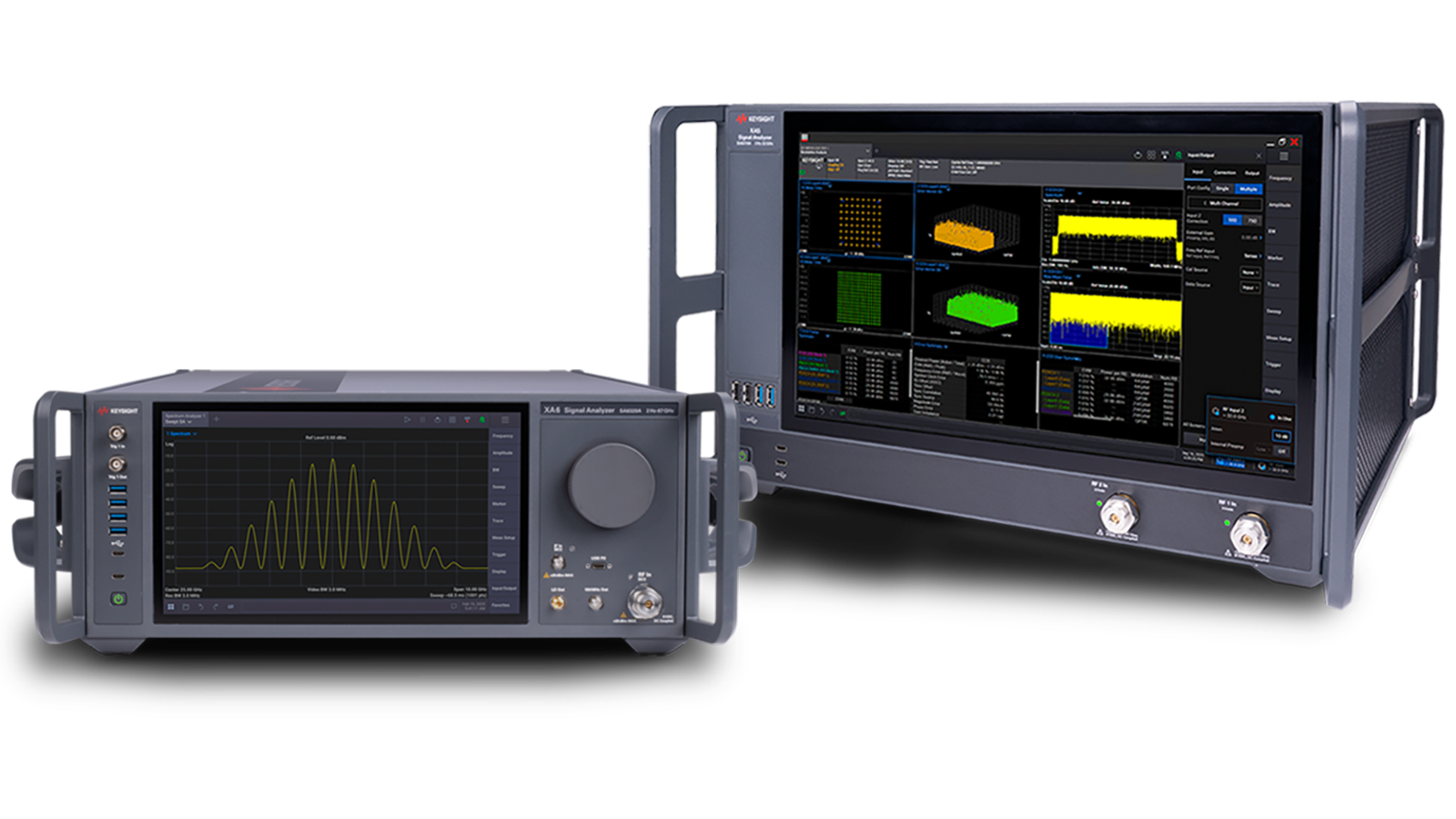
PN3-class Signal Source Analyzer
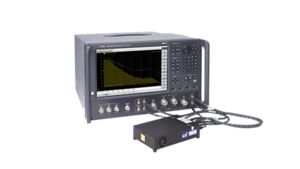

PN7-class Signal Source Analyzer
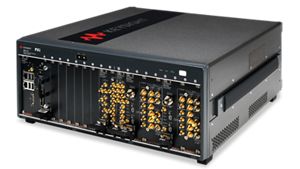

PN7-class Signal Source Analyzer, complete phase noise test system
Services and support
Innovate at speed with curated support plans and prioritized response and turn-around times.
Get predictable, lease-based subscriptions and full lifecycle management solutions—so you reach your business goals faster.
Experience elevated service as a KeysightCare subscriber to get committed technical response and more.
Ensure your test system performs to specification and meets local and global standards.
Make measurements quickly with in-house, instructor-led training, and eLearning.
Download Keysight software or update your software to the newest version.
Frequently asked questions
Direct Spectrum
This measurement method is the classical method of measuring phase noise: directly measuring the frequency spectrum of a continuous wave (CW) signal and its noise sideband power. Traditionally, this method could not separate AM noise from PM noise. Modern phase noise analyzers, signal analyzers, oscilloscopes, and network analyzers digitize and demodulate the signal into magnitude and phase, allowing AM/PM separation to occur up to the instrument's digitizing bandwidth. Multi-channel instruments are capable of cross-correlation.
Analog Phase Detector
This method uses a double-balanced mixer as a phase detector to suppress the carrier and measure the delta phase between the RF and LO ports. Removing the carrier raises the ceiling on ADC full scale or receiver preamp compression level and, therefore, optimizes system sensitivity by amplifying detected phase noise with low NF baseband LNAs.
This can provide a large improvement in initial sensitivity compared to the direct-spectrum method, but is dependent on reference source (LO) phase noise performance. Multi-channel instruments are capable of cross-correlation.
Cross-Correlation
This is not a measurement method but a technique that can use either of the two measurement methods above. The output signal is split and sent to two independent hardware channels, and the cross-spectrum (cross-PSD) is computed and averaged over many acquisitions. The noise that is correlated or common to both channels (from the DUT) will be retained, and the noise that is uncorrelated (produced by the measurement system) will be removed. The theoretical eventual sensitivity for cross-correlating phase noise analyzers is the kT thermal noise floor, at the expense of the time it takes to compute potentially billions of acquisitions.
Initial Measurement System Sensitivity
For non-cross-correlation phase noise analyzers, sensitivity shows the maximum dynamic range (minimum phase noise) that can be measured. For cross-correlation analyzers, this is an initial sensitivity that will improve with correlation gain.
Correlation Gain
Correlation gain improves initial sensitivity by 5 dB across the entire offset range for every 10X increase in correlation number until the kT thermal phase noise floor is reached.
Measurement Time to Initial Sensitivity
Correlation gain scales similarly for all cross correlation phase noise analyzers. Because time and correlation number are proportional to each other, the time that it takes to get to the initial sensitivity (usually 1 correlation at the closest-in offset) will dictate the total measurement time and allow apples-to-apples comparisons between phase noise analyzers.
Frequency Range and Offset Frequency
The frequency range of a phase noise analyzer dictates the center frequency of the DUTs that can be measured. Modern phase noise analyzers can measure from DC (baseband) to mmWave frequencies.
Using phase noise analyzers capable of measuring close-in phase noise (low offsets) is especially important for designing 10 MHz OCXOs, determining the phase noise contribution to EVM from OFDM signals and for designing radar systems.
Using phase noise analyzers capable of measuring far-out phase noise (high offsets) is important for determining the phase noise contribution to EVM for wideband single and multi-carrier applications and for determining the integrated phase noise (jitter) of high-frequency clocks over very wide bandwidths.
Input Power Range
Input power defines the effective dynamic range of the measurement because phase noise is always a noise-to-carrier measurement (relative to carrier power) in dBc/Hz.
Radar
Radar systems require excellent phase noise performance, especially at close-in offsets. Doppler radars measure the echo return signal that is frequency shifted due to moving targets. Phase noise on the radar's LO will end up on the target return signal and the large non-target clutter return signal from stationary objects such as the ground. Such phase noise on the clutter signal can partially or totally mask the target signal, depending on its level and frequency separation from the carrier.
Digital Communications
As communications systems become more complex and bandwidth becomes wider, the influence of phase noise on system performance becomes more apparent. For high-order modulation formats with wide bandwidths, far-offset phase noise is usually the dominant contributor to EVM.
Orthogonal Frequency-Division Multiplexing (OFDM)
In modern communications systems, some implementations of OFDM can space subcarrier frequencies very closely. These carriers can impose their phase noise on adjacent carriers. In this case, close-in phase noise usually has a dominant impact on performance. Carrier tracking can help mitigate this.