

Why Engineers Choose CODE V
Design high-performance optical systems faster with advanced optimization, analysis, and manufacturability tools.
CODE V helps optical engineers move from requirements to manufacturable designs with greater confidence. Explore more design possibilities using intelligent tools such as Global Synthesis and Glass Expert, evaluate image quality and performance tradeoffs, and identify manufacturing sensitivities before costly changes occur.
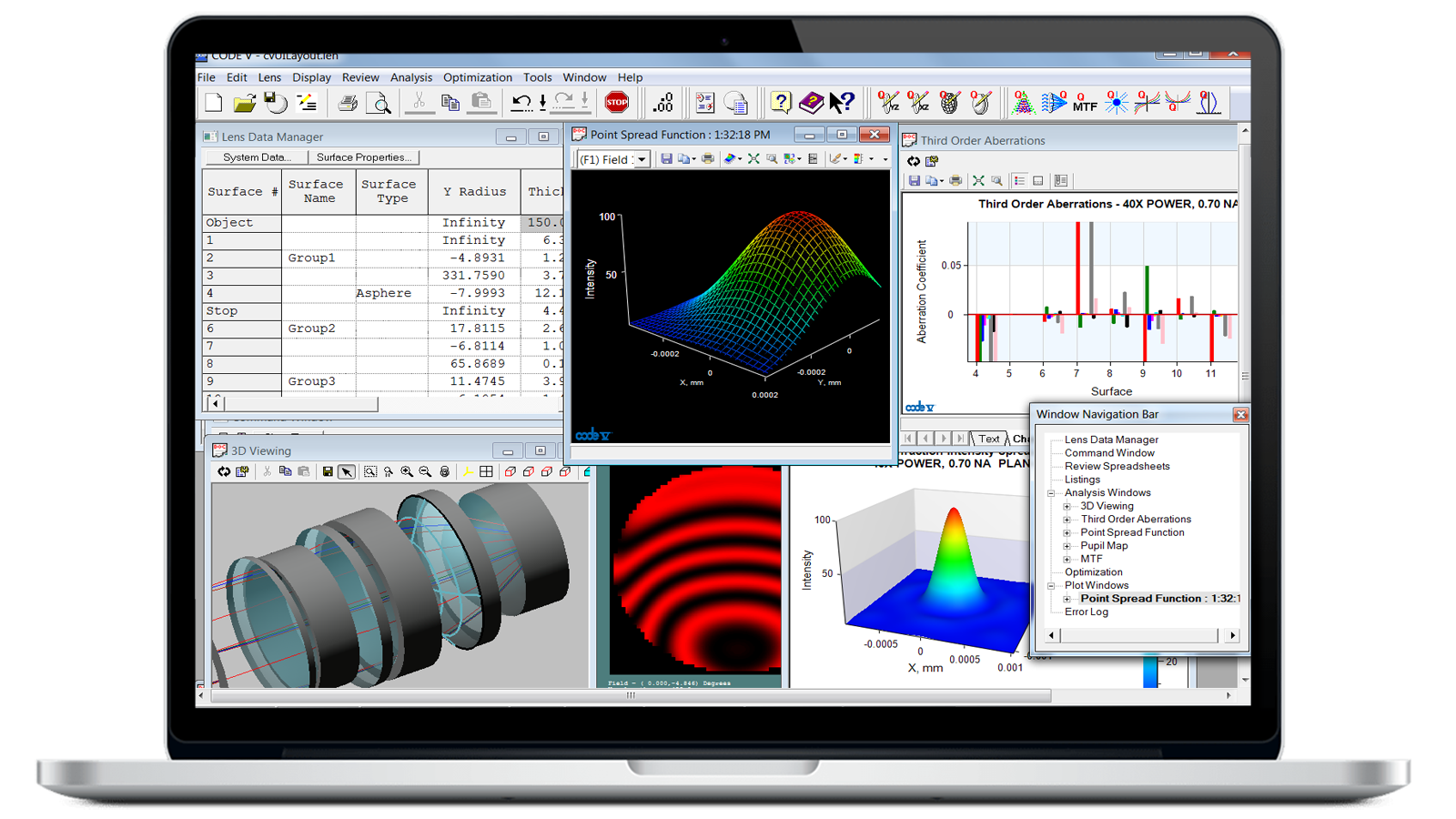
Model, analyze, optimize, and tolerance imaging optical systems within a single environment. From camera lenses and zoom optics to aerospace, defense, medical, and free-space photonic applications, CODE V provides the capabilities needed to develop complex optical designs that meet performance goals and manufacturing requirements.


Key Features

Accelerate lens design with AI-assisted starting points that help identify promising solutions early, reducing manual trial-and-error and speeding the path to optimization.

Explore a broader design space and uncover optical solutions that satisfy performance goals and engineering constraints, helping you reach better designs faster.

Reduce time spent evaluating material options by automatically identifying glass combinations that meet your optical performance requirements.

Analyze diffraction effects quickly and accurately with an efficient propagation method that supports both rapid design exploration and advanced optical analysis.

Optimize aspheric surfaces using Q-type polynomial representations that improve performance while supporting manufacturable, cost-effective designs.

Design robust optical systems by modeling the effects of temperature, pressure, mounting conditions, and material changes on system performance.
MetaOptic Design Module
Design meta optical surfaces with the CODE V MetaOptic Design add-on to significantly enhance the performance and functionality of traditional lenses.
- Enhance optical systems with advanced metalens technology.
- Apply intricate patterns of meta-atoms to surfaces using sophisticated meta-atom modeling.
- Use integrated tools to optimize metalens design and conventional refractive and reflective elements simultaneously.
Metalenses, like other diffractive elements, have the potential to become a powerful new tool in your optical engineering toolbox. With the MetaOptic Design module, you can combine ray tracing with electromagnetic field solvers to simplify imaging systems that include both conventional optics and metalenses.
Resources to Get You Started
CODE V from Keysight is a leading optical design software used by engineers worldwide to develop high-performance imaging systems across industries. With powerful tools for design, analysis, optimization and tolerancing, CODE V helps teams create optical systems that not only meet performance targets but are also efficient and cost-effective to manufacture. Intelligent defaults, expert automation tools and a user-friendly interface streamline the design process and reduce development time.


Blogs
More Resources
Application Notes
Head-Up Display Simulation

White Papers
Environmental Modeling and Athermalization in CODE V
Data Sheets
CODE V Beam Synthesis Propagation
Application Notes
Asphere design in CODE V
Application Notes
Interface with Ray Tracing Tools
Application Notes
Hybrid Simulation with CODE V and BeamPROP Ray Tracing Tools
Flyers
What’s New in CODE V 2026
Have Questions? We've Got Answers
CODE V is optical design software that provides engineers with intuitive, intelligent tools to deliver better solutions faster. With built-in features such as Global Synthesis, Beam Synthesis Propagation, and Glass Expert, along with accurate tolerancing and powerful design optimization, CODE V provides everything optical engineers need to design and simulate optical solutions.
Optical engineers use CODE V optical design software to model, analyze, optimize, and provide fabrication support for aerospace solutions, cameras, information display systems, microlithography, and photonics. More applications of CODE V include:
- Infrared spectrometers
- Segmented Cassegrain (mirror) telescopes
- Beam synthesis propagation of segmented mirror systems
- 3D visualization of a catadioptric system
- Stellar interferometers
- Coronagraphs
- Interferometric telescopes
- Cell phone lenses
- Panoramic video systems
- Fisheye and hyper-hemispherical fisheye lens simulation
- Zoom lenses
- Folded imagers
- Head-mounted displays with eye-tracking
- Lithography lens systems
Capabilities such as AI Start Expert, Global Synthesis and Glass Expert are key tools for reducing cycle time. AI Start Expert brings high-quality design starting points to the optical design engineer quickly and easily. Global Synthesis efficiently searches the design landscape. Glass Expert efficiently selects the optimal glass types for an optical design. These were once manual tasks that demanded time and attention. The optical design engineer is now able to use these tools to reach a much better design more efficiently.
Built-in expert systems such as Global Synthesis and Glass Expert automate complex design tasks that often require significant manual iteration. Engineers can reach viable starting points faster and spend more time refining performance.
Yes. CODE V includes tolerancing and manufacturability tools like Wavefront Differential Tolerancing (TOR) and Accelerated Custom Tolerancing (UserTol) that help engineers understand sensitivity to fabrication and assembly errors. This enables teams to identify potential issues earlier and avoid costly redesigns later in development.
CODE V supports the design and analysis of imaging optical systems, including lenses, cameras, telescopes, microscopes, consumer electronics optics, aerospace and defense systems, medical devices, and other precision imaging applications.
Multi-Environment Coupling (MECo) enables optical design engineers to efficiently optimize optical designs across environmental conditions, solving most issues before a Structural, Thermal, Optical (STOP) analysis is done. It also allows designers to evaluate performance changes resulting from temperature, pressure, mounting conditions, and material property variations. This helps develop robust optical systems that perform reliably across operating conditions.
CODE V is built around advanced computational optics technology. Tools such as desensitization constraints, optimization techniques, tolerancing techniques, and intelligent expert systems that help engineers find and analyze high-performance solutions more efficiently. The software combines design, analysis, tolerancing, and manufacturability workflows within a unified environment.
Yes. CODE V supports advanced asphere design and optimization techniques, including expert systems to help users select the best location for aspheres and the aspheric orders needed. CODE V includes many aspheric and freeform surface types that can improve convergence behavior and support practical manufacturing and tolerancing workflows.