What are you looking for?
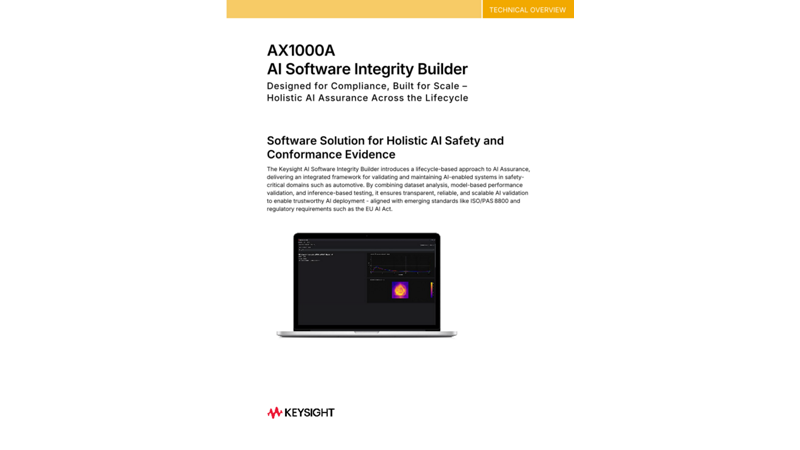
AX1000A Keysight AI Software Integrity Builder
Build justified trust in automotive AI through connected evidence across the lifecycle.
Starting from
Highlights
Building trustworthy AI across the lifecycle – transparent, validated, and compliant
AI systems operate as complex, dynamic entities, yet many of their decisions remain hidden from developers and users. This black box nature and the corresponding lack of transparency create significant challenges for industries, such as automotive, where safety and compliance are critical. An AI will nearly always give an answer, even if it is wrong or delivered with low prediction confidence. Developers struggle to understand the neural processes behind AI decisions, making it difficult to identify limitations in datasets or models. At the same time, regulatory frameworks, such as ISO/PAS 8800 for automotive, demand proven AI explainability and validation without providing clear guidance on how to achieve it.
Fragmented toolchains and siloed workflows further increase effort and risk gaps in regulatory conformance. Without early detection of hidden flaws, AI models risk compromising safety and trust once deployed. With the AI Software Integrity Builder, you can analyze your data model in detail and gain full visibility into the model’s behavior.
Keysight’s AI Software Integrity Builder introduces a novel, lifecycle-driven approach to AI Assurance, answering the essential question: “What happens inside my black box, and how do I ensure a trustworthy AI deployment?” The solution helps to deliver the connected safety evidence required for regulatory conformance, empowering teams to validate, explain, adjust, and continuously improve AI systems.
Unlike fragmented toolchains that address isolated aspects of AI testing, Keysight’s integrated framework spans the entire lifecycle: from dataset analysis and model validation to inference-based testing in real-world environments.
Key benefits:
- Designed for compliance: Supports compliance with emerging standards and regulations based on traceable and connected evidence required by e.g. ISO/PAS 8800 for automotive.
- Built for scale: Enables continuous AI assurance across development and maintenance workflows.
- Holistic lifecycle coverage: Covers not only dataset analysis & model optimization but also inference monitoring and domain adaptation – an all-in-one software solution.
Keysight empowers engineering teams to move from fragmented testing to a unified AI assurance strategy, enabling them to deploy AI systems that are not only performant but also explainable, auditable, and compliant by design.
Beyond Fragmented Testing – A Unified Lifecycle Approach to AI Assurance
While the market offers mostly open-source tools and vendor solutions that focus on isolated aspects of AI testing, most stop at analyzing datasets or models without addressing real-world behavior. Keysight closes this gap with a holistic lifecycle approach that not only validates what the model was trained on, but also how it behaves in deployment scenarios - an essential part of analysis for safety-critical domains such as automotive. This integrated software solution ensures traceability, explainability, and compliance with emerging regulations like the upcoming UNECE WP.29 ADS GTR and international standards such as ISO/PAS 8800.
Core capabilities include:
- Dataset analysis: Analyzes data quality using statistical methods to uncover biases, gaps, and inconsistencies that may affect model performance.
- Model-based validation: Delivers Explainable AI (XAI) by design, explaining model decisions and uncovering hidden correlations that enable developers to understand the patterns and limitations of an AI system.
- Inference-based testing: Goes beyond static validation by analyzing how the model performs in real-world environments, detecting deviations from training behavior, and recommending improvements for the next iteration.
Extend the Capabilities of Your AX1000A
Featured Resources




Frequently Asked Questions About AI Software Integrity Builder
Most AI validation toolchains focus on isolated tasks, such as dataset checks, model metrics, or functional tests. But they fail to capture how AI behaves across the entire lifecycle. This leaves critical gaps in transparency, robustness, and regulatory readiness, especially in safety-critical domains like ADAS and autonomous driving.
The AI Software Integrity Builder solves this by integrating data integrity analysis, model-based validation, system-in-context evaluation, and continuous inference monitoring into a single, unified workflow. This lifecycle-driven approach ensures alignment with the operational design domain (ODD), reveals global model behavior and competence boundaries, and aims for safety assurance even after deployment.
In summary, the solution turns fragmented validation activities into an end-to-end AI assurance pipeline that makes AI systems explainable, auditable, and trustworthy by design.
Most tools on the market address only parts of AI validation, such as dataset curation, explainability, robustness testing, or simulation, but they fall short of delivering a connected AI assurance workflow.
The AI Software Integrity Builder differs in three ways:
- Lifecycle Integration: It mirrors all five lifecycle stages (from data analysis to real-world inferencing) avoiding gaps that typically arise when separate tools are stitched together.
- Explainability by Design: Instead of isolated, single prediction explanations, the platform provides behavior insights that reveal class-level tendencies, spurious correlations, and competence boundaries.
- Continuous AI Assurance: Validation doesn’t end at deployment. The platform includes inference-based monitoring, drift detection, and governed update paths to keep AI performance aligned with the ODD over time.
This makes it not just a testing tool, but a full AI assurance framework built for transparency, safety, and regulatory robustness.
The platform is designed to complement, not replace, existing development environments. It supports flexible data ingestion, integrates with common machine learning (ML) frameworks, and connects to simulation, labeling, and MLOps tools already used in your workflows.
By aligning its analyses with the five lifecycle stages, it slots naturally into established processes, from data preparation and training pipelines to system‑level testing and post‑deployment monitoring.
Teams can adopt the platform step‑by‑step without disrupting current toolchains, while benefiting from a unified pipeline across all stages of development.
Further Reading
Want help or have questions?