What are you looking for?
Keysight at APS Global Physics Summit 2026
Visit us at Booth #2210
Floor Map
American Physical Society
March 16th - 19th,2026
Colorado Convention Center
700 14th St, Denver, CO 80202
Join us at APS 2026
- Discover how an integrated EDA workflow will accelerate Quantum chip development
- See how to precisely characterize single photon detector performance by measuring jitter and efficiency in an integrated, automated workflow.
- Learn how In-Situ cryogenic calibration and component characterization using a VNA approach enhances dynamic range after attenuation and works with multiple calibration techniques, including databased standards
- See the control and readout of superconducting qubits with the Keysight QCS combining dedicated quantum control hardware and full-stack software capabilities to provide a scalable and high-fidelity solution.
Booth Demonstrations at APS 2026


Demo 1: Single Photon Detection
See how to precisely characterize single photon detector performance by measuring jitter and efficiency in an integrated, automated workflow.


Demo 2: Cryogenic Device characterization
Learn how In-Situ cryogenic calibration and component characterization using a VNA approach enhances dynamic range after attenuation and works with multiple calibration techniques, including databased standards

Demo 3: Quantum EDA Workflows
Discover how an integrated EDA workflow will accelerate Quantum chip development.

Demo 4: Quantum Control System (QCS)
See the control and readout of superconducting qubits with the Keysight QCS combining dedicated quantum control hardware and full-stack software capabilities to provide a scalable and high-fidelity solution.
Keysight Technical Papers at APS Schedule


Modeling 3D Qubits in Keysight's Advance Design System
Join Matthew Ozalas, Keysight, Charles Baylis & Robert J. Marks, Baylor In this presentation, we demonstrate how ADS provides a package-aware design environment that enables quantum designers to perform realistic chip-in-package modeling, accelerating the development of scalable and reliable quantum processors.
- Thursday, March 19
- 6:06 pm
- Convention Center, Mile High Ballroom 4C
Hamiltonian-Based Modeling of Superconducting Circuits Using Keysight's Quantum Simulation Tools
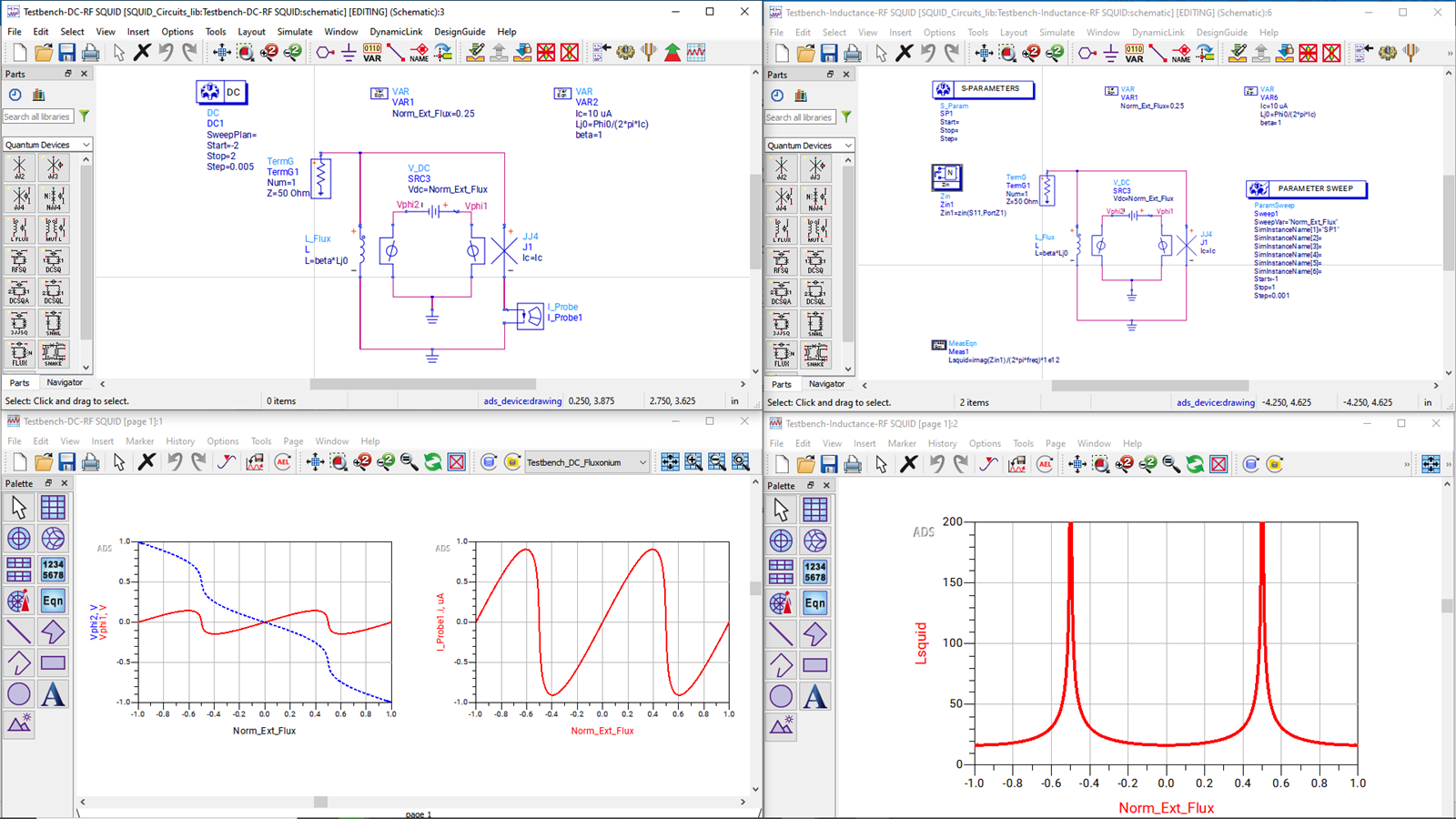
Current superconducting qubit design flows rely on iterative and computationally intensive electromagnetic (EM) simulations to tune circuit parameters. In this talk, we introduce Hamiltonian Analysis, a tool within Keysight Quantum Circuit Simulation, which extracts circuit parameters directly from schematics and computes the Hamiltonian, energy spectra, potential landscapes, and wavefunctions. This approach enables rapid validation of circuit parameters prior to EM simulation, significantly reducing the number of simulations required. Hamiltonian Analysis supports a wide range of superconducting qubit types, including transmons, tunable transmons, fluxoniums, flux qubits, 0–π qubits, and cos(2φ) qubits.
- Thursday, March 19
- 6:18 pm
- Convention Center, Mile High Ballroom 4C

Quantum e-Learning
If you do not plan to attend APS 2026 in Denver, register for these two webinars. Then check out the Newsroom to see how Keysight is innovating to help bring Quantum Systems to market.

Navigating the Design Challenges of Superconducting Quantum Systems
This webinar explores how Quantum EDA techniques, tailored to the unique requirements of quantum circuits, can facilitate the design process by providing tools for simulation, verification, and optimization. By navigating these challenges effectively, Quantum EDA offers a pathway towards realizing robust and scalable superconducting quantum systems, accelerating progress in quantum computing and quantum information processing.
Scalable, High-Fidelity Qubit Control and Readout with the Quantum Control System (QCS)
In this webinar, we will explore how the Keysight Quantum Control System (QCS) enables superconducting qubit experiments by combining dedicated quantum control hardware and full-stack software. We will look in some detail at the individual hardware modules, which enable cutting-edge signal generation and detection, and consider how the QCS API leverages the FPGAs on these modules, enabling real-time performance and features, while also providing an intuitive interface.