
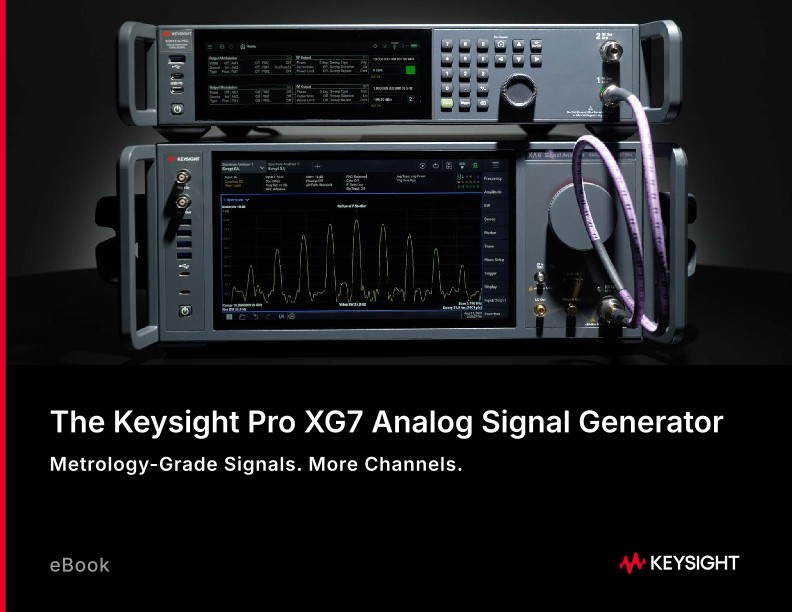
The Keysight Pro XG7 Analog Signal Generator
eBooks
As RF systems become more complex and measurement margins tighten, the quality of the signal source can directly affect an engineer’s ability to understand device-under-test (DUT) behavior. Phase noise, AM noise, broadband noise, spurious signals, and harmonics introduced by the source can obscure low-level responses, reduce measurement margin, and make it difficult to determine whether observed behavior originates in the DUT or the test stimulus. At the same time, growing multi-path and multi-channel test requirements can increase instrument count, rack space, cabling, control endpoints, and overall test-system complexity.
Discover how the Keysight Pro XG7 Analog Signal Generator combines metrology-grade signal purity, clean calibrated power, and up to two independent RF channels in a compact 2U platform to reveal true device performance and expand test capacity.
At the center of the SG6311A story is spectral purity. The signal generator is engineered to minimize source contribution across several critical noise characteristics, helping engineers preserve visibility into the behavior they are trying to characterize. The eBook examines phase noise, AM noise, broadband noise, harmonics, and non-harmonic spurious performance and explains why each matters in demanding RF measurements. Key performance examples include -135 dBc/Hz typical phase noise at 10 GHz and 10 kHz offset, -150 dBc/Hz typical AM noise at the same frequency and offset, and a -166 dBc/Hz typical broadband noise floor at 10 GHz and 30 MHz offset.
Rather than presenting these values only as specifications, the eBook connects signal purity to the measurement outcomes engineers care about. Lower source phase noise can improve visibility into low-level behavior near the carrier. Low AM noise provides a cleaner reference for demanding amplifier and metrology measurements. A low broadband noise floor can increase measurement margin farther from the carrier, while low spurious and harmonic content helps engineers distinguish DUT-generated responses from unwanted signals originating in the source.
The eBook also introduces the hybrid YIG / DDS RF architecture behind the SG6311A. It explains how complementary synthesis approaches and software-controlled mode switching help optimize signal-generation performance for different measurement requirements. The discussion extends beyond synthesis to show how the overall RF signal chain is designed to preserve signal quality from generation through the RF output.
In addition to signal purity, the SG6311A provides clean, calibrated output power up to +22 dBm across a 9 kHz to 20 GHz frequency range. This combination supports high-SNR measurements and helps deliver the required signal level through lossy test setups.
For applications that require multiple RF paths, the SG6311A is available with one or two fully independent RF channels in a compact 2U chassis. This high-density design helps engineers expand signal-generation capacity while reducing the need for additional instruments, rack space, cabling, and control endpoints.
The eBook connects these capabilities to applications including residual and cross-correlated phase-noise measurements, amplifier characterization, high-speed ADC and DAC testing, SERDES and optical communications, receiver sensitivity, LO substitution, radar and electronic warfare, satellite, direction finding, 5G and 6G RF testing below 20 GHz, and calibration and metrology workflows.
Readers will also learn how the SG6311A supports integration into established test environments through SCPI compatibility, familiar rear-panel connections, and default settings aligned with previous-generation PSG workflows. These capabilities can help teams reuse existing automation, simplify technology refreshes, and accelerate deployment while gaining the signal purity, channel density, and RF performance of the Pro XG7 platform.
Through product capabilities, technical proof points, application examples, and architecture insights, *Keysight Pro XG7 Analog Signal Generator* eBook shows how a cleaner signal source can help engineers reduce source-limited uncertainty, preserve DUT visibility, scale test capacity, and approach demanding RF measurements with greater confidence.