
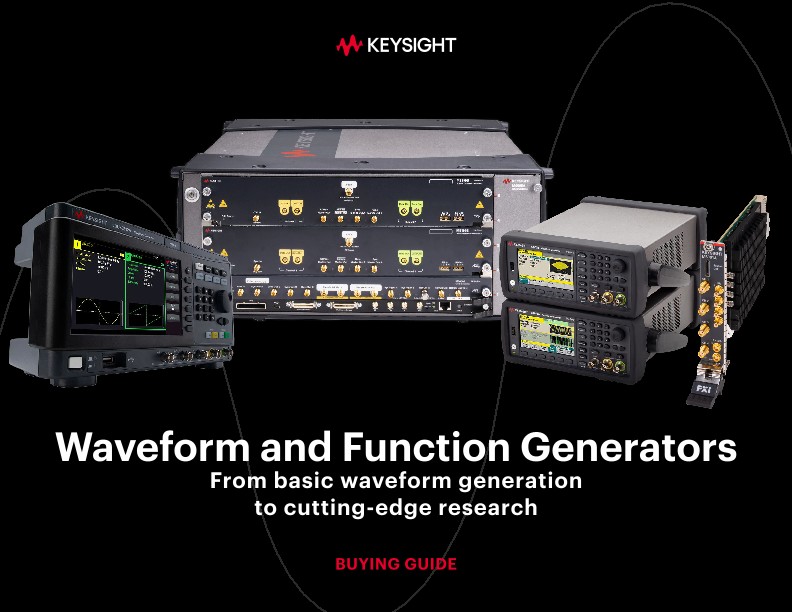
Waveform and Function Generators Buying Guide
Buying Guides
Selecting the right waveform or function generator depends on the signal fidelity, bandwidth, sample rate, and waveform complexity your application demands. Keysight offers three performance grades—Essential, Advanced, and Expert—each balancing bandwidth, sampling capability, arbitrary waveform performance, and connectivity. This guide compares these grades to help you determine which model aligns with your signal‑generation and timing‑validation needs.
Keysight’s waveform and function generators lineup is structured into three main performance grades with varying core features:
- Essential waveform and function generators come in one class. The WG1‑class Essential generators include the EDU33210 Series. These models deliver fundamental signal types, built‑in modulation, and intuitive usability in a compact entry‑level instrument. With a 20 MHz bandwidth, 250 MSa/s sampling, and a large color display, Essential generators are ideal for teaching labs and basic signal creation, offering 17 built‑in waveforms, multiple modulation types, and USB/LAN connectivity.
- Advanced waveform and function generators come in one class. The WG2‑class Advanced generators include the 33500 Series. These instruments extend capability with low jitter, flexible pulse generation, waveform summing, noise simulations, and bandwidth up to 100 MHz. Offering sample rates from 160 MSa/s to 320 MSa/s, Advanced generators provide the precision and flexibility required to simulate real‑world communication conditions and complex RF environments.
- Expert waveform and function generators come in one class. The WG3‑class Expert generators include the 33600 Series. These high‑performance instruments deliver up to 120 MHz bandwidth, 1 GSa/s sampling, deep memory, and jitter below 1 ps. They enable high‑speed, synchronized outputs, precise timing, and complex arbitrary waveform sequences for demanding applications in automotive systems, aerospace/defense, and digital communications.
Typical use cases further illustrate how each waveform generator grade supports different engineering needs:
- Essential waveform generators support foundational education and general‑purpose signal creation. Their built‑in waveform library, modulation types, bright display, and simple UI make them ideal for classroom learning, troubleshooting circuits, simulating communication signals, and generating standard patterns such as sine, square, ramp, and noise.
- Advanced waveform generators address more complex signal‑generation requirements such as multitone signals, radar pulses, frequency‑hopping patterns, and realistic noise environments. Their low jitter, low THD, and advanced pulse controls enable reliable device characterization in RF systems, wireless R&D, and aerospace applications. Adjustable noise bandwidth and waveform summing make them effective for stress tests, component verification, and digital modulation simulations.
- Expert waveform generators support mission‑critical testing with deep memory, high sample rates, and enhanced triggering capabilities. These models reproduce fast, precise waveforms required for automotive ECUs, high‑speed digital interfaces, IoT device validation, and synchronized multi‑instrument test setups. Their advanced sequencing, gated and burst modes, and real‑time variation features are ideal for timing‑sensitive systems and sophisticated waveform replication.
Portable options such as Keysight pulse generators provide sharp‑edge, picosecond‑accurate pulses for clock‑signal emulation, serial‑interface validation, and pattern generation, supporting high‑speed digital and mixed‑signal test scenarios.
Modular arbitrary waveform generators offer up to 80 GHz bandwidth and sampling rates up to 256 GSa/s in PXIe or AXIe chassis, enabling scalable, multichannel synchronization for manufacturing test, high‑density systems, optical communications, and leading‑edge research.
Before finalizing a waveform or function generator purchase, it’s important to consider key selection factors:
- Bandwidth: This determines the highest frequency content a generator can accurately reproduce. Choose Essential for signals up to 20 MHz, Advanced for up to 30 MHz or higher‑complexity signals, and Expert for demanding designs requiring up to 120 MHz. Modular generators extend bandwidth up to 80 GHz, and pulse generators support precision edges up to 3.35 GHz.
- Output channels: This determines whether you can generate independent or synchronized signals. Essential supports basic differential or modulated outputs, while Advanced and Expert offer enhanced timing stability for multi‑instrument synchronization. Modular systems scale to multiple synchronized channels across a chassis.
- Arbitrary waveform capability: This defines whether you can generate simple shapes or replicate complex real‑world signals and protocols. Essential supports built‑in and basic arbitrary waveforms, Advanced adds waveform summing and noise shaping, and Expert enables long sequences, deep memory, and real‑time variation. Pulse generators specialize in sharp‑edged, timing‑accurate waveforms, while modular AWGs deliver high‑resolution, ultrawide‑bandwidth signals.
- Sampling rate: This determines how accurately the instrument can reconstruct fast‑changing or complex signals. Essential and Advanced models support up to 250 MSa/s or 320 MSa/s, while Expert models reach up to 1 GSa/s. Modular AWGs extend sampling to 256 GSa/s for advanced research and high‑speed test.
- Interface and security: This determines how the instrument integrates into your environment. Essential, Advanced, and Expert models include USB and LAN, with GPIB available on Advanced/Expert for legacy systems. Modular AWGs support LAN, USB, PCIe, and AXIe/PXIe control, with optional NISPOM security for classified or protected environments.
- Memory depth: This determines how long or detailed your waveforms can be. Essential supports short burst signals, Advanced enables waveform sets and simulations, and Expert supports deep memory for long patterns and conditional sequencing. Modular AWGs provide fast memory access and deterministic timing for the most demanding applications.
Software expands the capability of waveform and function generators with tools for automated testing, waveform creation, sequencing, and integration with measurement workflows. Paired accessories such as probes, cables, adapters, and calibration tools help ensure accurate signal delivery and reliable performance across benchtop and automated test environments.
Keysight Support Services can reduce your learning curve, enhance your uptime, ensure the accuracy of your testing equipment, and provide the expertise you require, precisely when and where you need it. Maximize your instrument uptime, quickly optimize your test measurements, and get the answers you need at our fastest available times. KeysightCare curated support plans bundle critical services with prioritized response and turnaround times. High-performance instruments include one year of KeysightCare Assured.