
RSoft Photonic Device Tools
Flyers
The RSoft Photonic Device Tools portfolio from Keysight provides a comprehensive suite of simulation, design, optimization, and inverse design technologies for passive and active photonic devices. The solution supports engineers and researchers developing integrated photonics, optical communications components, semiconductor lasers, diffractive optics, metasurfaces, photonic crystals, optical fibers, and Photonic Integrated Circuits (PICs). By combining physics-based simulation with automated optimization, the platform enables rapid virtual prototyping, helping organizations reduce reliance on costly physical prototypes while accelerating innovation and shortening development cycles.
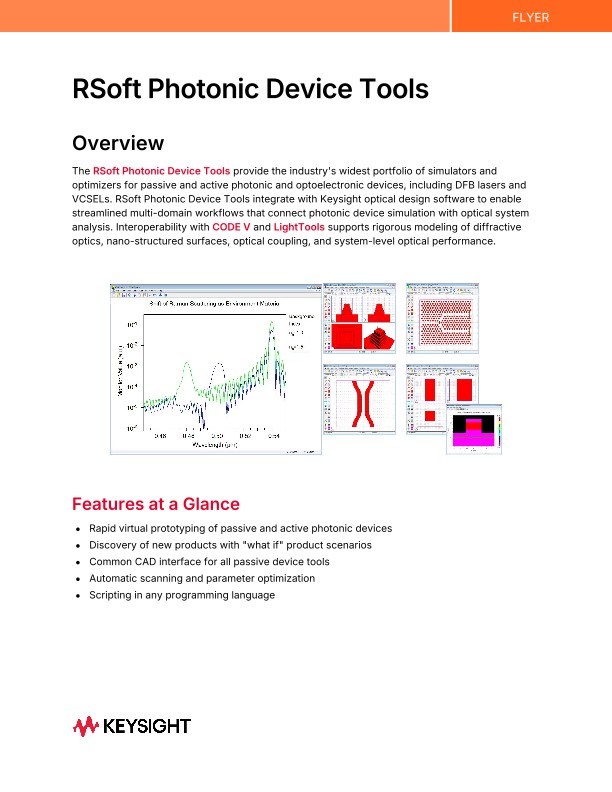
The portfolio integrates with Keysight optical design solutions, including CODE V and LightTools, allowing engineers to connect photonic device simulation with optical system analysis through streamlined multi-domain workflows. This interoperability supports rigorous modeling of diffractive optics, nano-structured surfaces, optical coupling, scattering behavior, and overall system-level optical performance. A common CAD environment provides a unified interface across multiple simulation engines, enabling users to move efficiently between tools without importing or rebuilding designs. Automated parameter scanning, optimization capabilities, and support for scripting in any programming language further improve productivity and design flexibility.
The RSoft Passive Device Tools address a broad range of photonic design challenges. FullWAVE FDTD provides rigorous Finite-Difference Time-Domain simulation for studying light propagation in complex photonic structures. BeamPROP BPM uses the Beam Propagation Method to analyze integrated and fiber-optic waveguide devices and circuits. DiffractMOD RCWA supports the design and simulation of diffractive optical elements, subwavelength structures, gratings, and photonic bandgap devices. BandSOLVE PWE automates the modeling and calculation of photonic crystal band structures, while FemSIM FEM calculates transverse and cavity modes using finite element analysis. GratingMOD CMT enables the design and synthesis of complex grating structures in fibers and waveguide circuits, and ModePROP EME provides a rigorous Maxwell-equation-based solution for modeling forward, backward, and radiating optical modes. MetaOptic Designer extends the platform to inverse design workflows for metalenses and metasurfaces, allowing engineers to create advanced photonic structures optimized for performance.
For active device development, the platform includes LaserMOD, which simulates the optical, electronic, and thermal characteristics of semiconductor lasers and related devices, and the Tapered Laser Utility, which provides specialized analysis and optimization for tapered semiconductor laser diodes. These capabilities support the design of advanced laser technologies used in sensing, communications, imaging, and photonic systems.
Additional utilities expand the platform's applicability across modern photonics workflows. The Photonic Device Compiler helps engineers create foundry-specific building blocks and augment photonic design kits (PDKs). MOST automates multi-variable optimization and parameter scanning across RSoft simulators to explore complex design spaces. The Topology Optimizer introduces inverse design capabilities using performance-driven optimization and fabrication-aware design rule checking. Other utilities include tools for LED simulation, solar cell analysis, multi-physics modeling, BSDF generation for system-level optical simulations, custom PDK generation for PIC workflows, and automated Arrayed Waveguide Grating (AWG) design for wavelength division multiplexing applications. These technologies support a wide spectrum of applications spanning integrated photonics, optical communications, laser design, advanced imaging systems, semiconductor manufacturing, sensing, and photonic integrated circuit development.
Engineers can license individual simulation engines based on project requirements, enabling flexible deployment while maintaining access to a broad ecosystem of photonic design technologies. By combining industry-leading simulation methods, automated optimization, inverse design capabilities, foundry-ready workflows, and integration with system-level optical design tools, the RSoft Photonic Device Tools portfolio provides a comprehensive platform for accelerating photonics innovation from component design through system validation.