

Why Choose Keysight Requirement Verification Suite (KRVS)
As design complexity grows, so does your data and your job—but it doesn’t have to delay your product launch. It is being driven by increased design requirements, miniaturization, standards, and regulations. Product complexity is growing exponentially and there is no end in sight. Over the next five years, industry experts anticipate a tipping point will occur where traditional processes won’t be able to keep up.
Keysight’s Requirements Verification Suite (KRVS) is the automated way to reduce the time and resources used during design verification across simulation and test. On its own or integrated with your in-house tools, KRVS helps you drive process transformation by weaving together simulation predictions, prototype measurements, analytics, and people.
Key Capabilities

Manage requirements across the complete verification lifecycle.

Track verification status with automated pass/fail reporting.

Connect simulation predictions with physical measurement results.

Automate verification across teams, sites, and projects.

Visualize results and accelerate engineering insights.

Connect third-party tools through flexible REST APIs.
- Requirements Management
- Test Automation
- Advanced Analytics
- Third-party Integration
Requirements and Results Management
Reduce compliance assessment to requirements by up to 50%
R&R serves as a centralized cockpit for managing requirements throughout the entire verification lifecycle—from initial design through to testing. It captures and organizes requirements, drives verification plans used in both simulation and physical testing, and automates compliance tracking. The system highlights unverified items, records pass/fail outcomes, and stores detailed results data for future analysis and traceability.
Test Automation
Accelerate design and test verification through automation and collaboration, at scale.
The Test Automation suite enables test automation teams to span organizations and geographies. Scale from a few developers to teams that traverse the globe and integrate large numbers of instruments and DUTs.
The suite is tailor-made for global research and development, design, and validation, Leveraging the OpenTAP open-source test sequencer and Keysight KS8400B PathWave Test Automation Developers System, the suite enables interoperation with a broad portfolio of simulation tools and test instruments from Keysight.
Advanced Analytics
Focus on design and testing, not time-consuming data analysis.
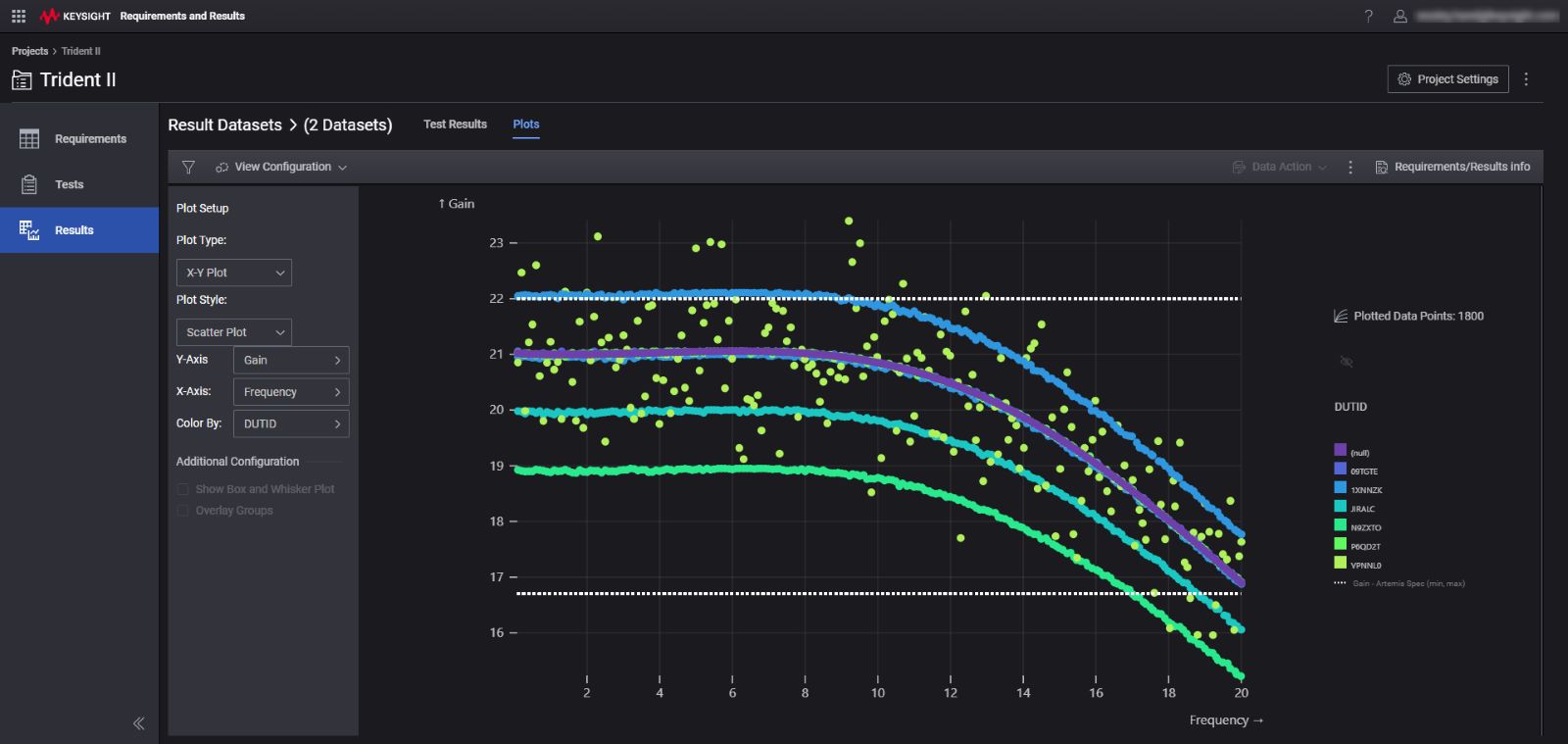
See how simple analysis can be with interactive charts designed to accelerate insights and reduce time to market for your engineering projects. Explore the test and measurement data visualization and powerful analytics features that will improve the workflow across your globally dispersed teams.

Third-party Integration
Optimize the design verification process with flexible integration for every workflow.
Every team has its own unique design and verification process. That’s why KRVS offers a powerful REST API—giving you the freedom to automate data input, import, and analysis using the third-party tools you already know and trust.
Whether you're capturing measurements or running advanced analytics, KRVS works seamlessly with your preferred tools—so you can focus on results, not restrictions.
Resources to Get You Started
As design complexity grows, so does your data and your job—but it doesn’t have to delay your product launch. Any design team using electronic design automation to accelerate product development must consider how best to use digital twin simulation and hardware verification in their process. Is your team plagued with manual workflows and isolated homegrown tools which are not scalable and difficult to maintain? Learn how Keysight’s Requirements Verification Suite can help reduce the time and resources used during design verification across simulation and test.


eBooks
Keysight Requirements Verification Suite

Solution Briefs
Keysight Requirements Verification Suite
Flyers
Keysight Requirements Verification Suite
Case Studies
Accelerate Requirements Compliance Verification
- W9801BKRVS 5-license Starter PackA comprehensive requirements management system. Includes the KRVS server plus 5 floating user licenses of Requirements & Results application.
- W9401EKRVS ServerKRVS Server provides web-based services to administer the collaborative suite of applications. Includes a shared server license for user administration, data storage, automation scheduling and analytics services.
- W9411EKRVS Requirements and ResultsKRVS Requirements & Results Management is a web-based application designed to accelerate confirmation of compliance to the design requirements. Includes a floating license for a single concurrent user.
- KS8500BTest Automation CloudA suite of test automation tools that let you create, collaborate, deploy and monitor at scale.
Have Questions? We've Got Answers
The Keysight Requirements Verification Suite is a software platform that streamlines requirements compliance and design verification across simulation and physical testing. It connects requirements, verification plans, test results, analytics, and reporting into a unified workflow, helping engineering teams reduce verification effort, improve traceability, and accelerate product development.
The suite automates key verification activities, including requirements management, compliance tracking, test execution, data collection, and result analysis. By eliminating manual processes and providing automated pass/fail assessment against requirements, organizations can significantly reduce the time and resources needed to validate designs and prepare compliance documentation.
Yes. The platform is designed to integrate with existing engineering environments through a flexible REST API and support for third-party tools. Teams can automate data input, import simulation and measurement results, and incorporate analytics while continuing to use many of the tools and processes already established within their organization.
The suite provides a centralized environment for managing requirements, verification plans, test activities, and results. Combined with its test automation capabilities, it enables engineering, validation, and test teams across multiple locations to collaborate efficiently, share data, maintain traceability, and ensure consistent verification processes throughout the development lifecycle.
Key benefits include improved requirements traceability, automated compliance assessment, faster design verification, reduced manual effort, centralized reporting, enhanced collaboration, and data-driven decision-making through advanced analytics. These capabilities help organizations manage increasing product complexity while reducing risk and accelerating time to market.