How to Characterize Ceramic Capacitor DC Bias Derating

Understand Bias-dependent Capacitance Loss
Ceramic capacitors, especially multilayer ceramic capacitors, exhibit strong capacitance dependence on applied DC bias voltage due to the nonlinear behavior of their dielectric materials. As voltage increases, the effective permittivity of the dielectric decreases, resulting in significant capacitance reduction compared to nominal values specified at zero bias. This DC bias derating effect can lead to insufficient capacitance in critical applications such as power delivery networks, decoupling circuits, and RF filtering, ultimately causing voltage instability, increased noise, and degraded signal integrity. Understanding and quantifying this behavior is essential for accurate circuit design and reliable system performance.
Engineers perform capacitance versus voltage characterization to evaluate how ceramic capacitors behave under real operating conditions. By sweeping DC bias voltage while measuring capacitance and dissipation factor, they can quantify voltage coefficients, identify nonlinear dielectric effects, and assess performance across the intended operating range. This enables informed component selection, proper derating strategies, and accurate modeling of capacitor behavior in simulation and design workflows. Such measurements are critical for ensuring sufficient capacitance margins and preventing performance degradation in semiconductor, RF, and power electronic applications.

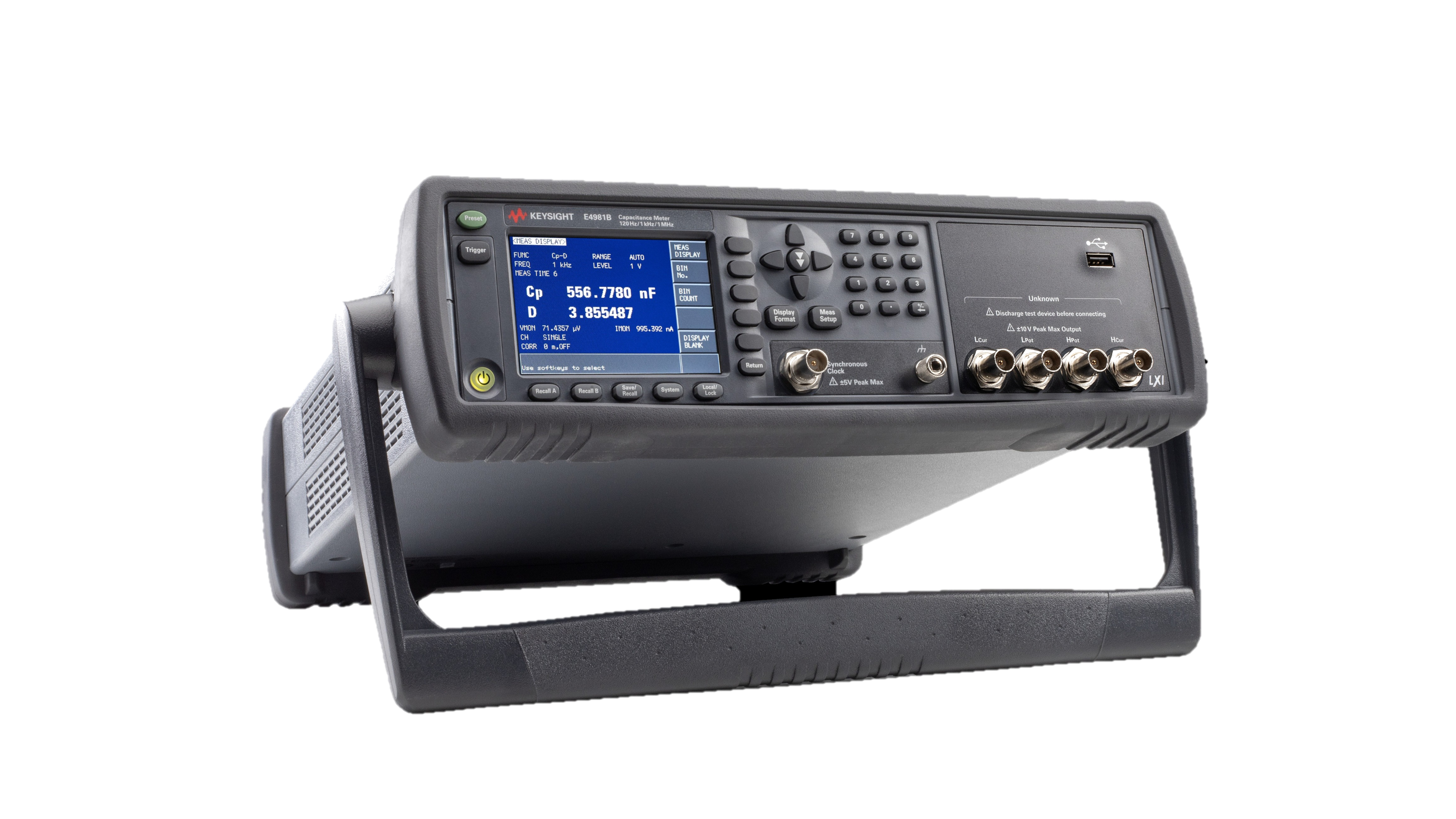
DC Bias Derating Measurement Solution
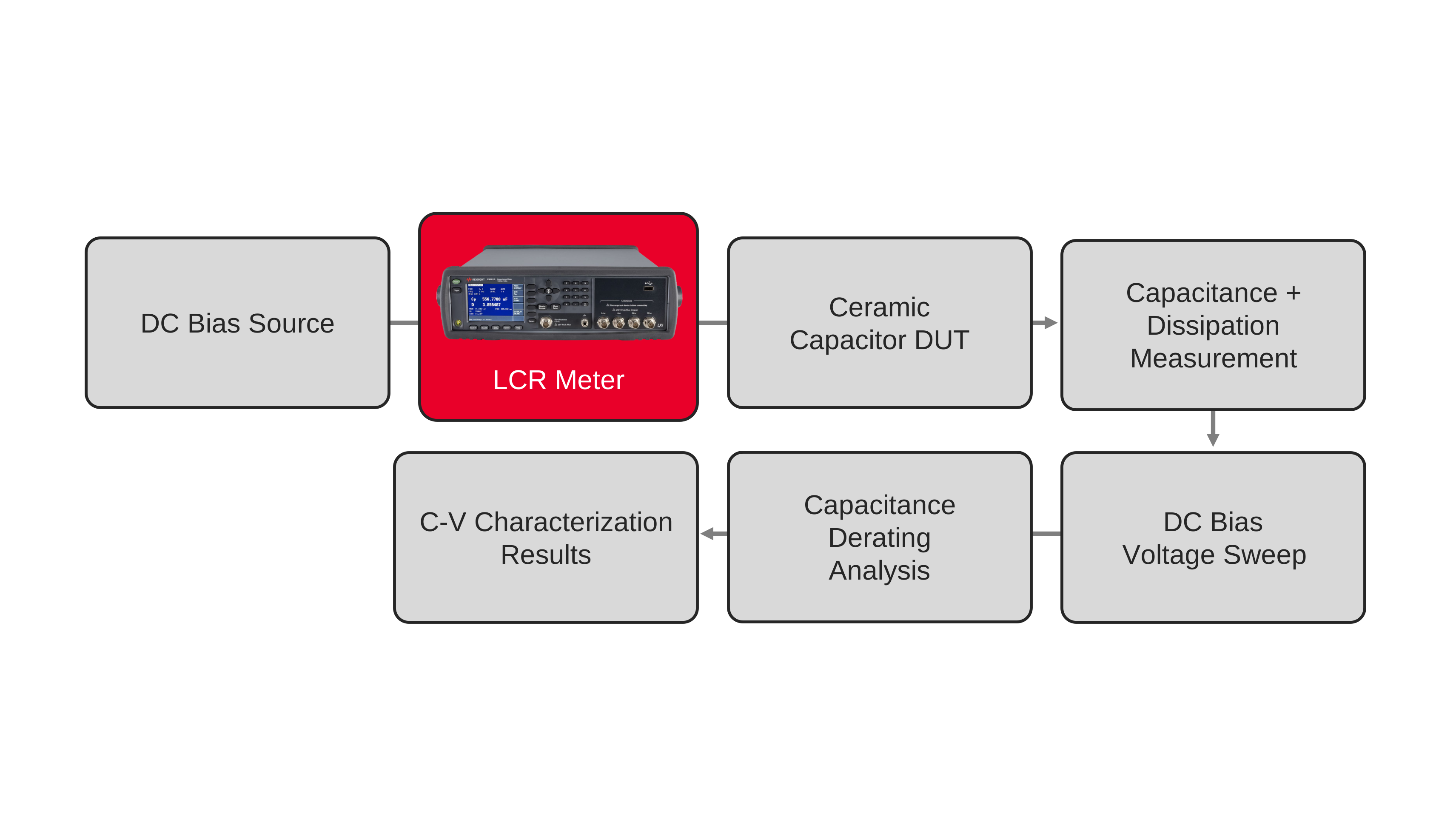
See Block Diagram of DC Bias Derating Measurement Solution

Explore Products for Our DC Bias Derating Measurement Solution
-

![]()
E4981B Capacitance Meter, 120 Hz / 1 kHz / 1 MHz


Discover Resources and Insights
Additional Resources for DC Bias Derating Measurement
Related Use Cases

-
![]()
Learn More
How to Verify Capacitive Sensor Element Consistency
Verify capacitive sensor element consistency using precision capacitance measurements to ensure uniform performance across devices.
Learn More

-
![]()
Learn More
How to Measure Parasitic Capacitance in Test Fixtures
Measure parasitic capacitance in fixtures and interconnects using precision LCR measurements to improve accuracy and reduce test errors with a capacitance meter.
Learn More
-
![]()
Learn More
How to Measure Capacitor Equivalent Series Resistance and Loss
Measure capacitor ESR and dissipation factor across frequency using a precision capacitance meter to validate component quality and loss behavior with a capacitance meter.
Learn More

Get in Touch with One of Our Experts
Need help finding the right solution for you?