How to Conduct Electromagnetic Interference (EMI) Testing
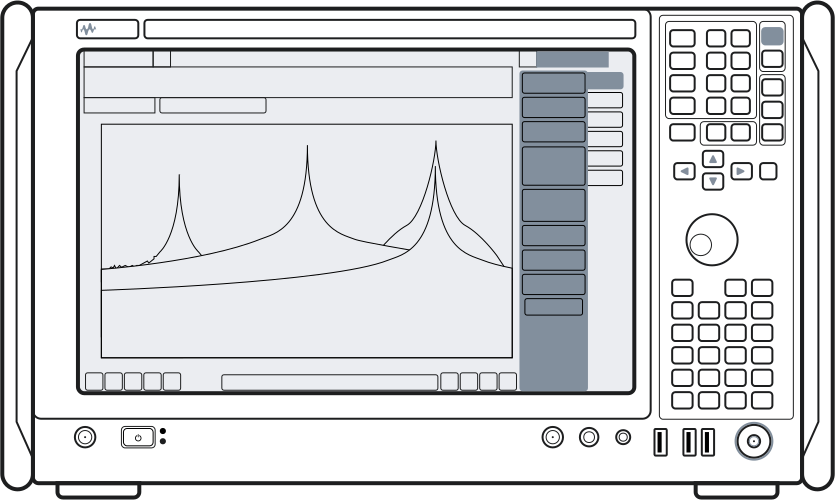
Performing real-time EMI testing using the time-domain scan method
Testing electromagnetic interference (EMI) compliance of electronic devices requires measurements of radiated emission (RE) and conducted emission (CE) generated by the equipment-under-test (EUT) under normal operation. Engineers must perform measurements to detect and analyze intermittent disturbance signals over long dwell times at each frequency, as specified by EMI testing standards. Use time-domain scan (TDS) and real-time scan (RTS), with highly overlapped fast Fourier transform (FFT) analysis bandwidth up to 350 MHz, to capture and measure gapless impulse signals accurately.
To detect EMI interference signals on the EUT, use an EMI receiver with wideband digital IF hardware and wideband time-domain scan to increase data capture bandwidth up to 350 MHz in a single segment. Sweep incoming signals continuously by setting the hold number and maximum hold incumbent signals to display all events and details of all detected signals. Use EMI measurement software to view the peak values and waterfall traces.
_Testing.png)
_Testing.png)
EMI pre-compliance and compliance test solution
See demo of EMI pre-compliance and compliance test
Explore products in our EMI pre-compliance and compliance test solution
-

![]()
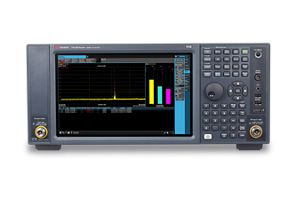
N9048B PXE EMI Test Receiver, 1 Hz to 44 GHz
-

![]()
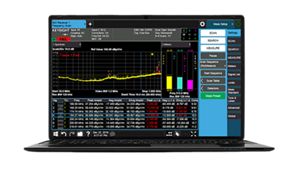
N6141EM0E EMI Measurement Application, Multi-Touch UI


Discover resources and insights
Additional resources for EMI pre-compliance and compliance testing
Related use cases


-
![]()
Learn More
How to Generate 5G New Radio Receiver Test Signals
Generate coded 5G new radio (NR) test signals for receiver bit error rate (BER), block error rate (BLER), packet error rate (PER), and frame error rate (FER) validation using PathWave Signal Generation (PWSG) software.
Learn more

-
![]()
Learn More
How to Validate Modulated Load Pull
Validate modulated load pull by measuring amplifier EVM, ACPR, NPR, and nonlinear behavior under wideband RF stimulus.
Learn more
-
![]()
Learn More
How to Validate Ultra Low Noise Voltage
Validate ultra-low noise voltage for oscillators using precision sources.
Learn more
Electromagnetic Interference (EMI) Testing FAQs
Electromagnetic Interference (EMI) is the disturbance that electronic devices endure due to electromagnetic radiation from other sources, or that are generated from your product. This interference is significant because it can lead to malfunctions, data corruption, or even total system failures. For engineers and manufacturers, understanding what is EMI is crucial to ensure device reliability across diverse environments.
Common EMI sources include household and industrial equipment.
Everyday items like microwaves, fluorescent lights, and smartphones can emit EMI, while industrial machinery, radio transmitters, and electric motors are also frequent contributors. These sources produce a variety of frequencies that may overlap with those used by sensitive electronics, causing interference.
The effects of EMI on devices can be substantial, leading to degraded performance, unintended resets, or incorrect readings in sensitive equipment such as medical devices, telecommunications systems, and automotive electronics. For instance, in medical imaging devices, EMI could impair image quality, risking misdiagnosis. Therefore, implementing effective EMI electromagnetic interference testing and mitigation strategies is crucial to preserve the integrity and performance of electronic systems.
Measuring EMI interference starts with understanding the type of emissions, the correct test environment, and the right equipment. The goal is to capture accurate, repeatable data that aligns with industry compliance standards.
- Test Standards and Regulations – For EMI testing, follow the compliance standards that apply to your product and market. Common examples include:
- CISPR – International EMC requirements for emission and immunity testing.
- FCC – U.S. regulations for electromagnetic emissions.
- MIL-STD-461 – Military EMI/EMC requirements for defense and aerospace equipment.
- ISO EMC Standards – Global standards for electromagnetic compatibility testing across industries.
Follow each standard’s specific test methods, frequency ranges, and detector requirements to ensure accurate and compliant results.
- Emission Type – Determine whether you are measuring radiated emissions (RE) or conducted emissions (CE) to select the right test setup.
- Test Environment – Use an anechoic or semi-anechoic chamber for RE, or a controlled conducted setup with Line Impedance Stabilization Networks (LISNs) for CE.
- Measurement Equipment – Choose an EMI receiver or signal analyzer with sufficient bandwidth, sensitivity, and dynamic range to capture all relevant signals.
- Signal Capture Method – Apply time-domain scan (TDS) or real-time scan (RTSC) to detect transient or intermittent signals that traditional sweeps might miss.
- Calibration and Verification – Regularly calibrate antennas, LISNs, and receivers to ensure measurement accuracy and traceability.
- Data Analysis – Use EMI measurement software to visualize results, apply limit lines, and generate compliance reports for faster troubleshooting.
- Pre-Compliance vs. Full Compliance – Decide whether to start with pre-compliance testing to identify issues early and reduce the risk of failures at accredited test labs.
Effective EMI pre-compliance testing requires careful attention to both setup and measurement practices. Engineers often face these challenges:
- Replicating the compliance environment – Using a setup that doesn’t match the target standard (e.g., incorrect chamber type, missing Line Impedance Stabilization Network for conducted emissions) can produce misleading results. Always match the test configuration to the requirements of standards like CISPR, FCC, or MIL-STD-461.
- Grounding and cable management – Long, unshielded, or poorly routed cables can act as unintended antennas. Maintain consistent grounding, use proper cable shielding, and follow standard-specific cable layouts.
- Calibration and verification – Skipping calibration of EMI receivers, antennas, and LISNs can make data unreliable. Verify equipment calibration before every test session.
- Frequency coverage gaps – Overlooking certain bands can cause a pass in pre-compliance but a fail in the official lab. Always scan the full frequency range required by your applicable standard.
- Ambient noise control – Background RF noise can mask emissions or create false positives. Measure and document ambient noise before starting tests, and apply noise subtraction if supported by your test equipment.
- Testing in only one operating mode – Some emissions occur only in specific configurations (e.g., high CPU load, wireless active). Test multiple operating states to uncover intermittent issues.
Tip: Document every setup detail, from cable routing to equipment settings, so you can replicate or adjust the configuration easily if re-testing is needed.
As the next generation of 5G mobile networks, autonomous driving vehicles, and the Internet of Things(IoT) takes shape, engineers are racing to design more wireless devices to meet accelerating market demand.
Simultaneously, the density and complexity of the electromagnetic environment are increasing as a result of the tremendous number of devices that connect wirelessly to the network. These dynamics pose a challenge for electromagnetic compatibility (EMC) testing due to the fact that wireless devices require certification to regulatory compliance standards that are also growing in number. It is important to identify and isolate EMC issues quickly during EMC compliance testing to help you bring devices to market faster and more efficiently.
Time-domain scan (TDS) is a spectrum measurement technique based on fast Fourier transform (FFT), which converts signals from the time domain into the frequency domain. Compared with traditional step-scan or sweep-scan methods, TDS significantly reduces measurement time without compromising accuracy.
The TDS method was formally adopted and approved in CISPR 16-1-1 (2010) as a standard-compliant measurement approach. During FFT processing, a window function (or filter) is applied to limit the frequency spectrum of the signals. CISPR 16-1-1 specifies the required bandwidths and the exact filter shapes to be used. EMI receivers must comply with the defined filter shape tolerance masks in order to meet the standard.
Keysight PXE and MXE EMI receivers both provide CISPR-compliant TDS measurement capabilities, enabling users to save substantial test time in their EMI compliance or pre-compliance workflows.
Real time scan (RTSC) is a unique feature in the Keysight PXE EMI receiver whereby it enable gapless signal capture and analysis with very wide FFT bandwidth up to 350MHz or 1GHz (options dependent). It enables simultaneous measurements and display of freq domain, time domain and spectrogram results, with up to 3 simultaneous EMC detectors measurements (up to six simultaneous detectors with the 1 GHz FFT).
You can perform gapless measurements and analysis of intermittent disturbance signals emanating from the EUT in a much faster way compared to traditional step/sweep method and without missing any. With this capability, the test lab is able to improve throughput of their EMC test to test more products and certify them in a shorter amount of time, and you are able to verify any intermittent or broadband emissions from your device before sending to the test lab for compliance testing.
1GHz real time scan bandwidth enable you to perform CISPR band C/D measurement in a single acquisition and without gaps, and obtain 6 detector measurements simultaneously. You will be able to capture all emissions from the EUT (Equipment Under Test), including transient, narrowband, and broadband signals, provides full visibility into the noise behavior of the device, helping engineers identify and resolve issues before formal EMC testing—increasing confidence in test success.
Many disturbance signals are fast and intermittent. Conventional step or sweep scan methods often miss these.
With a 1 GHz real-time, gapless capture, you can reliably detect all disturbance signals—whether transient, narrowband, or broadband—without the risk of missing critical emissions.
Without real-time scan, you would need to set long dwell times to increase the chance of capturing intermittent signals. This significantly extends test duration, particularly when repeated measurements are required across turntable positions and antenna heights.
The real-time scan function eliminates this inefficiency by enabling wideband FFT-based, gapless measurement. It allows complete characterization of the EUT’s noise performance while reducing overall test cycle time and increasing confidence of passing formal EMC tests.

Get in touch with one of our experts
Need help finding the right solution for you?