
What's New in CODE V Version 2025.03
Flyers
The CODE V 2024.03 release introduces powerful new features that further streamline the design of imaging optics. With the new Multi-Environment Coupling capability, engineers can model and optimize athermalized lens systems across varying environmental conditions, accounting for temperature- and pressure-dependent changes in materials and mountings. A new visualization tool for athermalization in the V3D view helps users better understand the interaction between lens elements and housings—without needing detailed mechanical computer-aided design (CAD) data. This version also includes support for designing meta optical surfaces, allowing engineers to model diffractive properties of flat, thin optical components using a new add-on tool.
Performance and usability improvements are also included in this release. The 2D Image Simulation feature now runs significantly faster on multi-core machines, making it easier to simulate real-world imaging performance. Users can also take advantage of an expanded Example Model Library, which adds 11 new examples to support learning and experimentation with features like Global Synthesis, Beam Synthesis Propagation and SpecBuilder.
Multi-Environment Coupling enhancements
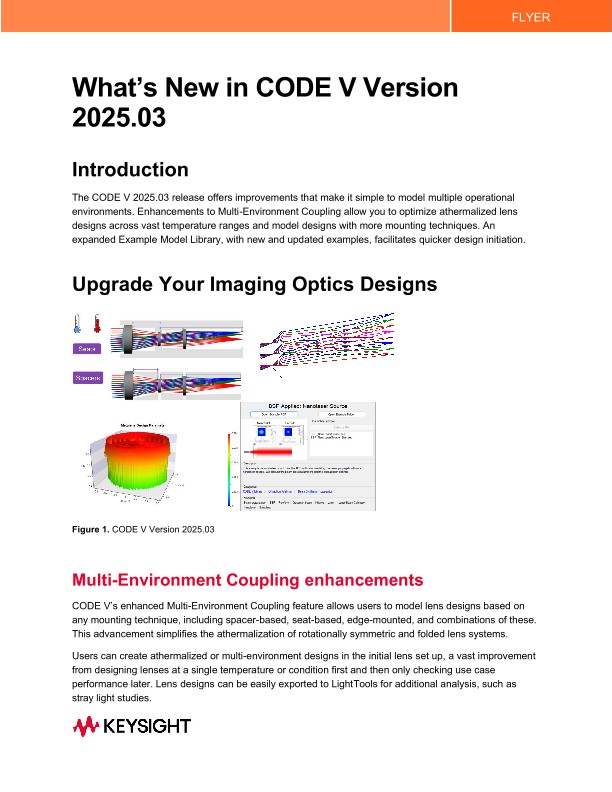
CODE V’s enhanced Multi-Environment Coupling feature allows users to model lens designs based on any mounting technique, including spacer-based, seat-based, edge-mounted, and combinations of these. This advancement simplifies the athermalization of rotationally symmetric and folded lens systems.
Users can create athermalized or multi-environment designs in the initial lens set up, a vast improvement from designing lenses at a single temperature or condition first and then only checking use case performance later. Lens designs can be easily exported to Light Tools for additional analysis, such as stray light studies.
Hidden Lens Module expiration date
CODE V Hidden Lens Modules (HLMs) contain encrypted lens design data, enabling users to exchange optical analysis data without revealing the underlying design. CODE V now allows HLMs to include an expiration date, ensuring they become non-functional after this date. This feature is useful for controlling access to optical analysis data within a specified period, such as outlined in a non-disclosure agreement.
CODE V Meta Optic design
The latest CODE V release has enhanced Meta Optic design capabilities, enabling users to:
- Export designs to Hidden Lens Modules.
- Plot metalens transmission versus large-scale diffracted orders.
- Observe and understand the effects of design parameters on diffracted power phase and transmission.
- Visualize variations in meta-atoms across an optical surface.
Download the PDF for more information