Added to favorites
Removed from favorites
The Ins and Outs of Satellite Communications
Getting a refresh on the fundamental aspects impacting satellite communications (SATCOM) is more critical than ever, as new market opportunities fuel the commercialization of space. Much of this activity focuses on the low Earth orbit (LEO) because of decreasing launch costs and the increased functionality of smaller, lighter satellites. These satellites support various use cases, including fifth-generation (5G) and eventually sixth-generation (6G) cellular non-terrestrial networks (NTN). Examples include communications coverage over vast distances and enhanced situational awareness on the ground for military and critical communications.
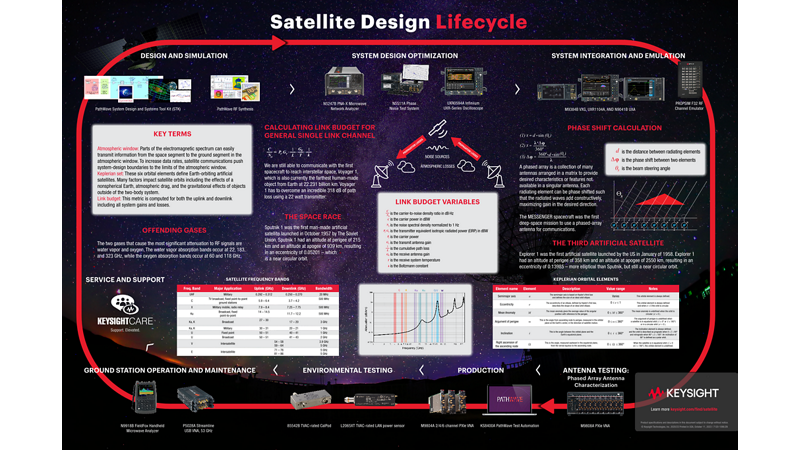
Rapid development creates unique challenges when designing and building these complex systems, including the orbits involved, link budgets, antennas, modulation standards, and the need to thoroughly test these systems. By understanding the various factors and their impact on design, satellite developers can optimize performance throughout the satellite development life cycle, regardless of orbit and application. To ensure optimized performance throughout the satellite life cycle, manufacturers and network operators must account for unique variables such as Doppler shift, ionosphere distortion, and atmospheric losses. They also need to ensure that satellite systems can navigate the crowded electromagnetic spectrum — a landscape that will only grow more congested as commercialization continues. Testing for situational awareness will be a significant part of effectively managing space traffic as new systems go into orbit. By modernizing your strategies to account for these and other challenges, you can play a pioneering role in the next phase of the space gold rush.