
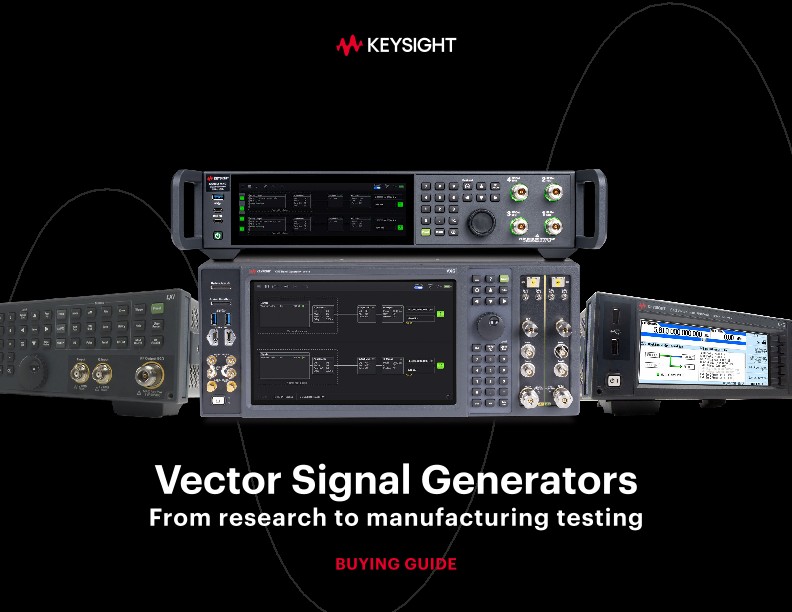
Vector Signal Generators Buying Guide
Buying Guides
Selecting the right vector signal generator depends on signal purity, modulation bandwidth, frequency range, output power, and switching speed. Keysight offers three performance grades—Essential, Expert, and Pro—each designed to support increasing levels of RF complexity from general‑purpose testing to advanced wideband, multichannel signal creation. This buying guide compares these grades to help you select the generator that aligns with your wireless, aerospace, or high‑performance R&D requirements.
Keysight’s vector signal generator lineup is structured into three main performance grades with varying core features:
- Essential vector signal generators come in two classes. The XG1‑class includes the CXG, and the XG2‑class includes the EXG. Essential models support bandwidths up to 160 MHz and test frequencies up to 40 GHz. With additive white Gaussian noise (AWGN), multitone generation, and preconfigured waveforms, they are optimized for entry‑level RF testing, IoT receivers, Bluetooth® systems, antenna measurements, and radar or electronics evaluation.
- Expert vector signal generators come in two classes. The XG4‑class includes the AP5041A–AP5042A, and the XG5‑class includes the N5186A MXG. Expert models extend modulation bandwidth up to 1 GHz with ultra‑low phase noise, fast switching speeds down to 2 μs, and up to four coherent channels. The XG5‑class adds an embedded reflectometer for match‑corrected signals. These instruments support FR1 5G, radar, oscillator characterization, carrier aggregation, coexistence, and DPD (digital predistortion) workflows.
- Pro vector signal generators come in one class. The XG7‑class Pro generators include the VXG. Pro models deliver up to 54 GHz of frequency coverage (extendable to 110 GHz), 2.5 GHz modulation bandwidth, real‑time multi‑signal creation, and channel bonding for up to 5 GHz aggregated bandwidth. They emulate up to 32 signals per unit with real‑time fading for advanced wireless, radar, EMSO, and 6G research environments requiring the highest signal purity and widest bandwidth.
Typical use cases further illustrate how each signal generator grade supports different engineering needs:
- Essential generators support general‑purpose RF testing such as IoT RF receiver evaluation, Bluetooth® testing, antenna range measurements, and entry‑level radar/RF hardware validation. Their AWGN and multitone capabilities simulate real‑world noise and distortion across bandwidths up to 160 MHz.
- Expert generators support sophisticated wideband signal creation, enabling FR1 5G waveform generation, radar scenario reproduction, complex coexistence/blocking evaluations, beamforming and MIMO testing, and DPD model verification. Their DDS architectures improve spectral purity, reduce LO feedthrough, and support rapid frequency hopping.
- Pro generators support the most demanding high‑frequency and ultra‑wideband applications. They generate signals up to 54 GHz (110 GHz with extenders) with 2.5 GHz bandwidth or 5 GHz aggregated bandwidth. Ideal use cases include 5G FR2, wideband radar pulse synthesis, GNSS CRPA receiver testing, digital wideband transceivers, and exploratory 6G neural receivers.
Modular and agile signal generators extend these capabilities into high‑density, automated, and multi‑threat simulation environments using PXIe or AWG‑based extensions, supporting rapid switching, high channel counts, and compact test‑system integration.
Before finalizing a vector signal generator purchase, it’s important to consider key selection factors:
- Maximum frequency: This determines the highest RF signal you can generate. Choose Essential (≤ 6 GHz) for entry‑level wireless, Advanced (≤ 40 GHz) for wideband RF and microwave, Expert (≤ 8.5 GHz) for high‑purity sub‑6 GHz, or Pro (≤ 54 GHz, extendable to 110 GHz) for cutting‑edge mmWave testing.
- Bandwidth: This defines how wide a modulated signal you can generate. Essential supports ≤ 120 MHz, Advanced ≤ 400 MHz, Expert ≤ 1 GHz, and Pro ≤ 2.5 GHz (or 5 GHz with channel bonding) for high‑bandwidth, next‑generation wireless standards.
- Number of channels: This determines multiport or phase‑coherent testing capability. Essential supports 1 channel, while Advanced, Expert, and Pro support up to 4 coherent outputs for MIMO, beamforming, and multi‑carrier testing.
- Phase noise: This impacts signal purity and modulation accuracy. Essential supports –119 dBc/Hz, Advanced improves to –146 dBc/Hz, Expert delivers –147 dBc/Hz, and Pro achieves the lowest levels at –148 dBc/Hz. Choose higher performance for mixers, oscillators, and high‑order modulation.
- Output power: This determines whether your generator can overcome test‑path losses. Essential provides +18 dBm, Advanced up to +24 dBm, Expert +27 dBm, and Pro +20 dBm for high‑frequency applications requiring strong RF drive.
Software extends the capability of analog signal generators with tools for automated testing, waveform creation, swept‑frequency control, and system‑level integration. Accessories such as attenuators, adapters, cables, and power sensors support accurate signal delivery and help ensure repeatable measurements across benchtop and automated test environments.
Keysight Support Services can reduce your learning curve, enhance your uptime, ensure the accuracy of your testing equipment, and provide the expertise you require, precisely when and where you need it. KeysightCare curated support plans bundle critical services with prioritized response and turnaround times, and high‑performance instruments include one year of KeysightCare Assured to maintain confidence in ongoing test performance.