
Methods for Characterizing and Tuning DC Inrush Current
Application Notes
Inrush current or input surge current is a temporary spike in electrical current that occurs when a device is first powered on. This is most pronounced within systems with large input capacitance, or within low-impedance electric devices such as motors, DC to DC converters. Inrush current may exceed a device’s steady-state current by up to 25 times, posing risks to device integrity and power components.
The ability to characterize and control inrush current is necessary in many industries, particularly in those where system reliability and protection are paramount. This includes automotive, avionics, and satellites. Failure to control inrush current may result in damage to components, excessive battery drain, and improper sizing of protective devices such as fuses or circuit breakers. Accurate characterization of inrush current enables engineers to make proper decisions on whether the current levels pose risks or if redesigns or voltage ramp rate changes need to be implemented to maintain performance.
The traditional approach for characterizing inrush current typically involves a power supply along with a digitizer or an oscilloscope and either a current shunt or a current probe. This multi-instrument method, while functional, poses significant challenges in test setup complexity, measurement accuracy, and system responsiveness. Consider, for example, low-performance power supplies: these often struggle with fully capturing worst-case inrush current peaks due to insufficiently rapid voltage ramp rates. Even with external switches to improve ramping, issues like supply voltage droop during transient responses can lead to incomplete or misleading measurements.
With current probes, the advantage of non-intrusive measurement comes at the cost of measurement accuracy due to a multitude of factors such as DC offset, drift, and shift. Shunt resistors are inexpensive and free of drift, but intrusively modify the circuit, thereby altering the profile of the inrush current. They also exhibit resistance changes due to heating during high current surges, which further obscures precise measurement.
In response to these problems, modern high-performance power supplies have incorporated advanced functionalities that aim condense inrush current characterization into a single-instrument solution. Such features include high-resolution current digitizers, programmable voltage ramping up to fast rates and more complex triggering mechanisms as well as exceptional transient response capabilities.
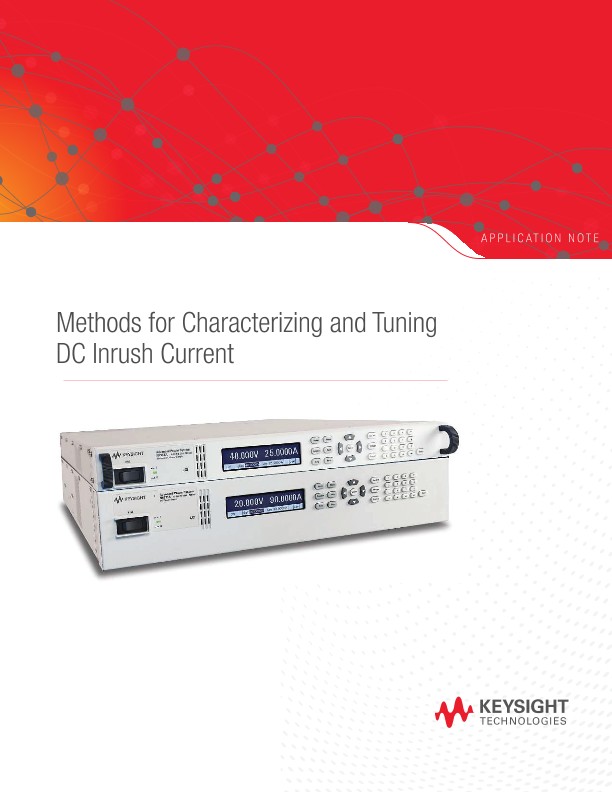
The Keysight N7951A dynamic DC power supply measures inrush current with a state-of-the-art technique. Among its many features, the N7951A offers an integrated, high-accuracy digitizer with up to 18 bits of resolution and can adjust sampling rates. This exceeds the resolving power of traditional oscilloscopes. In addition, the N7951A performs accurately level-triggered acquisition and can capture surges of current to over two times the rated output current, allowing comprehensive capture of high-magnitude functions.
One example from the document described capturing the inrush current on a DC electric motor rated for 15 V and running at approximately 1.3 A steady-state current. Using the built-in digitizer of the N7951A, the test recorded an inrush current peak of 54.55 A, which lasted for approximately 100 ms. The sinusoidal profile of the current was the result of the motor’s rotational dynamics and was coherent due to the high sampling rate and resolution. The N7951A's precision digitizer and ease-of-use enables accurate capture of the inrush current profile, outperforming traditional multi-instrument approaches in accuracy and simplicity.
Apart from characterization, the modern power supply allows for deterministic tuning of inrush current. In cases where inrush current needs to be limited to a certain peak, whether to protect fragile components, adhere to system level constraints, or for some other reason, the inrush surge can be controlled by adjusting the power supply’s voltage ramp rate. In this case, a voltage ramp rate of 40 ms from 0 V to 15 V resulted in an inrush current peak reduction of approximately 35 A. This method of tuning ensures certain safety limits for the inrush current, revealing a compromise where lower ramp rates lead to increased settling time to steady-state current.
Even more versatility is offered for custom waveform generation by the power supply’s arbitrary waveform function, which enables the emulation of non-linear real-life power-up sequences. This body of work proves most beneficial in duplicating intricate starting sequences of switching power supplies or recreating certain environmental conditions within a controlled laboratory environment.
Smoother inrush current testing transitions from outdated practices to contemporary, unified power supply systems offers numerous advantages. These include improved accuracy, streamlined architecture, minimized component count, quicker execution, and improved automation compatibility. A modern engineering tool enables both inrush current characterization and tuning which eliminates setup errors and enhances testing productivity in R&D and production settings.
As a final note, precise inrush current control is necessary for the safety of the device, overall system reliability, and accurate calculation of the protection circuit. Dynamic DC power supplies, such as the Keysight N7951A, modern devices offer rigorously defined solutions to these requirements due to their powerful integrated scaling approach, greatly surpassing the benchmarks set by traditional testing techniques. These advancements allow workflows to be simplified and at the same time, the accuracy and repeatability of inrush current measurements are enhanced for diverse applications.