How to Characterize Lithium-Ion Self-Discharge Versus Temperature

Correlate Self-Discharge Current With Temperature
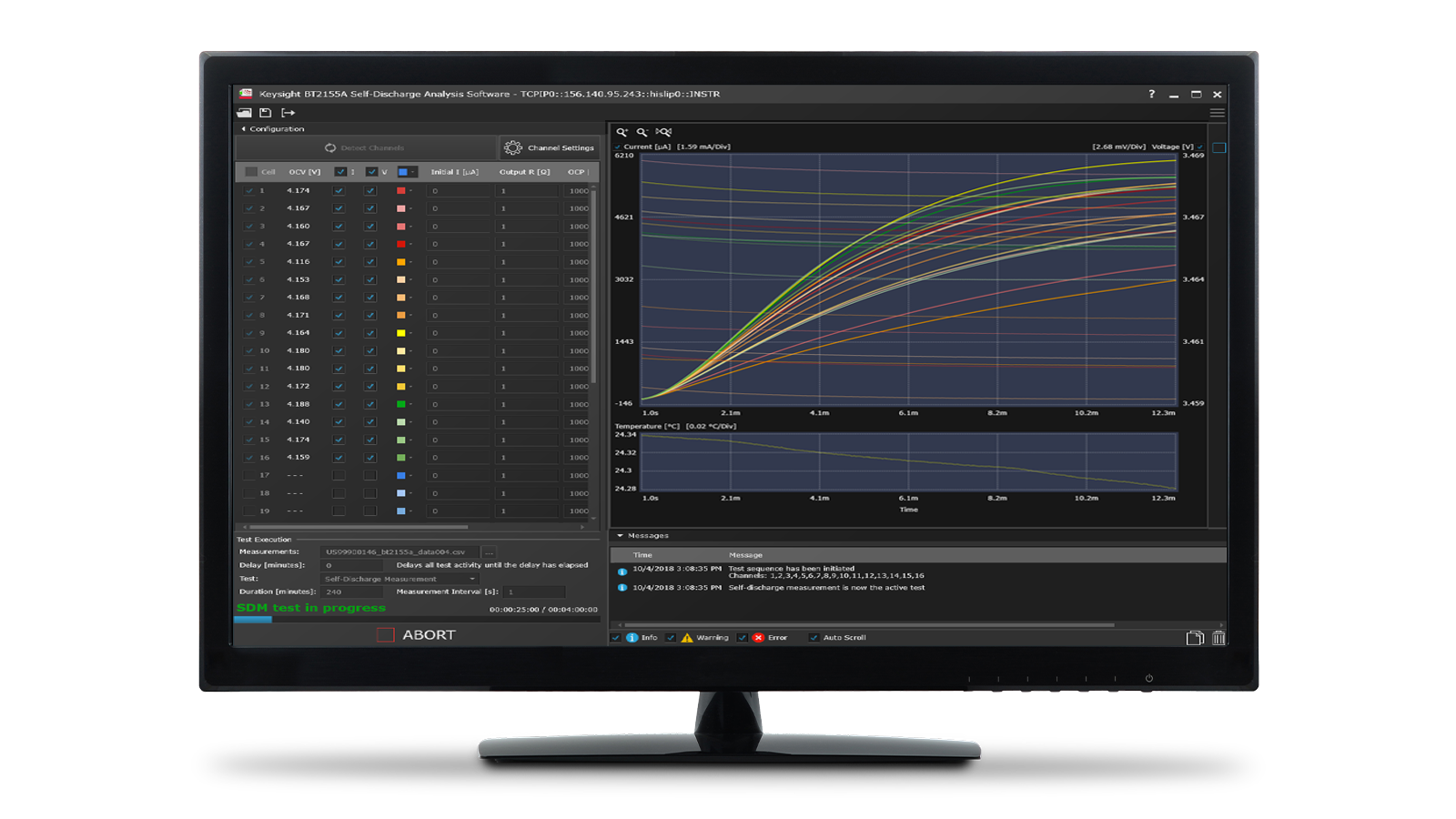
Characterizing temperature effects during battery self-discharge measurement requires simultaneous observation of cell current, voltage, and temperature because potentiostatic self-discharge measurements operate at electrical levels where relatively small thermal changes can influence the measured result. The test begins with a well-rested lithium-ion cell and a low-noise, highly stable direct current source adjusted to closely match the cell’s open-circuit voltage (OCV). The source is connected through a microammeter and maintains the cell at essentially constant voltage and state of charge (SOC). As internal self-discharge removes charge, the external source supplies replacement current. Once equilibrium is reached, the externally supplied current corresponds to the cell’s self-discharge current. Temperature must be monitored throughout this self-discharge current measurement because lithium-ion cell voltage exhibits temperature dependency. A stable thermal environment allows the electrical measurement to approach equilibrium with fewer temperature-induced disturbances. Continuous, time-aligned records of current, voltage, and temperature provide the data needed to evaluate whether current fluctuations coincide with thermal changes or whether the current is progressing toward a stable self-discharge level.
Thermoelectric effects must also be controlled during battery temperature testing because electrical connections between dissimilar metals can produce thermally induced voltages on the order of tens of microvolts per degree Celsius. Cell terminals may be made from nickel or another metal that creates such a voltage when connected to a dissimilar conductor. Connections at both cell terminals can provide opposing thermoelectric voltages that cancel when both terminals are at the same temperature, but a temperature difference between the terminals produces a net voltage. Changes in that temperature difference can therefore produce corresponding fluctuations in measured self-discharge current. State of charge introduces another variable in lithium-ion cell testing. Maintaining a reasonably high and consistent SOC therefore provides more suitable conditions for evaluating low-level current while controlling temperature-related voltage effects. Programmable series resistance can further adjust measurement settling time and sensitivity to external influences such as temperature changes. During acquisition, the cell should remain in a thermally stable environment, and temperature differences between its terminals should be minimized. The measurement system should continuously log cell current, voltage, and temperature so the three parameters can be examined over the same time interval.


Temperature-Aware Self-Discharge Measurement Solution
See Block Diagram of Temperature-Aware Self-Discharge Measurement Solution


Explore Products in Our Temperature-Aware Self-Discharge Measurement Solution
-

![]()
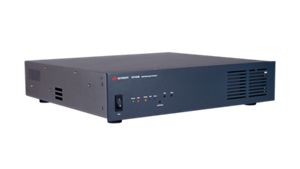
BT2152B Self-Discharge Analyzer
-

![]()
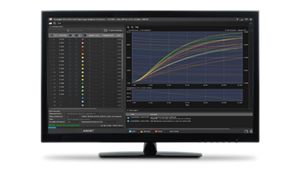
BT2155A Self-Discharge Analysis Software


Discover Resources and Insights
Additional Resources for Temperature-Aware Self-Discharge Measurement
Related Use Cases



-
![]()
Learn More
How to Streamline DC-to-DC Converter Testing
Performing DC-to-DC converter tests require multiple test instruments. Learn how to use an integrated DC power analyzer, an oscilloscope, and automation software to characterize DC-to-DC converters accurately and efficiently.
Learn More

-
![]()
Learn More
How to Reduce Lithium-Ion Self-Discharge Test Time
Reduce lithium-ion cell self-discharge test time by directly measuring self-discharge current with a potentiostatic method instead of relying on extended open-circuit voltage monitoring. Control voltage matching, source stability, cell equilibrium, temperature, and settling behavior to obtain self-discharge measurements in less time.
Learn More
-
![]()
Learn More
How to Emulate Partial Shading Conditions
Simulate partial shading in PV systems to validate inverter performance, MPPT behavior, and solar array efficiency under real-world conditions.
Learn More

Get in Touch with One of Our Experts
Need help finding the right solution for you?