


Why Use Machine Learning for Photonic Simulation
Model, analyze, and optimize waveguides, fibers, and integrated photonic devices with confidence.
Developing next-generation photonic devices requires simulation tools that combine physical accuracy, design flexibility, and computational efficiency. VPIdeviceDesigner™ provides a comprehensive simulation environment for analyzing and optimizing integrated photonic devices, optical waveguides, and fiber structures. Advanced finite-difference mode solvers, beam propagation methods (BPM), and eigenmode expansion (EME) techniques enable accurate modeling of complex 2D and 3D photonic structures. Engineers can define realistic materials, customize meshing strategies, analyze electromagnetic field behavior, and automate design exploration using an integrated Python environment. Seamless integration with photonic circuit and optical system design workflows enables efficient development from individual components through complete photonic systems. The result is faster design iterations, improved device performance, reduced prototyping costs, and accelerated innovation for advanced photonic technologies.
Key Capabilities

Simulate complex photonic devices with physics-based accuracy.

Analyze optical waveguides, fibers, and modes.

Model realistic three-dimensional photonic components.

Visualize and manipulate optical field distributions.

Automate performance-driven device exploration and tuning.

Leverage Python libraries for custom automation.
Resources to Get You Started
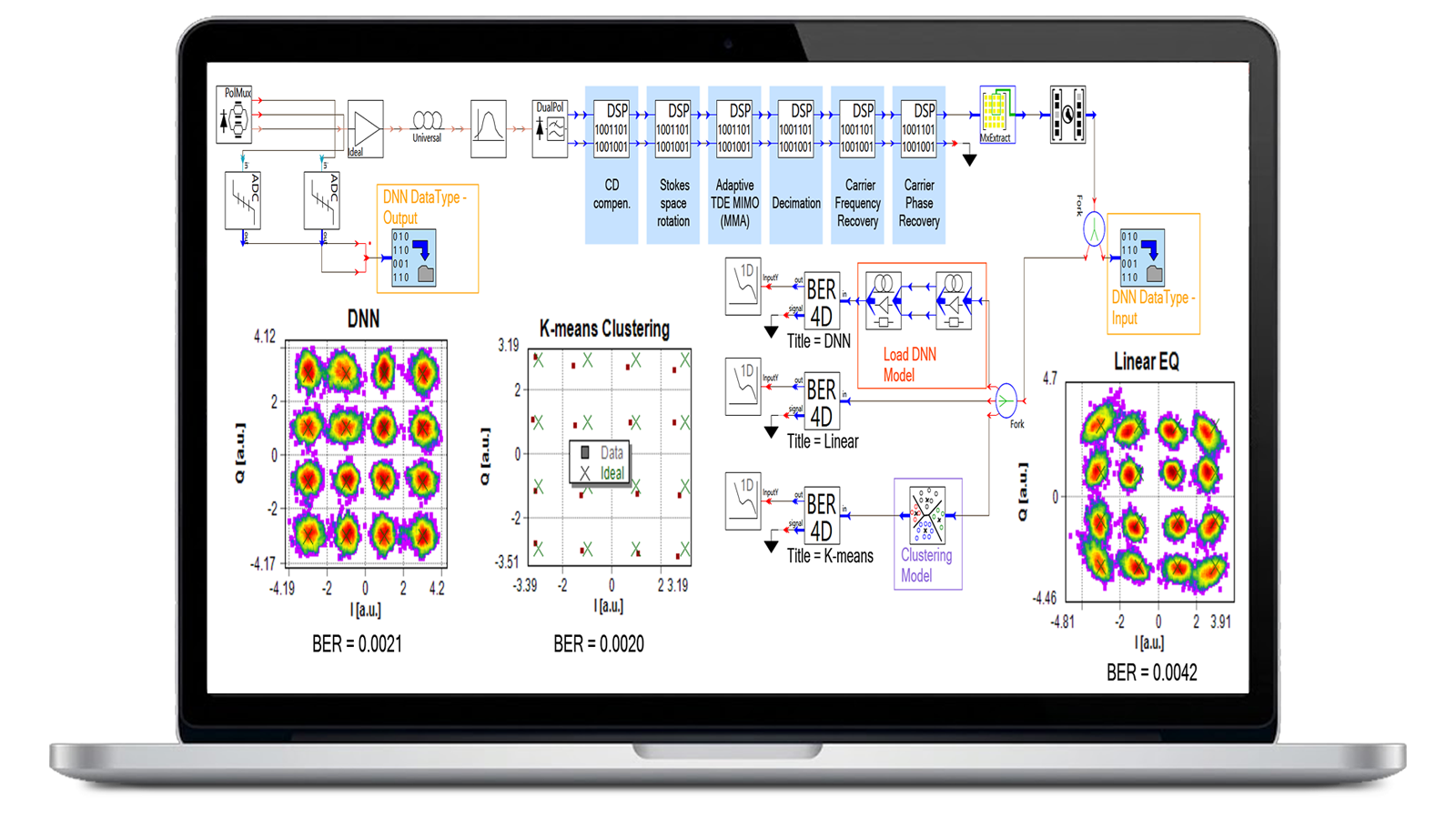
This brochure introduces VPItoolkit ML Framework for machine learning within the VPIphotonics Design Suite. It provides a Python-based deep neural network, support for custom algorithms, and tools for collecting training data, adjusting hyperparameters, and handling digital, electrical, and optical signals. HDF5 storage accommodates large, complex datasets, while hybrid DSP and machine learning simulations support optical equalization, fiber nonlinearity compensation, device characterization, inverse design, and system performance monitoring.


blogs
Completing Keysight's End-to-End Photonic Design Workflow
Brochures
Photonic Design Automation for Components, Systems & Networks

Have Questions? We've Got Answers
Machine Learning for Photonic Simulation (VPItoolkit ML Framework) is designed for the analysis, simulation, and optimization of integrated photonic devices, optical waveguides, and fiber structures used in communications, sensing, and photonic integrated circuits.
The software includes full-vectorial, semi-vectorial, and scalar finite-difference mode solvers, along with Beam Propagation Method (BPM) and Eigenmode Expansion (EME) simulation techniques.
Yes. Users can build and simulate sophisticated 3D photonic structures with customizable geometries, realistic material properties, nonuniform meshing, and advanced boundary conditions.
Integrated Python scripting enables automated parameter sweeps, optimization studies, custom analyses, and workflow automation, significantly reducing manual effort and accelerating design exploration.
The software integrates seamlessly with photonic circuit, PDK, optical system, and fiber optics design environments, enabling efficient device-to-system simulation and verification workflows.