


Why Use DSP Algorithm Library
Design, evaluate, and optimize DSP algorithms for next-generation optical transmission systems.
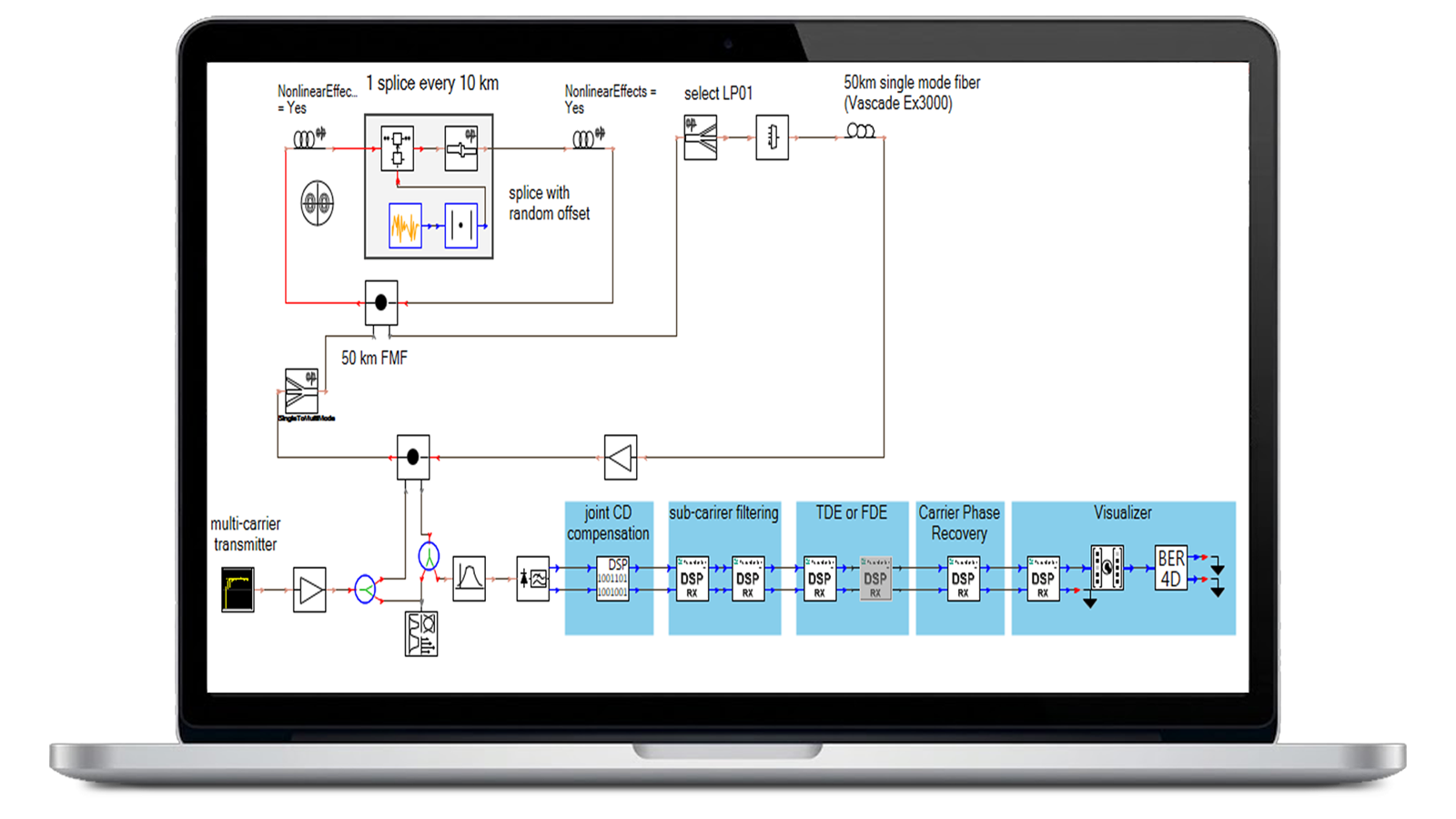
Modern optical communication systems rely on sophisticated digital signal processing (DSP) to maximize performance, increase capacity, and overcome transmission impairments. This solution provides a comprehensive library of lab-proven DSP algorithms that enable engineers and researchers to rapidly evaluate, optimize, and deploy advanced coherent communication technologies. Supporting a wide range of modulation formats, the platform includes capabilities for clock recovery, carrier recovery, polarization demultiplexing, chromatic dispersion compensation, PMD mitigation, nonlinear compensation, and digital pre-distortion. Seamless integration with optical system and laboratory simulation environments allows users to perform on-the-fly performance analysis while exploring design tradeoffs between DSP complexity and achievable system performance. By leveraging validated algorithms developed through extensive research and real-world testing, organizations can accelerate transceiver development, reduce design risk, and bring next-generation optical communications technologies to market faster.
Key Capabilities

Access extensive lab-proven signal processing algorithms.

Correct dispersion, PMD, and nonlinear distortions.

Recover signal frequency and phase accurately.

Analyze diverse coherent modulation formats.

Visualize constellations and signal quality metrics.

Evaluate DSP performance versus implementation complexity.
Resources to Get You Started
This brochure presents the VPItoolkit DSP Library, developed in collaboration with Fraunhofer HHI and integrated with VPItransmissionMaker Optical Systems and VPIlabExpert. The toolkit provides transmitter and receiver algorithms for channel equalization, synchronization, dispersion compensation, polarization demultiplexing, and nonlinear impairment mitigation. Supporting advanced modulation formats, including probabilistically shaped QAM, it enables simulation and offline processing of experimental signals. Design examples demonstrate shaped 256-QAM transmission and perturbation-based nonlinear equalization, supporting assessment of system performance and DSP complexity trade-offs.


blogs
Completing Keysight's End-to-End Photonic Design Workflow
Brochures
Photonic Design Automation for Components, Systems & Networks

Have Questions? We've Got Answers
The DSP Algorithm Library provides a collection of validated digital signal processing algorithms for designing, evaluating, and optimizing advanced optical communication systems and transceivers.
The library supports numerous modulation schemes including BPSK, QPSK, polarization-multiplexed QPSK, mQAM, probabilistically shaped QAM, and advanced multidimensional formats.
Users can compensate for chromatic dispersion, polarization mode dispersion, carrier phase and frequency offsets, I/Q imbalance, and fiber-induced nonlinear effects.
Engineers can benchmark DSP algorithms, compare modulation formats, analyze system performance, and evaluate tradeoffs between processing complexity and communication performance.
Yes. The library integrates directly with optical system simulation and laboratory validation environments, enabling seamless DSP evaluation from design through testing.