FieldFox Remote Display Signal Hunting
Demos
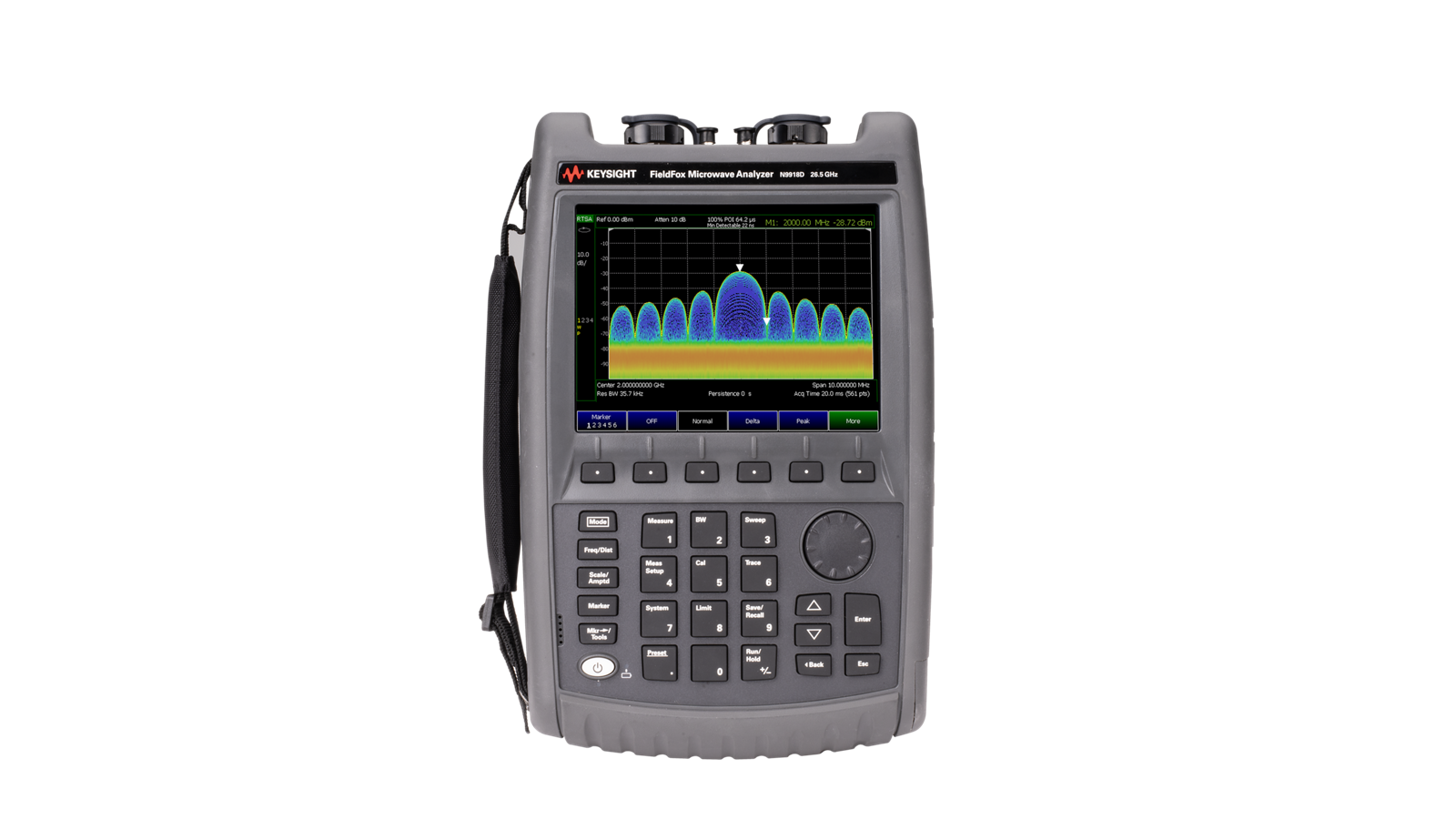
This video demonstrates how the Keysight FieldFox handheld analyzer can be used for remote display signal hunting while monitoring RF activity in a real-world urban environment. As a vehicle moves through a neighborhood, viewers observe live spectrum activity and gain insight into how wireless signals behave as location, distance, obstacles, and antenna orientation change. The demonstration highlights FieldFox's ability to provide continuous visibility into the RF environment, enabling users to identify, monitor, and track signals while remaining focused on the search mission.
The video begins by monitoring activity in the Wi-Fi band while traveling through an urban area. As the vehicle moves, the spectrum display reveals significant changes in both signal amplitude and frequency occupancy. Some signals strengthen, weaken, or disappear entirely as environmental conditions change. Buildings, terrain, antenna positioning, and proximity to signal sources all contribute to these variations. By visualizing these changes in real time, FieldFox helps users better understand signal propagation and identify areas of increased wireless activity.
A key focus of the demonstration is the practical process of signal hunting. Rather than simply detecting signals, users learn how to observe signal behavior and recognize patterns that can indicate the location of a transmitter. Signals that consistently increase in strength while moving in a particular direction may suggest that the source is nearby. By observing trends over time instead of relying on single measurements, engineers and technicians can make more informed decisions when locating unknown emitters or investigating sources of interference.
The video also demonstrates how FieldFox's marker functionality and Max Hold trace can be used to track individual signals during a mobile monitoring operation. Markers allow users to focus on specific peaks of interest, while Max Hold captures the highest observed signal levels over time. Together, these tools make it easier to monitor signal evolution and determine which transmissions are increasing in strength most rapidly. This capability is especially valuable in dynamic environments where signals can be difficult to follow as conditions change.
To illustrate how signal characteristics vary across frequency bands, the demonstration transitions to a lower-frequency spectrum region around 623 MHz. Here, viewers observe multiple broadband signals that remain relatively stable as the vehicle moves through the neighborhood. Compared to Wi-Fi signals, which often fluctuate significantly due to movement and environmental conditions, these lower-frequency signals exhibit greater consistency in both amplitude and frequency. This comparison highlights the diverse behaviors of RF signals in real-world environments and demonstrates the importance of adapting signal hunting techniques to different signal types.
Throughout the demonstration, FieldFox showcases how real-time monitoring, marker tracking, and Max Hold measurements can work together to simplify signal hunting and spectrum awareness tasks. The video provides practical insight into locating signals of interest, identifying signal trends, and understanding RF activity in changing environments. By combining powerful spectrum analysis capabilities with a portable platform and remote display functionality, FieldFox enables engineers, technicians, and spectrum managers to efficiently perform interference hunting, spectrum monitoring, wireless network assessment, and field-based RF investigations. The demonstration highlights how users can gain actionable insights and confidently track signals even in complex and rapidly changing wireless environments.