
Buying Guides
Arbitrary Waveform Generator Buying Guide for Electrical Engineers



Introduction
When you're validating high-frequency systems, characterizing semiconductor devices, or simulating complex RF environments, the integrity of your signal source can make or break your test results.
Arbitrary Waveform Generators (AWGs) are engineered to deliver the precision and flexibility needed for these demanding applications.
This guide is designed to help you identify the right AWG for your specific needs—whether that means higher sample rates, deeper memory, multi-channel synchronization, or seamless software integration.
We'll walk through key specifications, application-based selection criteria, and emerging features that push performance further. You’ll also see how leading engineers use AWGs to simulate real-world signals with repeatable, testable accuracy.
What is an Arbitrary Waveform Generator?
An Arbitrary Waveform Generator (AWG) is a test instrument that generates custom electrical signals with precise control over their shape, frequency, amplitude, and timing.
Basic function generators are limited to standard signals like sine, square, and triangle waves. In contrast, AWGs can generate complex, real-world signal patterns used in applications like wireless modulation, radar pulses, and semiconductor testing.
AWGs are designed to create custom signals with high precision. Their performance depends on key specifications like sample rate, bandwidth, vertical resolution, and memory depth. These factors determine how accurately the instrument can reproduce a desired waveform.
To get a clear foundation, check out Keysight’s AWG Basics Guide (PDF), which explains waveform generation fundamentals, core specs, and practical applications.
Definition and Core Functionality
An AWG generates programmable voltage signals by outputting digitally stored waveform data. This allows it to reproduce virtually any signal with outstanding fidelity.
- Function Generator vs. AWG: Function generators produce basic analog waveforms. AWGs simulate complex, real-world signals with greater control and resolution.
- Oscilloscope vs. AWG: An oscilloscope captures and visualizes signal behavior. An AWG creates the signal in the first place. When used together, they form a complete test and measurement workflow.
Core specs to understand:
- Sample rate (GSa/s): Determines how finely the waveform is digitized in time.
- Bandwidth (Hz): Indicates the frequency content the AWG can reproduce accurately.
- Vertical resolution (bits): Affects amplitude precision, critical in high-dynamic range testing.
- Memory depth: Limits the duration and complexity of the waveform playback.
Key Waveform Types
Modern AWGs support a broad range of signal outputs:
- Sine waves: Used to characterize frequency responses or perform harmonic distortion tests.
- Square waves: Useful in clock signal testing, digital emulation, and switching applications.
- Triangle waves: Often used for ramp testing or linear sweeps.
- Arbitrary/custom waveforms: Defined by the user to simulate captured real-world signals or mathematically generated patterns.
Custom waveform capability is where AWGs shine. Engineers working on radar, wireless communications, or high-speed serial interfaces often use AWGs to replicate non-standard, protocol-specific signals with full repeatability.
Common Applications
AWGs are critical to a wide range of test environments. Here are a few examples:
- Wireless Communications: AWGs simulate I-Q modulated signals like LTE, 5G, and Wi-Fi, making them ideal for pre-compliance testing and RF validation.
- Aerospace and Defense: Engineers use AWGs to generate radar pulses, electronic warfare scenarios, and encrypted signal profiles.
- Semiconductor Testing: High-resolution AWGs validate RF ICs, ADC/DAC performance, and digital logic under real operating conditions.
- R&D Labs: Researchers use AWGs to explore new modulation techniques, signal encoding, or quantum control sequences.
- Emerging Technologies: Quantum computing, automotive radar, and millimeter-wave testing demand precise waveform shaping and ultra-low jitter, capabilities best delivered by advanced AWGs.
For engineers looking to pair signal generation with advanced signal analysis, Keysight MXR-Series Oscilloscopes offer deep integration with AWGs, supporting synchronized measurements, triggering, and automation in a unified test setup.
Key Specifications and Features Explained
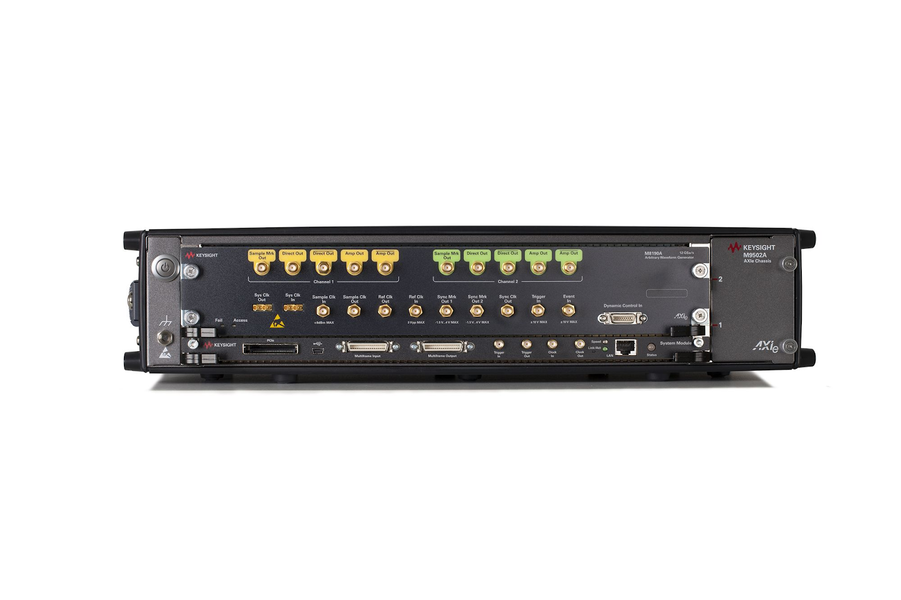
When selecting an Arbitrary Waveform Generator (AWG), understanding its core specifications is essential for choosing the right model for your application.
Whether you're building automated test sequences or pushing the boundaries of quantum pulse control, these specifications define what your AWG can do and how well it integrates into your workflow.
Sample Rate and Bandwidth
The sample rate, measured in gigasamples per second (GSa/s), defines how finely the AWG digitizes each second of the waveform.
A higher sample rate results in higher time resolution, which means the waveform more closely resembles its intended shape.
For example, to accurately reproduce a 1 GHz sine wave, a sample rate of at least 2.5-4 GSa/s is recommended, based on Nyquist criteria and practical fidelity needs.
Bandwidth, typically measured in MHz or GHz, defines the frequency range the AWG can output without distortion. Higher bandwidth allows for the generation of high-speed transitions, wideband modulations, and harmonics, which are critical in RF, radar, and high-speed serial testing.
Together, sample rate and bandwidth determine the maximum signal complexity your AWG can handle without losing detail or introducing aliasing.
Memory Depth and Vertical Resolution
Memory depth defines how many samples the AWG can store per waveform. This directly impacts the duration and complexity of the signal. Deeper memory is especially important for:
- Long modulation sequences
- Multi-pulse radar simulations
- Waveform segments requiring high resolution over time
For instance, testing communication protocols with long preambles or low-frequency envelope variations may require tens to hundreds of millions of points per channel.
Vertical resolution, measured in bits (typically 14-bit or 16-bit in high-performance AWGs), determines the amplitude precision of your waveform. Higher resolution results in:
- Lower quantization noise
- Finer signal detail
- Better dynamic range
This is crucial when simulating small signal variations, low-distortion signals, or analog front-end behavior in high-performance analog or RF systems.
Multi-Channel and Synchronization
Applications like radar testing, MIMO communications, or multi-signal mixed-signal validation require multiple synchronized outputs.
AWGs with multi-channel capability let you generate phase-coherent signals across multiple outputs, allowing you to test systems that rely on tight timing and phase alignment.
Synchronization techniques include:
- Common reference clock inputs
- Trigger buses
- Inter-channel skew adjustments
These features are especially important in beamforming, multi-lane serial testing, or quantum research, where time alignment between channels must be precise.
Modulation and Advanced Features
Modern AWGs support a wide range of modulation formats, including:
- AM (Amplitude Modulation)
- FM (Frequency Modulation)
- PM (Phase Modulation)
- PRBS (Pseudo-Random Binary Sequences)
- I-Q Modulation for complex digital communications
Advanced AWGs go even further with features like:
- Segmented waveform playback: Letting you store multiple waveform segments and play them back in user-defined sequences, ideal for stress testing or protocol emulation.
- Real-time waveform editing: Modify waveforms on the fly without reloading or interrupting playback.
- Low jitter performance: Essential for digital signal integrity testing and jitter-sensitive RF applications.
For a deeper look at optimizing waveform playback and signal quality, refer to Keysight’s M8100 Series Getting Started Guide (PDF), which outlines best practices for calibration, troubleshooting, and waveform management.
How to Choose the Right AWG for Your Application
Choosing the right AWG depends on your signal complexity, test setup, and long-term goals. This section covers key factors to consider, such as application type, budget, and integration, to help you find a model that fits your needs without overspending.
Defining Your Application Needs
Start by identifying the technical requirements of your test environment. Key questions to ask:
- What’s the maximum frequency or bandwidth you need to generate?
- Do you require precise modulation (e.g., QAM, PRBS, I-Q)?
- How many channels are needed? One may be enough for simple analog signals—but radar, MIMO, or automotive systems often require two or more synchronized outputs.
- Do you need real-time control or segmented waveform playback for protocol testing?
Example scenarios:
| Application Type | Key AWG Requirements |
|---|---|
| Wireless comms (5G, Wi-Fi) | I-Q modulation, multi-channel, >1 GSa/s sample rate |
| Radar/EW simulation | High bandwidth, low jitter, segmented waveform playback |
| Semiconductor validation | Deep memory, high vertical resolution, PRBS signal support |
| Quantum control | Sub-ns resolution, ultra-low jitter, phase-coherent outputs |
Understanding your use case helps you avoid under- or over-buying.
Balancing Budget and Performance
AWGs can range from cost-effective single-channel models to premium high-bandwidth instruments with ultra-deep memory. The key is to match the specs to your actual test scope, not theoretical “maximums” you may never use.
Tips to stay budget-smart:
- Don’t overpay for GHz-level bandwidth if your highest signal is under 100 MHz.
- Choose deeper memory only if your test cases require long-duration waveforms.
- Prioritize signal fidelity and low jitter for critical measurements over novelty features.
Keysight’s Premium Used Equipment line offers substantial savings, often up to 70% off, while retaining high performance, full warranty, and software support. Learn more in our Refurbished Arbitrary Waveform Generator Buying Guide.
Integration and Compatibility
Your AWG should fit into your existing test setup without requiring a complete rework. That means:
- Software integration with your test automation tools (e.g., SCPI, LabVIEW, Python).
- Hardware compatibility with existing clocks, triggers, and reference instruments.
- Drivers or APIs for seamless communication with other Keysight devices (like oscilloscopes or spectrum analyzers).
Common integration challenges include mismatched trigger logic, signal degradation through poorly shielded connections, or waveform format limitations. To avoid surprises, verify that the AWG’s interface options and scripting capabilities align with your test environment.
Vendor Evaluation and Support
Not all AWGs are supported equally. Before you buy, evaluate vendors on the following:
- Warranty length (Keysight offers up to 5 years even on used equipment)
- Technical support responsiveness and expertise
- Firmware and software updates
- Training resources and documentation availability
- Access to real user feedback (forums, user reviews, case studies)
Also consider the broader ecosystem. Keysight’s tools are designed to work together, minimizing friction when synchronizing or automating across devices.
Practical Applications and Use Cases
Arbitrary Waveform Generators do more than generate signals. They help simulate real-world conditions, meet regulatory standards, and support the development of advanced technologies. From testing wireless protocols to building radar systems or developing quantum control sequences, AWGs offer the precision and flexibility engineers need.
This section highlights real-world applications where AWGs add measurable value. For in-depth technical context, you can explore this industry white paper on AWG applications.
Wireless Communications Testing
Modern wireless standards such as 5G, Wi-Fi 6/7, and Bluetooth 5.x demand multi-carrier, multi-channel, and highly modulated signals for both transmitter and receiver validation.
AWGs make this possible by supporting complex I-Q modulation schemes like:
- QAM (Quadrature Amplitude Modulation)
- OFDM (Orthogonal Frequency Division Multiplexing)
- Custom bursts or frequency hopping
Engineers use AWGs to:
- Simulate edge-case signals for pre-compliance testing
- Validate receiver sensitivity under noise and interference
- Emulate specific protocol behaviors for interoperability testing
With high sample rates and fine resolution, AWGs reproduce wideband signals that closely match live environments—enabling faster debug cycles and fewer surprises during certification.
Aerospace and Defense
AWGs are mission-critical in radar system development, electronic warfare simulation, and satellite communications. These applications require:
- Multi-channel synchronization for beamforming or phased array radar testing
- Wide bandwidths to simulate high-frequency pulsed signals
- Segmented waveform playback for dynamic threat or target profiles
Use cases include:
- Generating frequency-agile radar pulses for target emulation
- Synthesizing jamming signals or countermeasure scenarios
- Stress-testing RF front-ends under complex, time-varying conditions
AWGs help defense engineers simulate real-world electromagnetic environments, without risking mission assets or relying on live trials.
Semiconductor Testing
In semiconductor validation, precision is non-negotiable. AWGs allow you to:
- Drive RFICs, ADCs/DACs, and high-speed logic with custom signal profiles
- Emulate noisy or worst-case inputs for reliability testing
- Characterize nonlinear response under controlled modulation stress
High vertical resolution and low jitter performance ensure that minute signal deviations are visible during analysis. Whether you're validating clock performance, stress-testing power amplifiers, or running eye diagram tests, the waveform integrity from your AWG directly affects your measurement accuracy.
R&D and Emerging Technologies
In research labs, flexibility is just as important as precision. AWGs serve as a programmable signal sandbox for innovation across:
- Quantum computing: Ultra-low jitter and phase-coherent outputs are needed for generating qubit control pulses.
- Automotive radar: Engineers simulate wideband chirps and FMCW waveforms to test next-gen ADAS systems.
- Advanced modulation research: AWGs support non-standard and evolving modulation schemes, allowing you to experiment beyond off-the-shelf capabilities.
The ability to design, edit, and output custom waveforms on demand accelerates iteration cycles and allows research teams to quickly adapt to new ideas or hardware constraints.
Best Practices for Optimizing AWG Performance
To get the most from your AWG, it’s important to go beyond default settings. Signal fidelity, stability, and test repeatability all depend on how you configure, maintain, and deploy your waveform generator.
This section offers practical advice on waveform design, noise reduction, maintenance routines, and debugging strategies.
Waveform Design Tips
Start with solid signal fundamentals:
- Use high sample rates to maintain signal detail, especially for fast transitions or high-frequency content.
- Choose deep memory if you need long or segmented playback without losing resolution.
- Apply waveform smoothing or filtering during design to avoid aliasing or bandwidth overshoot.
Avoid unnecessary oversampling, it can increase memory usage and output time without improving fidelity.
Minimizing Jitter and Noise
Jitter and noise degrade signal quality, especially in RF and digital systems.
- Use shielded cables and proper grounding techniques to minimize EMI.
- Ensure clock synchronization when using multiple channels or external references.
- Maintain tight control of triggering and timing alignment across instruments.
If signal edges appear unstable or if your device under test behaves unpredictably, jitter is a likely culprit.
Calibration and Maintenance
Prevent drift and signal errors with regular upkeep:
- Calibrate the AWG according to your lab's schedule or usage frequency.
- Check for firmware updates that improve stability or add new features.
- Perform periodic hardware diagnostics to catch connector wear or output degradation.
Routine maintenance ensures that your output matches what your specs promise.
Software Tools and Troubleshooting
Modern AWGs come with powerful tools for automation and debugging:
- Use Keysight’s PathWave Waveform Creation software to program and simulate complex signals with a visual interface and export them directly to compatible instruments.
- Automate testing with scripting languages like:
- Python (PyVISA): Control your AWG using VISA commands over LAN, USB, or GPIB.
- SCPI: Use standardized instrument command sets for seamless integration into automated test systems.
- LabVIEW: Build graphical test sequences that interact with AWGs and other test equipment.
For troubleshooting, check for:
- Mismatched sample rates or waveform lengths
- Improper trigger settings between instruments
- Clipping caused by incorrect output voltage levels
Always verify that the waveform you design is the one actually being output. Use oscilloscope feedback and simulation previews to catch discrepancies early and ensure signal fidelity.
Integrating AWGs into Automated Test Systems
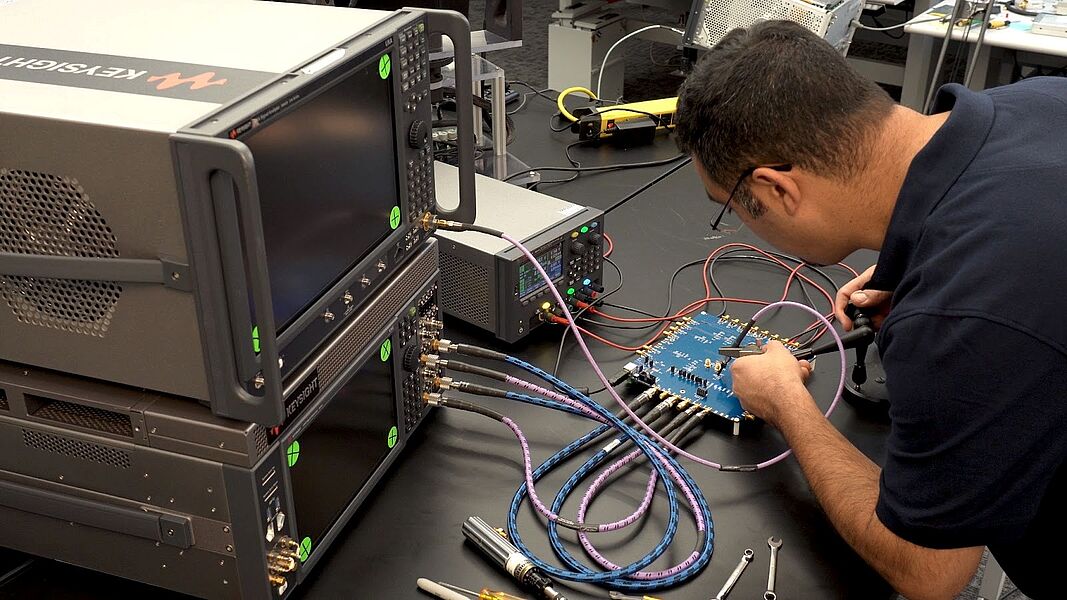
Automating signal generation with an AWG improves control, speeds up test cycles, and allows for continuous, complex testing. In high-mix environments, automation makes it easier to manage waveform variations and coordinate multiple instruments.
Modern AWGs support open software architectures, making integration into automated workflows straightforward. You can script waveforms, sync with other tools, and adjust parameters in real time. Keysight’s integrated toolchain helps teams control instruments, log results, and run tests from a single script or plan.
Automation Benefits
In automated environments, AWGs help deliver:
- Higher throughput: Run back-to-back tests without manual setup or reconfiguration.
- Consistent signal generation: Minimize drift or inconsistencies by executing identical waveforms with each cycle.
- Faster debugging: Quickly iterate by modifying waveform parameters via script instead of navigating front panels.
- Reproducible results: Share test scripts across teams or facilities to maintain quality and performance standards.
- Closed-loop testing: Pair AWGs with real-time data capture to make dynamic waveform adjustments based on DUT behavior.
These advantages are particularly important for regression testing, compliance testing, and adaptive stress scenarios.
Software and APIs
Modern AWGs support multiple programming interfaces and APIs to suit your existing workflow. These include:
- IVI drivers: Ideal for test system integration, supporting a standardized API across multiple vendors.
- SCPI commands: The standard for low-level instrument control across almost all AWGs, including those from Keysight.
- LabVIEW: For engineers building graphical user interfaces or automation panels.
- Python (PyVISA): A versatile scripting option that allows dynamic waveform editing, sequencing, and logging.
Using these tools, you can:
- Generate complex signals on-the-fly based on external inputs.
- Create waveform libraries for different product configurations.
- Integrate waveform changes directly into automated pass/fail routines.
Custom waveform generation is also supported via Keysight’s PathWave software, or via uploading .csv or binary files programmatically to the AWG.
Synchronization and Workflow Examples
AWGs rarely operate in isolation. In advanced test setups, they are synchronized with oscilloscopes, signal analyzers, power supplies, or digital controllers to replicate real-world conditions and capture every response with precise timing.
Common synchronization strategies include:
- Reference clock sharing to maintain frequency alignment
- Trigger routing for start/stop event coordination
- Skew correction for aligning signals across multiple AWG channels or instruments
Example: Multi-Domain Receiver Testing
- AWG generates frequency-agile I-Q signals with embedded control pulses.
- A digital controller injects protocol-level commands.
- A signal analyzer captures spectral performance.
- A high-speed oscilloscope verifies time-domain transitions.
- Python script manages test sequencing, captures results, and adjusts waveform parameters based on DUT feedback.
This type of integrated test enables full-spectrum validation—functional, spectral, and timing—in one pass.
By selecting an AWG that works natively with your ecosystem, you reduce configuration complexity and accelerate your path from setup to actionable data.
Emerging Trends and Innovations in AWGs
As testing needs grow more demanding, AWGs are advancing to keep up. Engineers working in RF, digital, and quantum domains now rely on tools with higher sample rates, real-time control, and modular designs.
These innovations unlock new applications, from quantum pulse control to wideband signal generation for 6G and radar. Choosing the right AWG means planning not just for today’s tests, but for tomorrow’s technologies
Higher Speed and Bandwidth
Next-gen AWGs are now delivering sample rates exceeding 100 GSa/s and analog bandwidths in the tens of GHz, enabling:
- More accurate emulation of high-frequency analog and RF signals.
- Support for wideband communication protocols, including mmWave and sub-THz bands.
- Improved signal fidelity for fast rise-time pulses and complex modulations.
These specs are crucial for applications like high-speed serial link testing, radar signal development, and satellite communication payloads, where signal degradation or timing errors are not an option.
Modular and Multi-Channel Designs
To keep pace with increasingly complex test setups, AWG manufacturers are embracing modular and scalable designs.
- Modular chassis systems allow users to expand channel count or performance specs without replacing their entire setup.
- Synchronized multi-channel AWGs offer phase-coherent outputs ideal for MIMO, beamforming, and quantum logic gates.
- Independent channel control supports mixed waveform types in parallel—e.g., analog plus digital or control plus RF.
This approach allows teams to scale efficiently and tailor their equipment investment to current workloads while maintaining a path to grow as testing needs evolve.
Real-Time Editing and Control
One of the most promising innovations in modern AWGs is the ability to modify waveforms in real time, enabling:
- Adaptive testing, where waveform content changes based on DUT responses.
- Hardware-in-the-loop (HIL) simulations for real-world conditions in automotive and aerospace systems.
- Quantum pulse shaping, where signal integrity must be preserved across nanosecond-level changes.
These innovations let engineers test dynamic systems without stopping to recompile or reload waveforms, drastically reducing test cycles and increasing productivity.
Conclusion
As electronic systems become faster and more complex, the ability to generate precise, reliable, and customizable signals is critical.
Arbitrary Waveform Generators play a central role in that process, allowing engineers to validate designs, simulate real-world conditions, and streamline test automation across industries.
Selecting the right AWG means looking beyond surface specs. It requires a clear understanding of your signal requirements, integration needs, and long-term testing goals. Choosing a solution that aligns with your workflow can save time, reduce rework, and provide a platform for scalable success.
The Keysight Used Equipment Store offers a wide selection of professionally refurbished AWGs that combine high performance with significant savings. Backed by expert support and up to five years of warranty, these solutions make it easier to invest in the capabilities you need without compromising reliability or precision.
Whenever You’re Ready, Here Are
5 Ways We Can Help You
Call tech support US: +1 800 829-4444
Press #, then 2. Hours: 7am – 5pm MT, Mon– Fri
Contact our sales support team
Create an account to get price alerts and access to exclusive waitlists
Talk to your account manager about your specific needs
FAQs
Start by defining your application needs, such as maximum frequency, required channel count, signal complexity, and modulation type. Then evaluate technical specs like sample rate, memory depth, and bandwidth, making sure they align with your DUT and test environment. Don’t forget to consider software integration and support.
- Sample rate determines time resolution and signal accuracy (especially for fast transitions or wideband signals).
- Bandwidth limits the frequency range the AWG can accurately reproduce.
- Vertical resolution impacts amplitude precision and signal detail, which is critical for low-noise or small-signal testing.
Function generators output standard waveforms (sine, square, triangle), while AWGs can create fully customizable, complex waveforms. AWGs also offer higher sample rates, deeper memory, and support for advanced modulations.
Multi-channel AWGs are essential for applications like MIMO, beamforming, or mixed-signal testing. Synchronization ensures phase-coherent outputs across channels or instruments, which is critical in radar, quantum research, and automotive radar systems.
Modern AWGs support:
- Amplitude Modulation (AM)
- Frequency Modulation (FM)
- Phase Modulation (PM)
- PRBS (Pseudo-Random Binary Sequences)
- I-Q modulation
They can also play back arbitrary/custom waveforms, protocol bursts, and real-time-edited sequences.
A higher sample rate allows the AWG to recreate signals with greater time resolution, minimizing distortion, aliasing, and rounding errors. This is especially important when testing high-speed or fast-transitioning signals.
- Overestimating required bandwidth and overspending
- Underestimating memory depth for long or segmented signals
- Ignoring software integration needs
- Failing to account for synchronization in multi-instrument setups
- Not verifying waveform output with a scope before testing
Look for support for:
- SCPI commands
- IVI drivers
- Python (PyVISA)
- LabVIEW integration
Also consider waveform editing tools like Keysight’s PathWave for real-time creation and control.
AWGs are widely used in:
- Wireless communications (5G, Wi-Fi, Bluetooth)
- Aerospace and defense (radar, electronic warfare)
- Semiconductor testing (RFICs, mixed-signal validation)
- Quantum computing (pulse control)
- Automotive electronics (ADAS and radar simulation)
Regular calibration, firmware updates, and periodic hardware checks are essential. Working with a vendor like Keysight ensures access to documentation, responsive technical support, and warranty coverage.