


Title
A smooth, single-frequency waveform: the basic stimulus for frequency-response, distortion, and RF measurements. A sine wave's amplitude, frequency, and phase can each be modulated to carry information.
Buying Guide
Your Complete Signal Generator Buying Guide

Introduction
Choosing a signal generator often starts with a mismatch: the market spans everything from basic function generators to microwave vector sources, and datasheets do not always make it clear which tier your work needs. This guide closes that gap. It covers what each specification means, which type of generator fits which job, and which certified-used Keysight models fit each tier. If you already know your highest test frequency, the model table and selection flowchart in “Which Keysight Signal Generator Should You Buy?” map it to a model.
Summary
- A signal generator produces test signals with known, settable properties (frequency, amplitude, waveform, modulation) so you can drive a circuit and see how it responds.
- Buy by tier: a Trueform waveform generator (33522B, 33622A) for baseband and general bench work to 120 MHz, an X-Series RF generator (EXG N5171B/N5172B, MXG N5182B) to 6 GHz, and a PSG microwave generator (E8257D analog, E8267D vector) for microwave work to 44 or 67 GHz.
- The two specs that separate look-alike instruments: phase noise (spectral purity, in dBc/Hz at an offset) and, for digital work, modulation bandwidth (up to 160 MHz on the X-Series, depending on installed options; up to 2 GHz on the VXG M9384B).
- Analog or vector is the key fork: analog generators produce clean continuous-wave (CW) and swept signals; vector generators add I/Q modulation for digitally modulated signals (5G, Wi-Fi, radar waveforms).
- For arbitrary waveform generators, Keysight’s sample-rate guidance is practical: Nyquist allows half the sample rate, but usable output tops out near 40% of sample rate after reconstruction filtering.
- Certified used from Keysight saves 40 to 90% against new list prices, with up to 5 years warranty options, Keysight calibration, and KeysightCare support.
In a hurry? Browse the certified used signal generators and request a quote.
What Is a Signal Generator?
A signal generator is an electronic instrument that produces signals with specific, settable electrical waveforms. Signal generators are used to design, test, and manufacture systems and components: you feed a known signal into a device and measure what comes out. Depending on the application, the output can be repetitive or single-shot, and modern instruments can set frequency, amplitude, and modulation with calibrated precision. For a deeper primer, see what a signal generator is and how to use a signal generator.
The most basic units produce sine, square, and triangle waves. More capable instruments generate pulses, ramps, noise, and arbitrary waveforms, and add amplitude, frequency, and phase modulation. At the top of the range, vector signal generators reproduce complete digitally modulated standards.
Common Waveforms Produced by Signal Generators
| Waveform | What it is and when to use it |
|---|---|
| Sine Wave | A smooth, single-frequency waveform: the basic stimulus for frequency-response, distortion, and RF measurements. A sine wave's amplitude, frequency, and phase can each be modulated to carry information. |
| Square Wave | A signal that alternates abruptly between two voltage levels. Its fast, harmonic-rich edges make it the standard stimulus for digital circuits, clocks, and timing tests. |
| Triangle and ramp waves | Linear rises and falls at a constant rate, with or without a DC offset: useful for sweep drives, comparator tests, and linearity checks. |
| Pulse | A short transition with settable width, period, and edge times, for stress-testing digital inputs and timing paths. |
| Arbitrary | Any waveform you can define point by point, replayed from memory through a digital-to-analog converter (DAC). |
Waveform
What it is and when to use it
Sine Wave
Square Wave
Title
A signal that alternates abruptly between two voltage levels. Its fast, harmonic-rich edges make it the standard stimulus for digital circuits, clocks, and timing tests.
A signal that alternates abruptly between two voltage levels. Its fast, harmonic-rich edges make it the standard stimulus for digital circuits, clocks, and timing tests.
Triangle and ramp waves
Title
Linear rises and falls at a constant rate, with or without a DC offset: useful for sweep drives, comparator tests, and linearity checks.
Linear rises and falls at a constant rate, with or without a DC offset: useful for sweep drives, comparator tests, and linearity checks.
Pulse
Title
A short transition with settable width, period, and edge times, for stress-testing digital inputs and timing paths.
A short transition with settable width, period, and edge times, for stress-testing digital inputs and timing paths.
Arbitrary
Title
Any waveform you can define point by point, replayed from memory through a digital-to-analog converter (DAC).
Any waveform you can define point by point, replayed from memory through a digital-to-analog converter (DAC).
How Is a Signal Generator Different from an Oscilloscope?
The confusion is common, but the distinction is simple. A signal generator is a source: it creates the signals. An oscilloscope is a measuring instrument: it displays a voltage as it changes over time. On a working bench, the generator and the oscilloscope work as a pair: the generator drives the circuit, the scope shows the response. If your question is "which instrument do I buy first," the answer follows from the job: to create test signals, buy a generator; to observe circuit behavior, buy a scope.
What Do You Use a Signal Generator For?
The primary use of a signal generator is in the name: to generate signals. In practice, that breaks into four recurring jobs:
- Design validation and new-circuit test: drive a prototype with known stimuli and verify the response.
- Troubleshooting existing circuits: substitute a clean, known signal to isolate and debug a failing stage.
- Testing receivers and RF chains: supply calibrated, modulated signals at precise levels, down to the microvolt range a receiver test may need, or stand in as the local oscillator (LO) for a mixer under test.
- Generating clocks and reference signals: provide stable timing for digital systems and synchronization for multi-instrument setups.
Different waveforms expose different problems, which is why the waveform list above matters at buying time: a bench that only needs sine and square waves can buy a far less advanced instrument than a lab reproducing 5G downlinks.
What Features Should You Look For in a Signal Generator?
Several key specs separate signal generators that look alike on a category page. Work through these 6, in order, against your own test plan:
- Waveforms and modulation
- Frequency range
- Frequency resolution
- Sampling rate (for arbitrary waveform generators)
- Phase noise and spectral purity
- External frequency reference and output impedance
Waveforms and Modulation
Signal generators are classified first by the waveforms they produce: sine, triangle, square, pulse, arbitrary, and so on. Match the list to your test plan, not to the longest datasheet.
Modulation is the second axis. Modulation is the process of varying a signal to convey information, and the common analog types are amplitude modulation (AM), frequency modulation (FM), and phase modulation (PM). Digital work adds another requirement: a vector signal generator adds I/Q modulation, the in-phase and quadrature architecture behind modern digital standards. Keysight's white paper The Essential Signal Generator Guide draws the line clearly: an analog signal generator produces continuous-wave signals with basic modulation, while a vector signal generator produces complex, digitally modulated signals. That distinction, analog or vector, is one of the most important choices on the order form.

Frequency Range
The frequency range is the span of frequencies the generator can produce, specified as minimum and maximum. Choose it from the highest frequency your test plan needs, plus headroom, because range is a major price axis. Three tiers cover most buying decisions:
- Baseband and general benchtop work to 120 MHz: Trueform waveform generators (33522B at 30 MHz, 33622A at 120 MHz).
- RF work to 6 GHz: X-Series generators (EXG N5171B analog, N5172B vector, MXG N5182B vector), all 9 kHz to 6 GHz.
- Microwave work to 44 or 67 GHz: PSG generators (E8267D vector to 44 GHz, E8257D analog to 67 GHz) and the VXG M9384B (1 MHz to 44 GHz). Keysight’s current lineup also includes the VXG M9484C to 54 GHz, and frequency extenders take Keysight sources past 100 GHz.
A wider range usually costs more. A range that ends below your next project can cost a second instrument. State your highest test frequency clearly, then buy one tier of headroom if the budget allows.
Frequency Resolution
Frequency resolution is the smallest step the instrument can make when changing frequency. For many applications, fine resolution matters: when testing narrowband filters, crystal devices, or receiver channels, you need to place the carrier precisely, not approximately.
If a generator has a frequency resolution of 1 Hz, it can generate signals that differ by only 1 Hz. Modern synthesized instruments can resolve far finer steps than that. Check the resolution spec against the narrowest channel spacing in your test plan before purchasing.
Sampling Rate
Sampling rate applies to arbitrary waveform generators, and it is often misunderstood. It is the rate at which the instrument's DAC updates its output, in samples per second: an AWG plays waveforms out of memory; it does not sample an input signal.
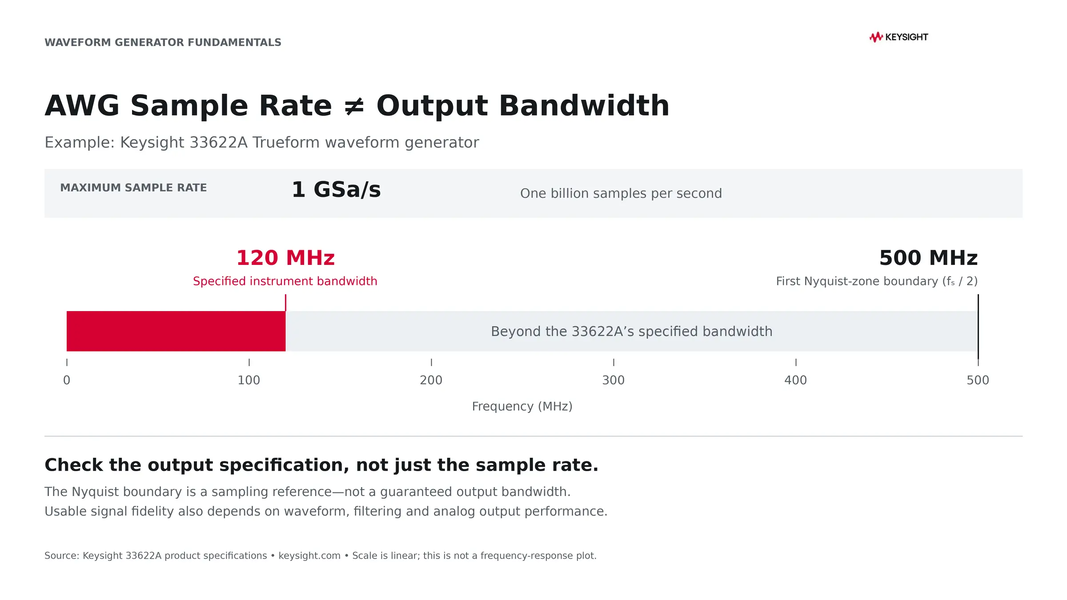
Two numbers follow from the sample rate, and Keysight's guide to arbitrary waveform generator specifications explains both. The Nyquist limit requires the DAC to produce at least 2 points per period, so a 1 GSa/s generator can theoretically produce 500 MHz. In practice, the reconstruction filter reduces usable bandwidth: Keysight's guidance puts usable output at up to roughly 40% of the sample rate, so at most about 400 MHz from that same 1 GSa/s instrument. The specified bandwidth also depends on the analog output path. Memory depth matters too: memory divided by sample rate is your maximum play time, and effective number of bits (ENOB), not the DAC's headline bit count, reflects the real-world resolution.
The Trueform 33622A illustrates the practical arithmetic: 1 GSa/s and 14 bits deliver a specified 120 MHz of bandwidth, not 500 MHz.
Phase Noise and Spectral Purity
Two generators with identical frequency ranges can behave very differently in a receiver test, and phase noise is often why. NIST defines phase noise as the rapid, short-term, random fluctuations in the phase of a wave, specified in dBc/Hz: decibels below the carrier, per hertz of bandwidth, at a stated offset from the carrier. The definitions behind those datasheet numbers are standardized in IEEE Std 1139-2022, so the spec is based on metrology, not marketing language.
Spectral purity is the umbrella term: phase noise plus harmonics and spurious outputs. Keysight's application note How Signal Generator Spectral Purity Affects Measurements explains why it matters: noise on your stimulus appears in your measurement, so a noisy source can mask exactly the behavior you are trying to see.
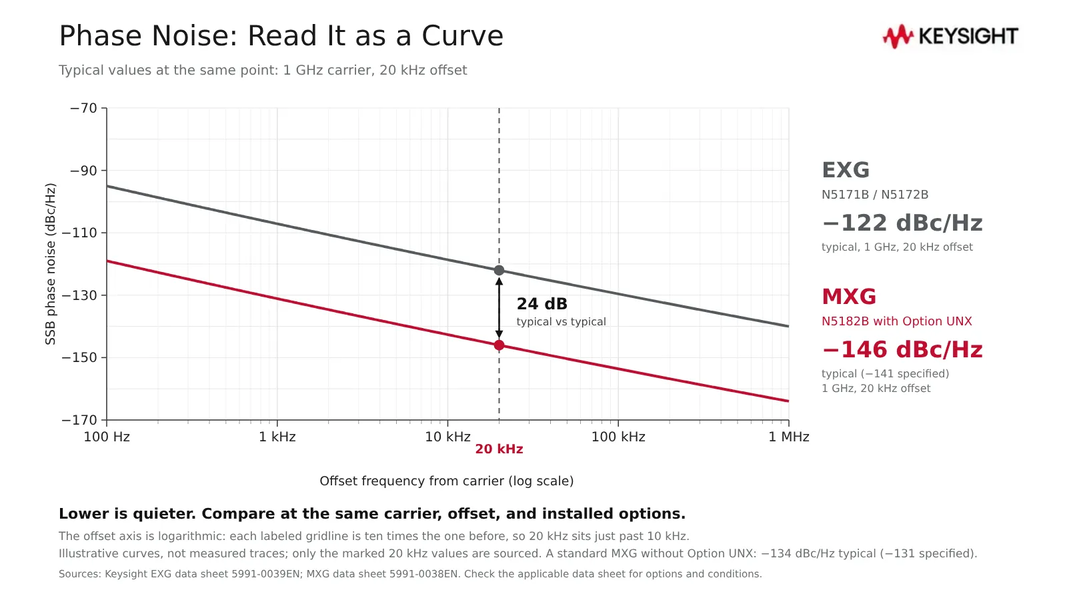
Read the spec as a curve, not a single number, and compare instruments at the same carrier and offset. Class examples from the Keysight MXG and EXG data sheets, both at a 1 GHz carrier and 20 kHz offset: the MXG N5182B with low-phase-noise Option UNX offers -146 dBc/Hz typical (-141 dBc/Hz specified), against -122 dBc/Hz typical for the EXG, a 24 dB gap. A standard MXG without that option is specified at -131 dBc/Hz (-134 dBc/Hz typical), still about 12 dB quieter than the EXG in typical values. That gap can be the difference between an adequate source and one that limits your measurement. Microwave sources are rated at their own carrier and offset: with Option UNY, the PSG E8257D offers -126 dBc/Hz typical (-120 dBc/Hz specified) at 10 kHz offset at a 10 GHz carrier, so set it beside figures quoted at that same point, not beside the X-Series pair.
External Frequency Reference and Output Impedance
Two practical specifications complete the checklist:
- External frequency reference (phase lock). Modern generators can lock to an external reference, typically 10 MHz, through reference input and output connectors. Locking every instrument on the bench to one house standard, the practical meaning of “phase lock mode” on older spec sheets, keeps frequencies consistent across the setup. A fixed, repeatable phase relationship between generators additionally requires a shared local oscillator, for example through Option 012 (LO in/out) on the X-Series or a phase-coherent multi-channel instrument.
- Output impedance. RF and waveform generator outputs are designed as 50-ohm systems: the instrument expects a 50-ohm load, and amplitude calibration assumes it. Driving a mismatched load can cause reflections and level errors rather than instrument damage in most bench cases, but the displayed amplitude may not match the actual delivered level. Check the output connector type (BNC on bench generators; precision coaxial on RF sources), use 50-ohm cable throughout, and check whether the instrument can re-scale its displayed amplitude for high-impedance loads.
What Are the Types of Signal Generators?
Types overlap with the features above, but buyers often shop by type and use case, so here is the map. For the full taxonomy, see the types of signal generators guide. Audio-frequency and video signal generators are left out: any modern function or waveform generator covers the audio band, and video pattern generators are a specialist broadcast category outside this store's focus.
Arbitrary Waveform Generator
An arbitrary waveform generator (AWG) generates electrical signals with waveforms you define, replayed from memory through its DAC. That can include simulating real-world signals: an AWG can replay a captured cardiac waveform to test a medical device that detects heartbeats, or reproduce a sensor’s output, including its noise.
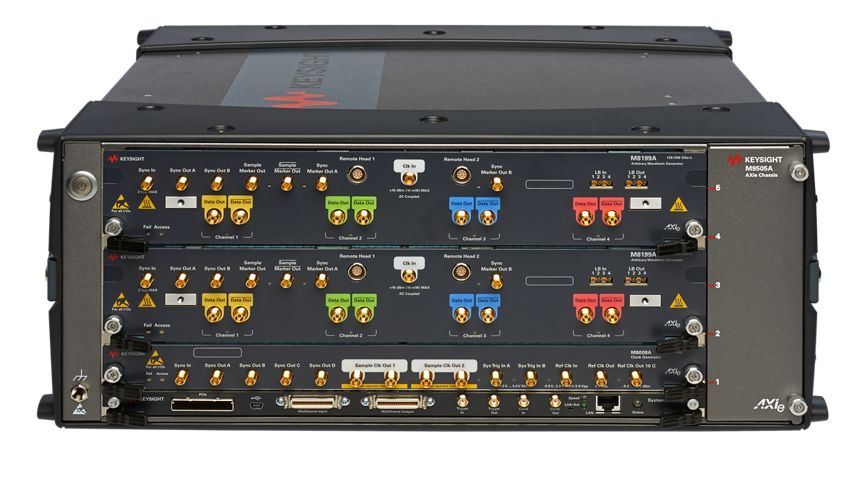
The trade-off is cost per point: deep memory, high sample rates, and good ENOB cost money. If your bench needs complex or captured waveforms, an AWG is the right tool. If you only need standard waveforms, a function generator one tier lower can do the job for less. The arbitrary waveform generator versus function generator guide walks through that decision.
Vector Signal Generator
A vector signal generator is an RF signal generator with a built-in I/Q modulator, so it can produce digitally modulated signals, including 5G NR, Wi-Fi, satellite links, and radar waveforms. The transmitter-quality requirements those signals must meet, including channel bandwidths and error vector magnitude, are defined in standards such as 3GPP TS 38.101-1 for 5G NR. That is why receiver test benches specify vector sources.
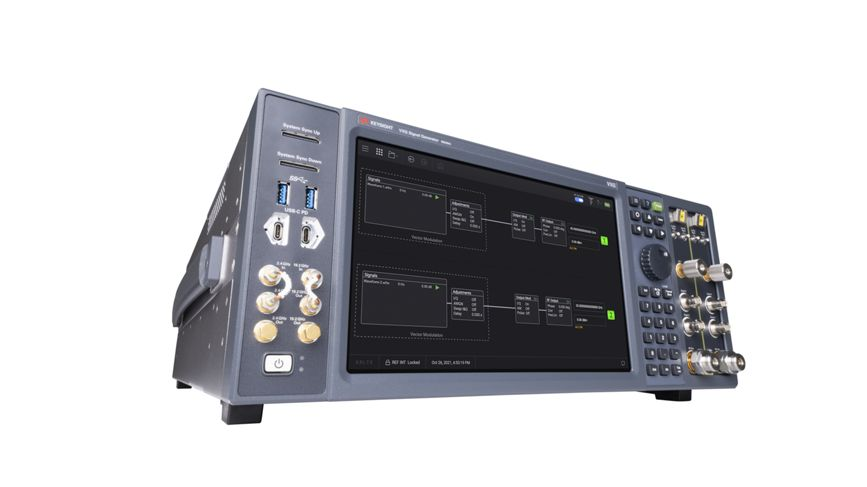
The spec that often separates vector generators is modulation bandwidth: how wide a signal the I/Q system can reproduce. The X-Series (N5172B, N5182B) provides up to 160 MHz of RF modulation bandwidth, depending on installed options, which covers most sub-6 GHz standards. The VXG M9384B extends to 2 GHz of modulation bandwidth for wideband 5G, satellite, and radar work. Vector instruments need periodic calibration to maintain I/Q accuracy, which is one reason to choose Keysight-calibrated used units over unknown-provenance units.
Pulse Generator
A pulse generator produces electrical pulses with settable shape, width, period, and edge times. Pulse and pattern generators support high-speed digital timing tests, serial-data stress tests, and component characterization: the 81134A pulse pattern generator, for example, produces patterns and pulses to 3.35 GHz on 2 channels.
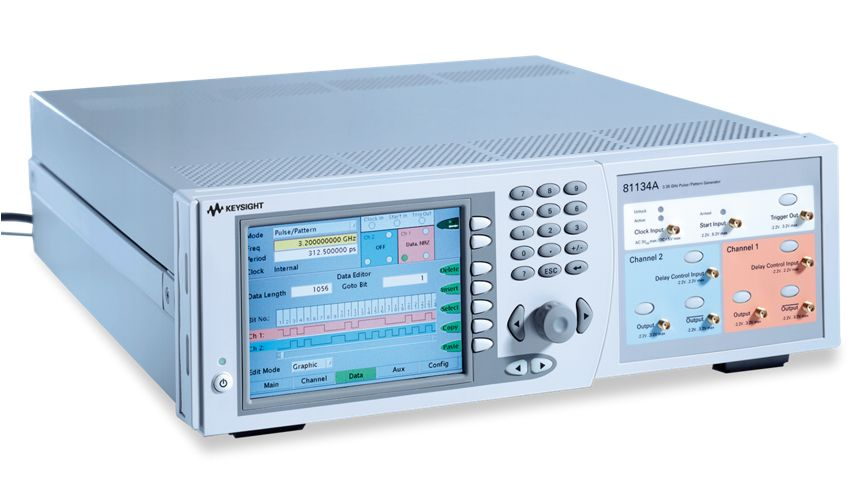
Timing accuracy is the key spec: check jitter and transition-time specs against your fastest signal, and keep the instrument calibrated, since a drifted pulse generator may report edges at the wrong time.
Radio Frequency Signal Generator
An RF signal generator creates continuous-wave and modulated signals at radio frequencies for testing and troubleshooting receivers, amplifiers, and RF modules in cellular, satellite, and general wireless work.
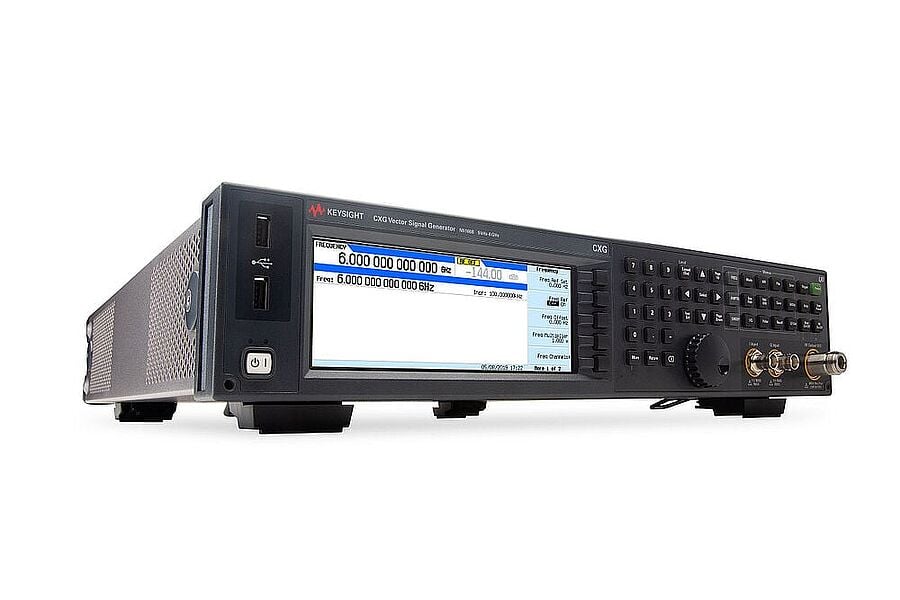
RF generators divide into analog and vector types. Analog generators provide CW (Continuous Wave) plus AM/FM/PM for local oscillator substitution, interference testing, driving an amplifier into compression, and level-calibrated receiver work. Vector generators add I/Q modulation. Phase noise is one of the key ranking specs in this class; at microwave frequencies, it can become the defining one.
Which Keysight Signal Generator Should You Buy?
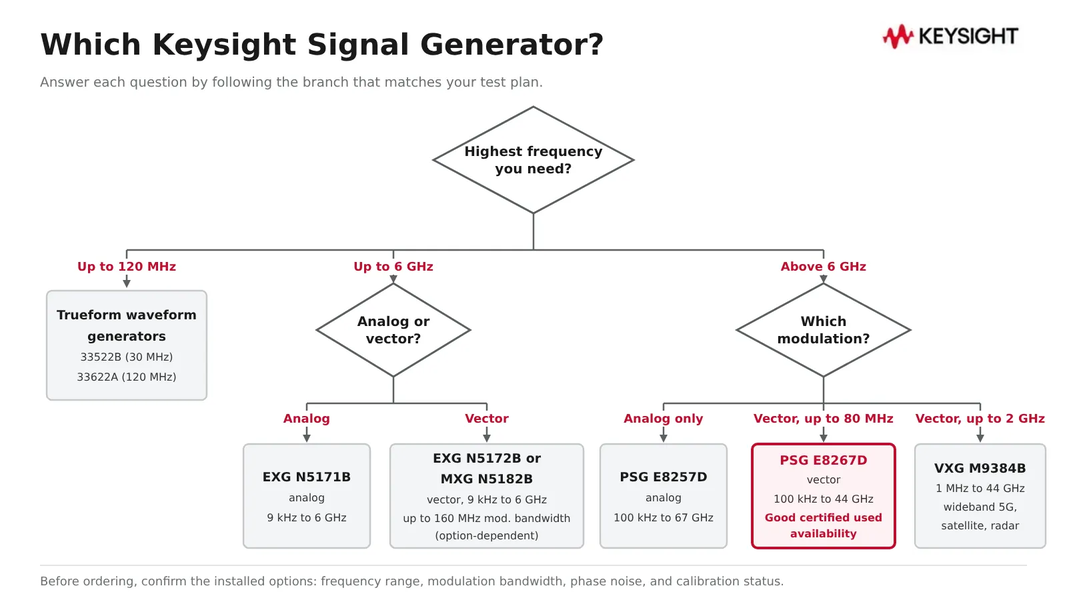
Match the tier to your highest frequency and your modulation needs; Keysight's current signal generators run from 9 kHz to 54 GHz natively, with frequency extenders reaching past 100 GHz. Every row below is verified against the official Keysight product pages.
| Job | Keysight model | Family | Range / bandwidth | Type |
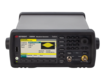
| Bench and baseband work, 2 channels | 33522B | Trueform 33500B Series | 30 MHz, 250 MSa/s, 16-bit | Waveform/arb |
| Faster baseband and pulse work | 33622A | Trueform 33600A Series | 120 MHz, 1 GSa/s, 14-bit | Waveform/arb |
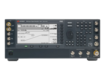
| RF analog, manufacturing test | N5171B | EXG X-Series | 9 kHz to 6 GHz | Analog |
| RF vector, general purpose | N5172B | EXG X-Series | 9 kHz to 6 GHz, up to 160 MHz mod BW (option-dependent) | Vector |
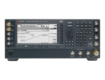
| RF vector, R&D-grade phase noise | N5182B | MXG X-Series | 9 kHz to 6 GHz, up to 160 MHz mod BW (option-dependent) | Vector |
| Microwave analog, up to 40 GHz | N5183B | MXG X-Series | 9 kHz to 40 GHz | Analog |
| Microwave analog, to 67 GHz | E8257D | PSG | 100 kHz to 67 GHz | Analog |
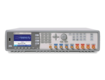
| Microwave vector, radar/EW/satcom | E8267D | PSG | 100 kHz to 44 GHz, up to 80 MHz mod BW | Vector |
| Wideband 5G/satellite, dual channel | M9384B | VXG | 1 MHz to 44 GHz, up to 2 GHz mod BW | Vector |
| Pulse and pattern timing test | 81134A | Pulse pattern generator | 15 MHz to 3.35 GHz, 2 channels | Pulse |
The certified used instrument we highlight is the PSG E8267D vector signal generator (100 kHz to 44 GHz, up to 80 MHz modulation bandwidth): the microwave vector source for radar, electronic warfare, and satellite test benches, with good availability certified used now, including Keysight Premium Used units. On the RF tier, note an important lifecycle fact: Keysight's product page announces that the MXG N5182B is to be discontinued, naming the N5186A as its successor. That makes certified used the practical way to put MXG-class phase noise (-146 dBc/Hz typical at 1 GHz, 20 kHz offset, with Option UNX; check installed options per listing) on a bench at a fraction of a current-generation price; confirm calibration support for your planning horizon when you request a quote. For high-volume 6 GHz work on a tighter budget, the EXG pair (N5171B analog, N5172B vector) covers manufacturing test in a rack-friendly form factor, and the vector signal generators category page shows the wider certified-used lineup.
Is a Used Signal Generator Worth It?
Signal sources can age well when maintained: performance depends heavily on the synthesizer design, and periodic calibration helps keep the instrument accurate over time. That makes the used-equipment question mostly a provenance question.
| Decision factor | Certified used from Keysight | New |
| Price versus new list | Up to 90% lower (Keysight Used), up to 70% lower (Keysight Premium Used) | Full list price |
| Warranty | Up to 5 years warranty options | Standard factory warranty options |
| Calibration | Keysight calibrated (Keysight Premium Used); calibration as listed (Keysight Used) | Factory calibrated |
| Inspection | 101-point checklist on Keysight Premium Used units | Factory final test |
| Installed options | Verified per listing, with more options addable on Keysight Premium Used | Configured at order |
| Support | KeysightCare access | KeysightCare access |
| Availability | Multiple units in stock across tiers | Lead time depends on configuration |
Buying certified used equipment direct from Keysight removes most of the usual used-market risk. Keysight Premium Used units are refurbished at the factory that builds new instruments, inspected against a 101-point checklist, fully calibrated, and pass the same final test as a new product. Keysight Used units ship in working condition with calibration as listed, at deeper savings. Both tiers offer up to 5 years of warranty options. Calibration is one detail to insist on for any signal source, because a generator with drifted level accuracy or degraded spectral purity fails quietly: your measurements move, and nothing on the front panel says why. Confirm the calibration status and installed options per listing before you order.
How to Narrow Down Your Choice
The buying decision comes down to four questions. What is the highest frequency your test plan needs? Do you need analog purity or vector modulation? What phase noise can your most sensitive measurement tolerate? For arbitrary waveforms, how much usable bandwidth and play time does the sample-rate math give you? Answer those questions, and the model table above should narrow the choice quickly: Trueform for the bench, X-Series for RF, PSG or VXG for microwave.
Certified used from Keysight brings these instrument families within reach of tighter budgets, with warranty options and Keysight calibration behind them. Browse the certified used signal generators and request a quote for the configuration that fits.
Whenever You’re Ready, Here Are
5 Ways We Can Help You
1
Browse our certified used signal generators and request a quote for current pricing
2
Call tech support US: +1 800 829-4444
Press #, then 2. Hours: 7am – 5pm MT, Mon– Fri
3
Contact our sales support team
4
Create an account to get price alerts and access to exclusive waitlists
5
Talk to your account manager about your specific needs
Frequently Asked Questions
A signal generator is an instrument that produces electrical signals with known, settable properties: frequency, amplitude, waveform shape, and modulation. Engineers use signal generators to drive circuits under test, substitute for missing signals during troubleshooting, and supply calibrated stimuli for receiver and component measurements.
Start with frequency range (your highest test frequency plus headroom), then decide analog or vector by whether you need digitally modulated signals. After that, rank candidates by phase noise at your working offsets, modulation bandwidth if you need vector capability, and practical bench features: channel count, external reference connectors, and remote control over USB, LAN, or GPIB with SCPI commands, so you can automate tests from Python or LabVIEW and make them repeatable.
A function generator produces standard lower-frequency waveforms, such as sine, square, triangle, and pulse, up to tens or hundreds of megahertz for general circuit work. An RF signal generator produces calibrated continuous-wave and modulated carriers at radio and microwave frequencies, with the level accuracy and spectral purity receiver testing often requires. The Trueform 33622A sits in the first camp; the EXG, MXG, and PSG families sit in the second.
Analog is enough when your tests use continuous-wave, swept, or AM/FM/PM signals, such as local-oscillator substitution, interference generation, and filter sweeps. You need vector capability when your device expects a digitally modulated signal. An analog generator cannot produce a 5G NR or Wi-Fi signal, or a complex radar waveform such as a wideband chirp, although its FM and pulse modulation cover narrowband chirps and simple pulsed-radar tests. Buying analog when you need vector capability can create a costly gap; buying vector when analog is enough may waste budget.
The frequency range is the span between the lowest and highest frequencies the instrument can produce. It varies by instrument class: Trueform waveform generators reach 30 to 120 MHz, X-Series RF generators span 9 kHz to 6 GHz, and PSG microwave generators run from 100 kHz up to 67 GHz, with frequency extenders reaching beyond that range.
A signal generator usually outputs an AC waveform: a time-varying signal at a set frequency, which includes audio-band signals. Many waveform generators can also apply a DC offset or output a DC level, so the practical answer is AC by design, with DC offset available on many bench instruments.
The price range is wide because frequency range and modulation capability drive the hardware: a bench waveform generator and a 44 GHz vector source are different classes of machine. Certified used pricing from Keysight sits well below new list across those classes; request a quote on a specific model and option set for a current figure.
A 2-channel benchtop Trueform waveform generator can cover many learning and hobbyist projects, from audio filters to the analog front end of an Arduino or Raspberry Pi project: standard waveforms, modulation, sweep, and arbitrary playback in one instrument for a beginner or a teaching lab. Keysight's certified used pricing puts lab-grade instruments inside education budgets, and Keysight offers an additional 15% education discount for educators and researchers on top of the standard certified-used savings.
Browse the certified used inventory and request a quote
Sources
- Keysight Technologies, How Signal Generator Spectral Purity Affects Measurements (application note, lit. 5952-2019): spectral purity, drift, and short-term instability.
- Keysight Technologies, The Essential Signal Generator Guide, Part 2 (white paper, lit. 5992-3619): single-sideband phase noise measurement and the analog-versus-vector distin
- Keysight Technologies, Understanding Phase Noise Needs and Choices in Signal Generation (application note, lit. 5991-1744): synthesizer architecture and phase noise trad
- Keysight Technologies, Know Your Top Arbitrary Waveform Generator Specifications (Keysight Knowledge Center): Nyquist, the 40% usable-bandwidth
- IEEE Standards Association, IEEE Std 1139-2022: Standard Definitions of Physical Quantities for Fundamental Frequency and Time Metrology.
- NIST, Time and Frequency from A to Z: Phase Noise.
- 3GPP, TS 38.101-1: NR User Equipment radio transmission and reception, Range 1.
- Keysight Technologies, PSG, MXG and EXG Microwave Signal Generators (brochure, lit. 5991-4876): portfolio overview (2017); current ranges and phase-noise figures come from th
- Keysight Technologies, PSG Signal Generators data sheet (lit. 5989-0698EN): E8257D phase noise, specified and typical, by option.
- Keysight Technologies, X-Series MXG Signal Generators data sheet (lit. 5991-0038EN): N5182B phase noise with and without Option UNX; baseband bandwidth options.
- Keysight Technologies, X-Series EXG Signal Generators data sheet (lit. 5991-0039EN): EXG typical phase noise; baseband bandwidth options.
- Keysight Technologies, M9484C VXG and V3080A Vector Signal Generator and Frequency Extender (data sheet, lit. 3122-1445.EN): VXG frequency range and
- Keysight Technologies, How to Generate Multi-Channel Phase-Stable and Phase-Coherent Signals (Keysight blog): shared 10 MH