


Title
Takes many samples in one pass, on its own clock
Keysight Oscilloscope Glossary
What Is a Digital Sampling Oscilloscope?

Introduction
A digital sampling oscilloscope measures a signal at a series of points in time, converts each measurement into a number and shows the numbers as a waveform. A sampling oscilloscope, also called an equivalent-time sampling oscilloscope, builds the waveform from many passes of a repeating signal, which suits repeating high-speed signals where noise and jitter requirements are tight. A real-time oscilloscope takes its samples in one pass, which suits one-off events.
A sampling oscilloscope needs two things before it can build a waveform. The first is a repeating signal. What is the second?
Key Takeaway
A digital sampling oscilloscope digitizes a signal, stores it and lets you analyze it. Real-time sampling captures a single event; equivalent-time sampling needs a repeating signal. Check bandwidth, sampling rate, memory depth and triggering before you buy.
Understanding Digital Sampling Oscilloscopes
Digital oscilloscopes observe and measure electronic signals. Unlike an analog oscilloscope, which draws the incoming voltage directly, a digital oscilloscope digitizes the signal and stores it for analysis, as Keysight's oscilloscope basics article describes. Keysight's comparison of real-time and sampling oscilloscopes reports that all modern oscilloscopes are digital storage oscilloscopes (DSOs), so the name alone does not tell you which sampling method an instrument uses. Most DSOs on the market are real-time oscilloscopes, and this page uses DSO for that type from here on. The wider family is covered in our digital oscilloscope entry.
Key Components of a DSO
- Analog front end: conditions the incoming signal for sampling.
- Analog-to-digital converter (ADC): converts the conditioned signal into digital values.
- Memory: stores the digitized signal for processing and display.
- Digital processing unit: handles filtering, scaling and waveform reconstruction.
- Display: shows the processed waveform.
How DSOs Work
Think of a DSO as a camera for electrical signals: it takes snapshots in rapid succession and joins them into a picture of the waveform.
Analog Signal Conditioning
The signal must fit the ADC's input range before it can be digitized.
- Attenuation: large voltages are reduced to a level the ADC can accept.
- Amplification: small voltages are boosted into a measurable range.
- Filtering: unwanted frequencies and noise are reduced.
Sampling and Digitization
The ADC turns the conditioned signal into numbers in three steps.
- Sampling: the ADC records the signal's amplitude at discrete intervals set by the sampling rate.
- Quantization: each sample is rounded to the nearest available digital level.
- Encoding: the levels are converted to binary code for processing.
Two settings shape the result. The sampling rate is how many samples the ADC takes per second, and a higher rate resolves faster changes, up to the limit set by the bandwidth. The bit depth is the number of bits per sample, which sets how finely the amplitude is measured.
Storing and Processing
Once the samples are in memory, the oscilloscope can process them:
- Waveform averaging: combines repeated acquisitions of a repeating signal to reduce random noise.
- Fast Fourier transform (FFT): converts the time-domain signal into frequency components for spectral analysis.
- Math functions: differentiation, integration and similar calculations.
What Is the Difference Between Real-Time and Equivalent-Time Sampling?
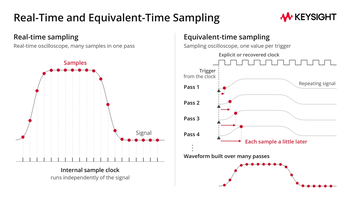
Keysight's comparison of real-time and sampling oscilloscopes describes the two methods like this. A real-time oscilloscope uses an internal sample clock that runs independently of the signal, at a rate faster than the signal. Remember the second thing? A sampling oscilloscope samples in step with the signal and needs either an explicit clock or a clock recovered from the data. A sampling oscilloscope digitizes a single value per trigger and repeats this over many passes.
| Real-time oscilloscope | Sampling (equivalent-time) oscilloscope | |
|---|---|---|
| How it samples | Takes many samples in one pass, on its own clock | Takes one value per trigger, over many passes |
| Signal it needs | Repeating or one-off signals within its bandwidth | A repeating signal plus an explicit or recovered clock |
| Triggering | Can trigger on arbitrary criteria | Triggers from the clock or a pattern derived from it |
| Typical use | General debugging, single events, protocol decoding | High-speed serial, optical and TDR measurements |
Real-time oscilloscope
Sampling (equivalent-time) oscilloscope
How it samples
Title
Takes one value per trigger, over many passes
Signal it needs
Title
Repeating or one-off signals within its bandwidth
Title
A repeating signal plus an explicit or recovered clock
Triggering
Title
Can trigger on arbitrary criteria
Title
Triggers from the clock or a pattern derived from it
Typical use
Title
General debugging, single events, protocol decoding
Title
High-speed serial, optical and TDR measurements
The Keysight oscilloscope basics article gives the same limit: equivalent-time sampling only works for repetitive signals, because it builds the image over several acquisitions.
Both types make eye diagrams, histograms and jitter measurements, and both are available with bandwidths of more than 100 GHz. A sampling oscilloscope can use a converter with a lower sample rate and higher vertical resolution, often up to 14 bits. Keysight describes it as strongest where noise and jitter requirements are most stringent, and names optical transceiver manufacturing test as a key application. A sampling oscilloscope can also combine electrical, optical and TDR channels. Keysight's sampling oscilloscopes include the DCA-X platform (such as the N1000A mainframe, which takes plug-in modules) and the standalone DCA-M.
Advantages of Digital Sampling Oscilloscopes
Signal Detail
- Sampling rate: on a real-time oscilloscope, a higher rate resolves faster changes and short transient events, up to the limit set by the bandwidth. It matters most for fast digital signals.
- Bit depth: more bits give finer amplitude steps, which helps you see small differences in signal behavior.
Functions Beyond Display
- Triggering options: on a real-time oscilloscope, edge, pulse width and pattern triggering let you capture a specific event inside a complex signal.
- Post-processing: mathematical functions and other calculations run on the stored data.
- Storage and playback: captured waveforms can be saved and recalled later.
Usability
- Interface: many DSOs have a built-in touch screen as well as front-panel buttons.
- Remote operation: some DSOs can be operated remotely from a PC.
Common Applications
Most of these uses come from Keysight's real-time versus sampling comparison.
Signal Integrity Analysis
- Eye diagrams: overlay many symbol transitions to show noise and jitter on a high-speed bus. A bit error rate tester counts the errors themselves.
- Jitter measurement: quantify the timing variation of data and clock signals.
Debugging and Production Test
- Intermittent faults: a triggered capture with pre-trigger samples shows the signal before and after a sporadic event.
- Protocol decoding: real-time oscilloscopes can be fitted with software that decodes and tests protocols such as USB, DDR and PCI Express.
- Optical transceiver manufacturing test: a key application for sampling oscilloscopes.
What Specifications Should You Consider?
When you select a DSO, compare these specifications:
| Specification | Description |
|---|---|
| Bandwidth | The frequency at which a sine wave's displayed amplitude falls to about 70.7% of its true value (the 3 dB point), according to Keysight. Choose a bandwidth well above your signal's highest frequency. |
| Sampling rate | How often the signal is sampled. Higher rates resolve faster changes, up to the bandwidth limit. |
| Memory depth | How many samples can be stored. Deeper memory keeps the sampling rate high over longer captures. |
| Vertical resolution | The precision of amplitude measurements, usually in bits. |
| Triggering options | The types of event that can start an acquisition. |
| Connectivity | Ports such as USB and external monitor outputs, and remote operation from a PC. |
Specification
Description
Bandwidth
Title
The frequency at which a sine wave's displayed amplitude falls to about 70.7% of its true value (the 3 dB point), according to <a href="t3://page?uid=3807>Keysight</a>. Choose a bandwidth well above your signal's highest frequency.
Sampling rate
Title
How often the signal is sampled. Higher rates resolve faster changes, up to the bandwidth limit.
Memory depth
Title
How many samples can be stored. Deeper memory keeps the sampling rate high over longer captures.
Vertical resolution
Title
The precision of amplitude measurements, usually in bits.
Triggering options
Title
The types of event that can start an acquisition.
Connectivity
Title
Ports such as USB and external monitor outputs, and remote operation from a PC.
Our used oscilloscope buying guide walks through these choices in more detail.
Tips for Using a Digital Sampling Oscilloscope
- Select the appropriate bandwidth: choose a bandwidth well above the highest frequency component of your signal. Keysight's bandwidth limits article suggests at least five times that frequency. At the rated bandwidth, a sine wave already reads about 30% low, because the 3 dB point is 70.7% of the true amplitude.
- Set the sampling rate with margin: The sampling theorem says a signal can be rebuilt exactly if it is sampled at more than twice its highest frequency, and sampling below that causes aliasing. Keysight's oscilloscope basics article recommends a sample rate of at least 2.5 times the bandwidth, ideally 3 times or more, which for a 100 MHz oscilloscope means at least 250 MSa/s, ideally 300 MSa/s or more. Its bandwidth limits article uses a stricter five times, or 500 MSa/s for the same oscilloscope. Both apply to real-time sampling.
- Adjust the vertical scale: fill the screen with the signal's amplitude range without clipping it.
- Use matching probes: Keysight's oscilloscope basics article gives 600 MHz as the dividing line between passive and active probes, but individual probes differ: Keysight's N2876A passive probe is rated from DC to 1.5 GHz into a 50 ohm oscilloscope input. Check the probe's own bandwidth, because probe quality affects measurement accuracy.
- Use the trigger: a stable trigger isolates the event you want to see.
Where Does Time-Domain Reflectometry Fit?
Time-domain reflectometry (TDR) checks impedance along a cable, connector or circuit board trace, and Keysight describes it as a sampling oscilloscope measurement. On its TDR impedance page, a sampling oscilloscope with a TDR/TDT module sends a calibrated step into the device under test and captures the reflected signals. The reflections are converted into impedance versus time or distance. Keysight's application note High Precision Time Domain Reflectometry explains the principle: wherever the impedance changes, part of the step is reflected back. The arrival time of the reflection, together with the propagation velocity in the device, gives the position of the change, and the size of the reflected pulse compared with the original gives its magnitude. The same note says the rise time of the step and the oscilloscope's bandwidth limit the accuracy. For the first reflection from a resistive mismatch, the reflection coefficient is (ZL – Z0)/(ZL + Z0), where Z0 is the reference impedance and ZL is the impedance at the discontinuity. A reflection with the same sign as the step means the impedance rose, and an opposite sign means it fell.
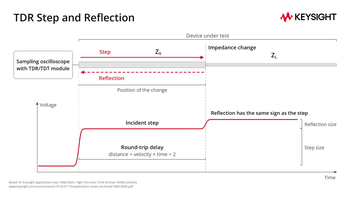
A vector network analyzer (VNA) approaches the same question from the frequency side. A VNA sweeps a test signal across a band and measures what reflects, and some VNAs can convert those results into a time-domain view. Keysight's application note Time Domain Analysis Using a Network Analyzer describes the method. If you check cables or lines for impedance and reflection, a network analyzer gives you the frequency-domain view. The E5071C (up to 20 GHz) is one such VNA, sold used. Check which options are installed on each unit if you need time-domain analysis. The E5071C is discontinued: its data sheet gives a last order date of May 31, 2021, and Keysight recommends the E5080B for new purchases.
Frequently Asked Questions
Equivalent-time sampling builds a waveform from many passes of a repeating signal. On each trigger the oscilloscope takes one sample, a little later in the pattern each time, and then reconstructs the waveform from those samples, as Keysight's comparison describes. Some real-time oscilloscopes also offer a random equivalent-time sampling mode, so the mode name alone does not make an instrument a sampling oscilloscope.
Yes. A sampling oscilloscope acquires over many passes, so it needs a repeating pattern and either an explicit clock or a clock recovered from the data. A real-time oscilloscope can capture a non-repeating signal.
Keysight uses the two names for the same type of instrument. It describes its sampling oscilloscopes as digital communication analyzers (DCAs) to highlight their strength with the high-speed digital signals used in data centers and wireline telecommunication systems. The store has a category page for digital communication analyzers.
Putting a Digital Sampling Oscilloscope to Work
A digital sampling oscilloscope gives you stored waveforms to measure, compare and analyze, whether you debug a circuit or characterize a high-speed link. Pick the sampling method that matches your signal: real-time for one-off events, equivalent-time for repeating high-speed signals.
Browse used oscilloscopes in the Official Keysight Used Equipment Store.
Whenever You’re Ready, Here Are
5 Ways We Can Help You
1
Browse our used oscilloscopes
2
Call tech support US: +1 800 829-4444
Press #, then 2. Hours: 7am – 5pm MT, Mon– Fri
3
Contact our sales support team
4
Create an account to get price alerts and access to exclusive waitlists
5
Talk to your account manager about your specific needs
Sources
- Keysight Technologies, Real-Time vs. Sampling Oscilloscopes: What Are the Differences?: sampling methods, clocking, triggering
- Keysight Used Equipment Store, Oscilloscope Basics: equivalent-time sampling and the sample rate guideline.
- Keysight Technologies, High Precision Time Domain Reflectometry (5988-9826): reflection principle, position and magnitude, accuracy limits.
- Keysight Technologies, Characterize TDR impedance: sampling oscilloscope with TDR/TDT module.
- Keysight Technologies, Time Domain Analysis Using a Network Analyzer (5989-5723EN).
- Keysight Technologies, E5071C ENA Vector Network Analyzer data sheet (5989-5479EN): discontinuance notice and E5080B recommendation.
- Stanford CCRMA, Sampling Theorem: reconstruction and aliasing.
- Keysight Used Equipment Store, What Is a Network Analyzer?.
- Keysight Used Equipment Store, What Are Bandwidth Limits in Oscilloscopes?: the 3 dB point, 70.7% amplitude and the five-times rules.
- Keysight Used Equipment Store, What Is a Digital Storage Oscilloscope?.
- Wikipedia, Time-domain reflectometer: reflection coefficient and sign convention.
- Keysight Technologies, N2876A Passive Probe, 100:1, 1.5 GHz: passive probe bandwidth.