



Title
256
Buying Guide
14-Bit Oscilloscope Buying Guide: Specs, ENOB, and When You Need One

Introduction
You know the moment. The rail should show 2 millivolts of ripple, but instead the screen shows a wide band of quantization noise. The datasheets you compare emphasize bit count and bury the noise floor. The whitepapers crop their axes, and the deadline does not care. Buying a high-resolution oscilloscope should not require a course in converter theory or a leap of faith.
This guide explains the buying decision behind the 14-bit class: what the extra bits actually buy, how to read ENOB, when 8 bits is enough, which Keysight instrument delivers native 14-bit resolution, and what the capability costs to own. The reference instrument throughout is the Keysight InfiniiVision HD3 (HD304MSO), available certified used direct from Keysight.
Overview
- A 14-bit oscilloscope digitizes each sample into 1 of 16,384 levels, which is 64 times the 256 levels of an 8-bit scope. At a 5 V full scale, that means an ideal step size of about 0.31 mV versus about 19.5 mV.
- Bits set the ceiling; ENOB and the noise floor show what the instrument can actually deliver. ENOB is measured per IEEE Std 1057-2017, and the question that follows is always: at which frequency?
- The Keysight InfiniiVision HD3 (HD304MSO) is a native 14-bit instrument: 3.2 GSa/s, 200 MHz to 1 GHz bandwidth options, 20 to 100 Mpts memory, 4 analog + 16 digital channels, 50 µVRMS noise floor (2 mV/div, 50 Ω, 1 GHz), integrated 100 MHz WaveGen (HD3WAVEGEN license option) and frequency response analyzer.
- When your work is logic timing or general debug, 8 to 10 bits is usually enough. Millivolt ripple, PSRR, and EV bus measurements are where 14 bits pay.
- Certified used instruments cost well below new list price and can include up to 5 years of warranty options and calibration documentation.
What Does 14-Bit Resolution Actually Mean?
A 14-bit oscilloscope digitizes each sample into 1 of 16,384 levels (2 to the power of 14), 64 times the resolution of an 8-bit scope's 256 levels. That is the job of a digital oscilloscope's converter: turn the analog signal into discrete levels while preserving the waveform details that matter. Waveform details smaller than one level may disappear into the record, which is why bit count helps determine what the instrument can resolve.
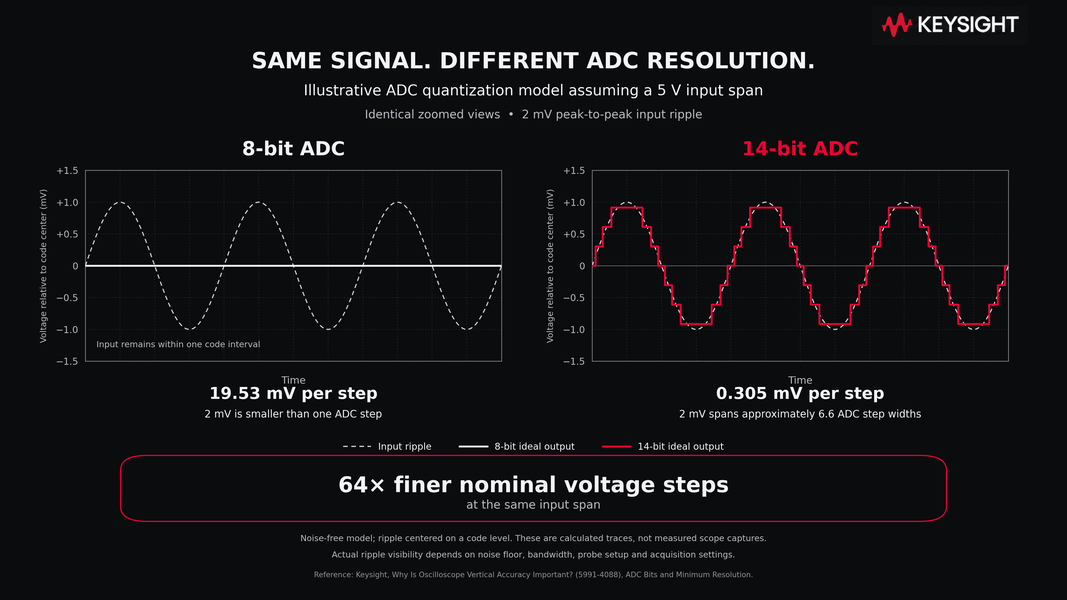
The math turns bit depth into an ideal step size quickly. Divide the full-scale range by the level count. For an ideal converter at a 5 V full scale, an 8-bit converter steps in about 19.5 mV increments, while a 14-bit converter steps in about 0.31 mV increments. A 2 mV ripple can sit inside a single ideal 8-bit step; at 14 bits, it spans about six levels. Treat this as an illustrative quantization calculation, not the smallest signal a given oscilloscope can resolve: real measurement capability also depends on vertical scale and offset, front-end noise, ENOB, bandwidth, and the probe setup, which the sections below cover.
| ADC resolution | Levels | Ideal ADC step size at 5 V full scale | Illustrative detail at or below one step |
|---|---|---|---|
| 8-bit | 256 | 19.5 mV | mV-class ripple, small sensor signals |
| 10-bit | 1,024 | 4.9 mV | fine ripple detail, low-level noise |
| 12-bit | 4,096 | 1.2 mV | sub-millivolt regulation artifacts |
| 14-bit | 16,384 | 0.31 mV | 0.3 mV-scale detail; front-end noise and ENOB often set the limit first |
ADC resolution
Levels
Ideal ADC step size at 5 V full scale
Illustrative detail at or below one step
8-bit
Title
19.5 mV
19.5 mV
Title
mV-class ripple, small sensor signals
mV-class ripple, small sensor signals
10-bit
Title
1,024
1,024
Title
4.9 mV
4.9 mV
Title
fine ripple detail, low-level noise
fine ripple detail, low-level noise
12-bit
Title
4,096
4,096
Title
1.2 mV
1.2 mV
Title
sub-millivolt regulation artifacts
sub-millivolt regulation artifacts
14-bit
Title
16,384
16,384
Title
0.31 mV
0.31 mV
Title
0.3 mV-scale detail; front-end noise and ENOB often set the limit first
0.3 mV-scale detail; front-end noise and ENOB often set the limit first
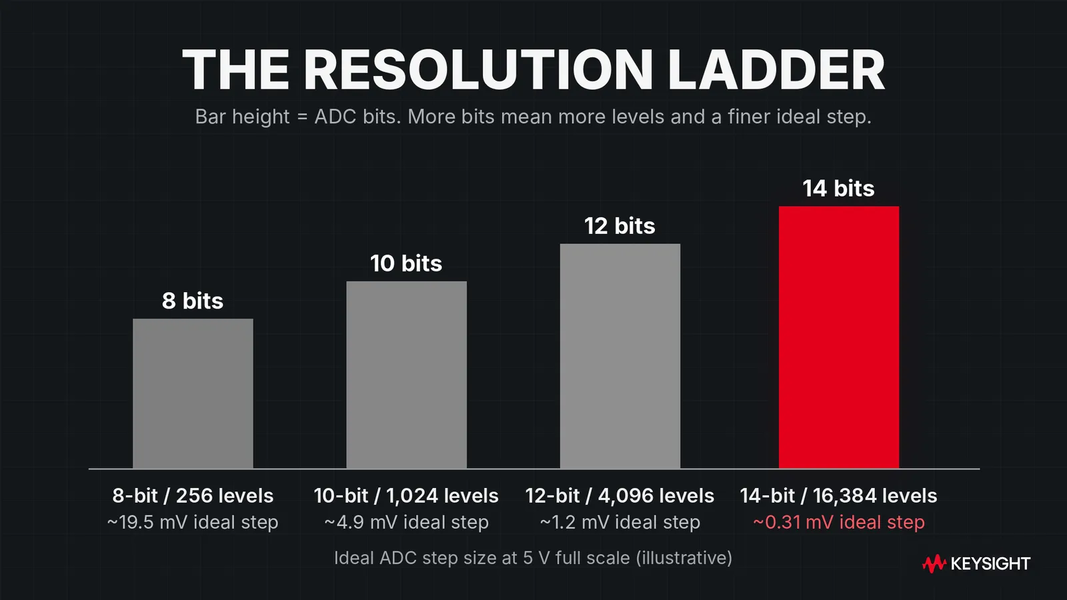
The ceiling is set by the standard converter formula SNR = 6.02·N + 1.76 dB (Analog Devices MT-001, Walt Kester): about 49.9 dB for an ideal 8-bit converter versus 86.0 dB for 14 bits. That 36 dB gap can be the difference between a usable measurement and a noisy estimate at millivolt scale.
If the fundamentals are new, our vertical resolution glossary entry covers what high vertical resolution means on screen and the analog-to-digital converter entry covers how the sampling works.
Is 14-Bit Real? ENOB, Noise Floor, and the Honest Datasheet
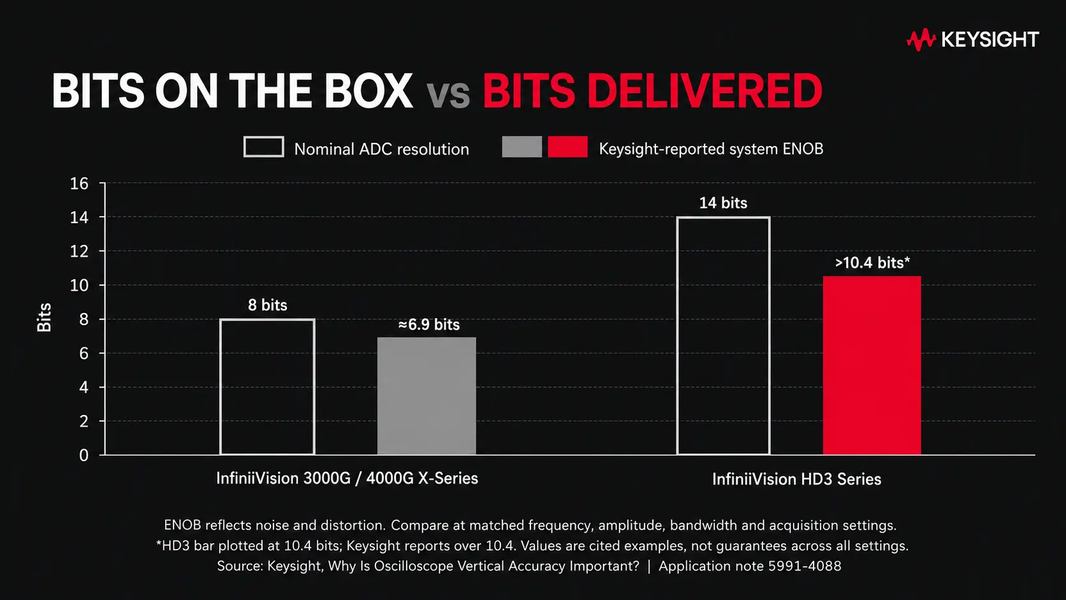
Nominal bits set the ceiling, but ENOB and the noise floor show what the instrument can actually deliver. Noise and distortion reduce real-world resolution, which is why effective number of bits matters.
ENOB is a measured quantity, not just a nominal bit count. IEEE Std 1057-2017 covers terminology and test methods for digitizing waveform recorders, including sine-wave-fit methods, while IEEE Std 1241-2023 provides common terminology and test methods for evaluating analog-to-digital converters. When a datasheet quotes ENOB, the follow-up question that matters is: at which frequency was it measured?
The front end affects the resolution before the ADC sees the signal. A low-noise amplifier chain helps keep the delivered bits closer to the nominal bit count. Keysight's published support data makes the point with system-level numbers: general-purpose 8-bit InfiniiVision models measure system ENOB around 6.9, while the HD3 series measures system ENOB above 10.4 (Keysight support KB on oscilloscope ENOB). Pair that with the HD3's about 50 µVRMS noise floor (at 2 mV/div, 50 Ω, 1 GHz), and the 14 bits stay useful in practice, not just on the spec sheet.
Read any high-resolution oscilloscope datasheet with this checklist:
- ENOB at your working bandwidth, not just the headline value
- Noise floor at the V/div settings you actually use
- Native ADC bits versus software-enhanced mode bits
- Sample rate while the full resolution is active
- Input sensitivity range for your smallest signals
One more habit worth keeping: check how sampling rate is specified alongside resolution, because the 2 specs trade against each other in converter design.
Precision numbers you can verify beat adjectives: see the 14-bit InfiniiVision HD3 (HD304MSO) offer and request a quote.
When Do You Need 14 Bits (and When Is 8 Enough)?
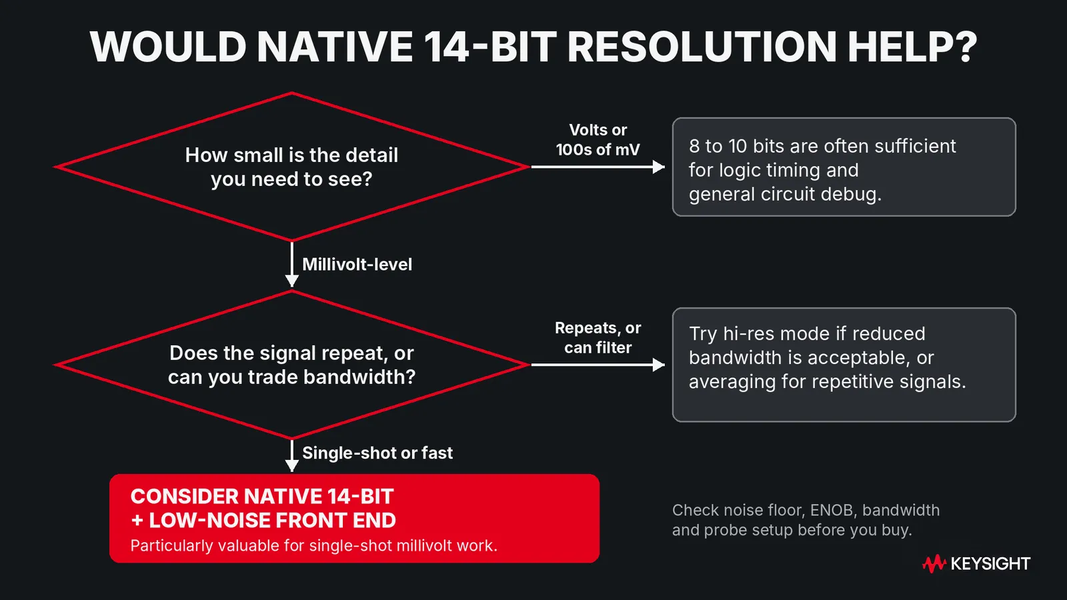
Buy the bits your signals need: millivolt work often needs 14 bits, while logic timing usually does not. Here is a working map. Treat the values as application-dependent guidance rather than hard thresholds: the resolution a measurement needs also depends on vertical range and offset, bandwidth, front-end noise, probe attenuation, and the measurement uncertainty you need.
| Measurement | Typical signal | Typical resolution to consider (bits) |
|---|---|---|
| Digital logic and timing verification | volts | 8 |
| General circuit debug | 100s of mV | 8 to 10 |
| Power rail ripple on 1 to 5 V rails | 1 to 10 mV | 12 to 14 |
| PSRR and regulator output noise | µV to mV | 14 |
| EV bus ripple riding large offsets | mV on 12 to 800 V systems | 14 |
| Precision sensor and AFE chains | µV to mV | 14 |
Measurement
Typical signal
Typical resolution to consider (bits)
Digital logic and timing verification
Title
volts
volts
Title
8
8
General circuit debug
Title
100s of mV
100s of mV
Title
8 to 10
8 to 10
Power rail ripple on 1 to 5 V rails
Title
1 to 10 mV
1 to 10 mV
Title
12 to 14
12 to 14
PSRR and regulator output noise
Title
µV to mV
µV to mV
Title
14
14
EV bus ripple riding large offsets
Title
mV on 12 to 800 V systems
mV on 12 to 800 V systems
Title
14
14
Precision sensor and AFE chains
Title
µV to mV
µV to mV
Title
14
14
Two buying triggers cover many real cases. The first trigger is small signals riding large offsets. Measuring millivolt ripple on a 48 V or 400 V bus means the signal of interest occupies only a sliver of the input range, and a high-resolution front end leaves more levels for that detail. The second trigger is deep dynamic range in one capture. PSRR sweeps and regulation artifacts may sit 40 to 80 dB below the carrier or rail.
Power and EV examples show why this matters. Analog Devices' signal-chain power guidance (Perez and Pasaquian, Analog Dialogue, March 2021) puts it plainly: every high-speed signal chain has a maximum allowable rail ripple, established before the power tree is designed. Verifying millivolt-class limits on a 1 V rail is measurement work where an 8-bit front end may not provide enough resolution. In EV work, the signals of interest get even smaller relative to the rail: millivolt-level ripple and transients on battery-management supply rails need to be seen and correlated with bus activity, which is where high vertical resolution and a low noise floor pay off.
If your work sits in the top half of the table, you may be able to keep the budget lower and skip the premium tier. For automotive-leaning work, the automotive oscilloscopes glossary frames where scopes fit in vehicle labs.
Not sure which row you live in? Browse the certified used inventory and request a quote with your measurement list.
Native 14-Bit vs Hi-Res and Averaging Modes
Many modern scopes offer resolution-enhancement modes, and they can be useful once you understand the trade-offs. Hi-res, or boxcar, filtering averages adjacent samples inside one acquisition. It adds apparent bits but costs bandwidth. Averaging combines repeated acquisitions. It adds apparent bits but requires a repetitive, stable signal. Neither mode restores a single-shot transient that the ADC did not resolve.
The trade-off is well documented in converter research. R. H. Walden's IEEE survey observed resolution falling roughly 1 bit for every doubling of sample rate, and Boris Murmann's public ADC Performance Survey (1997-2026) tracks the same frontier today. Hi-res and averaging modes approach that limit from the other side: they add apparent bits by giving up bandwidth or requiring repetition. In the HD3, a native 14-bit ADC at 3.2 GSa/s is a deliberate architecture choice. It preserves native bit depthon each acquisition across its specified instrument bandwidth, instead of relying on filtering or repeated captures to add apparent resolution. Its 15- and 16-bit high-resolution settings, by contrast, use bandwidth limiting. Other 14-bit architectures make their own trade-offs, so check the bandwidth at which a datasheet specifies full native resolution.
| Approach | Single-shot? | Full bandwidth? | Works on transients? | Typical use |
|---|---|---|---|---|
| Native 14-bit ADC (HD3) | Yes | Yes (across specified bandwidth) | Yes | mV ripple, PSRR, EV rails, precision chains |
| Hi-res (boxcar) mode | Yes | No (filtered) | Partly (slow edges survive) | slower signals on an existing scope |
| Averaging | No (needs repeats) | Yes | No | repetitive waveforms, noise cleanup |
Approach
Single-shot?
Full bandwidth?
Works on transients?
Typical use
Native 14-bit ADC (HD3)
Title
Yes
Yes
Title
Yes (across specified bandwidth)
Yes (across specified bandwidth)
Title
Yes
Yes
Title
mV ripple, PSRR, EV rails, precision chains
mV ripple, PSRR, EV rails, precision chains
Hi-res (boxcar) mode
Title
Yes
Yes
Title
No (filtered)
No (filtered)
Title
Partly (slow edges survive)
Partly (slow edges survive)
Title
slower signals on an existing scope
slower signals on an existing scope
Averaging
Title
No (needs repeats)
No (needs repeats)
Title
Yes
Yes
Title
No
No
Title
repetitive waveforms, noise cleanup
repetitive waveforms, noise cleanup
Sampling Rate
Resolution-enhancement modes can be the right answer when the signal is slow, repetitive, or bandwidth-tolerant and the scope is already on the bench. The averaging glossary entry covers the math. When the problem is a one-time transient with millivolt detail, native hardware resolution matters most.
What Should You Check Before Buying a 14-Bit Oscilloscope?
Seven checks should shape the purchase: ENOB, noise floor, rate, memory, channels, software, documentation.
- ENOB at your bandwidth: ask for the measured value and test frequency.
- Noise floor at your V/div: check µVRMS at the sensitive settings you will actually use.
- Sample rate at full resolution: confirm the instrument maintains its native bit depth at the sample rate you need.
- Memory depth: long captures at full rate need enough points. The HD3 includes 20 Mpts standard memory, with 50 or 100 Mpts options.
- Channels: 4 analog plus 16 digital channels can cover rail-plus-bus correlation without a second instrument.
- Software licenses: confirm what is included versus added, including power analysis (HD300PWRA), automotive decode (HD300AUTA), aerospace decode (HD300AERA), embedded protocols (HD300EMBA), or the HD300BDLA bundle.
- Documentation: calibration certificate and warranty options on the specific unit; one avoidable failure costs more than the instrument gap (78% of customers lose more than $25k a day when equipment fails). Quality-system-driven labs: ask for Keysight Premium Used units.
On certified used listings, configuration is part of the purchase decision. Can't compare units side by side? Request the configuration sheet and calibration documentation for the exact unit before you commit. Our team can confirm installed options against your requirements so the instrument that arrives matches the plan. The broader used oscilloscope buying guide and the 15-features checklist cover the general-purpose criteria this list extends.
Which Keysight Oscilloscope Delivers 14-Bit Resolution?
The InfiniiVision HD3 (HD304MSO) carries Keysight's highest native ADC resolution in the 200 MHz to 1 GHz class. It pairs a native 14-bit ADC (16,384 levels) with a deep-memory custom ASIC architecture, about 50 µVRMS noise floor (2 mV/div, 50 Ω, 1 GHz), 3.2 GSa/s sample rate, 200 MHz standard bandwidth upgradeable by license to 350 MHz, 500 MHz, or 1 GHz, 20 Mpts standard memory with 50 and 100 Mpts options, 4 analog plus 16 digital channels, a 1.3 million waveforms-per-second update rate, and an integrated 100 MHz WaveGen through the HD3WAVEGEN license option. Keysight positions the series as a 14-bit precision oscilloscope for general-purpose applications. It ships in 2-channel and 4-channel models; this guide focuses on the 4-channel HD304MSO configuration.
The application software stack matches the measurements this guide covers: HD300PWRA automates power supply characterization, including PSRR and control loop response; HD300AUTA adds CAN/CAN FD/CAN XL/LIN/SENT decode; HD300AERA covers ARINC 429/MIL-STD-1553; HD300EMBA handles embedded protocols; and HD300BDLA bundles all four packages. Mask testing with custom measurement thresholds and Fault Hunter software, which can run unattended for up to 48 hours and log signal anomalies and glitches, can turn one-off debugging checks into repeatable test automation.
Price the HD3 as a whole bench, not a standalone scope. The same unit can combine the oscilloscope, a 100 MHz waveform generator, frequency response analysis, protocol analysis, a digital voltmeter, and a counter. Depending on the configuration, the quote you request may replace two or three separate line items in the lab plan. On a certified used basis, that consolidation can bring the purchase closer to an approval threshold.
The practical ladder, from Keysight datasheets: Keysight's Infiniium MXR-Series and EXR-Series are native 10-bit ADC instruments at 16 GSa/s, with high-resolution modes that can reach 16 bits at reduced effective rate. They are the better route when you need more than 1 GHz of bandwidth or 8 analog channels; the certified used Infiniium MXR608A (6 GHz, 8 channels) and Infiniium EXR258A (2.5 GHz, 8 channels) listings cover that tier. When resolution is not the constraint, used 8-bit InfiniiVision MSOX units like the MSOX4154A remain a strong value option.
| Tier | Model | Native bits | Key numbers | Fits |
|---|---|---|---|---|
| Precision 14-bit | HD304MSO | 14-bit | 3.2 GSa/s, 200 MHz to 1 GHz, 4+16 ch, 50 µVRMS (2 mV/div, 50 Ω, 1 GHz) | mV ripple, PSRR, EV rails, precision chains |
| High bandwidth | used MXR608A | 10-bit | 16 GSa/s class, 6 GHz, 8 ch | over-1-GHz work, more channels |
| Value bench | used MSOX4154A | 8-bit | 1.5 GHz, 4+16 ch | general debug, decode work |
Tier
Model
Native bits
Key numbers
Fits
Precision 14-bit
Title
HD304MSO
HD304MSO
Title
14-bit
14-bit
Title
3.2 GSa/s, 200 MHz to 1 GHz, 4+16 ch, 50 µVRMS (2 mV/div, 50 Ω, 1 GHz)
3.2 GSa/s, 200 MHz to 1 GHz, 4+16 ch, 50 µVRMS (2 mV/div, 50 Ω, 1 GHz)
Title
mV ripple, PSRR, EV rails, precision chains
mV ripple, PSRR, EV rails, precision chains
High bandwidth
Title
used MXR608A
used MXR608A
Title
10-bit
10-bit
Title
16 GSa/s class, 6 GHz, 8 ch
16 GSa/s class, 6 GHz, 8 ch
Title
over-1-GHz work, more channels
over-1-GHz work, more channels
Value bench
Title
used MSOX4154A
used MSOX4154A
Title
8-bit
8-bit
Title
1.5 GHz, 4+16 ch
1.5 GHz, 4+16 ch
Title
general debug, decode work
general debug, decode work
Fit by buyer: if you defend purchases in design reviews, the HD3 gives you one defensible instrument with documented calibration and warranty options. If you run a research lab, check current education and research discount terms, and keep the documentation ready for grant or audit requirements.
Before you order, run the pre-order check:
- Bandwidth license: HD304MSO bandwidth is set by license: 200 MHz standard, with 350 MHz, 500 MHz, and 1 GHz upgrade options. Ask which bandwidth the specific unit carries and what the upgrade path costs before you decide the tier. Request a quote on the unit, and our team can confirm the installed configuration.
- Memory option: confirm whether the unit includes 20 Mpts standard memory or 50/100 Mpts options for long full-rate captures.
- Software: confirm which HD300-series licenses are installed versus quoted as add-ons.
- WaveGen: confirm whether the 100 MHz WaveGen through the HD3WAVEGEN license option is enabled on the specific unit, especially if frequency response analysis matters to your workflow.
- Documentation: confirm that the calibration certificate is current and warranty options are selected. Accuracy and precision claims depend on that paperwork.
Match the tier to your signals: see the InfiniiVision HD3 (HD304MSO) offer and request a quote.
What Does a 14-Bit Oscilloscope Cost to Own?
The purchase price is only one part of the ownership math. As of October 2026, certified used direct from Keysight runs 40 to 90% below new list price, plus 5% for buying online and 15% for education and research customers. Certified used units can include calibration documentation and up to 5 years of warranty options. Keysight Premium Used instruments pass a final 101-point quality check, and KeysightCare support can back the bench.
| Ownership path | What you get | What to check |
|---|---|---|
| New HD3 | Current list price, full factory coverage | 14-bit |
| Certified used HD3 | Savings versus new list, up to 5 years warranty options | 10-bit |
| Keysight Premium Used HD3 | Remanufactured by Keysight, same final test as new: all the same, except for the price | 8-bit |
| Used Infiniium MXR / MSOX tiers | Bandwidth or budget priorities served |
Ownership path
What you get
What to check
New HD3
Title
Current list price, full factory coverage
Current list price, full factory coverage
Title
14-bit
14-bit
Certified used HD3
Title
Savings versus new list, up to 5 years warranty options
Savings versus new list, up to 5 years warranty options
Title
10-bit
10-bit
Keysight Premium Used HD3
Title
Remanufactured by Keysight, same final test as new: all the same, except for the price
Remanufactured by Keysight, same final test as new: all the same, except for the price
Title
8-bit
8-bit
Used Infiniium MXR / MSOX tiers
Title
Bandwidth or budget priorities served
Bandwidth or budget priorities served
Title
Downtime belongs in the comparison. Keysight reports that 78% of customers lose more than $25,000 a day when equipment fails, which is why warranty options and support belong in the cost discussion, not outside it. If usage is short-term, weigh the buy vs rent comparison. When procurement wants as-new paperwork, the Keysight Premium Used line may be the better path. Research labs can check the education and research offers page for current discount terms.

What Can 14 Bits Measure That 8 Bits Cannot?
Fourteen bits can make millivolt-level problems measurable, so you can act on them. Three bench cases show where the extra resolution matters.
Power integrity. A 3.3 V rail with 2 mV of switching ripple can look flat on an 8-bit scope because the ripple sits inside a single 19.5 mV step at a 5 V full-scale setting. At 14 bits, the same ripple spans about six levels, so its shape, frequency, and load dependence are easier to measure. PSRR verification pushes further. Measuring 60 dB of rejection means resolving an output residual 1,000 times smaller than the injected disturbance, which is where dynamic range, not just bit depth, decides the measurement.
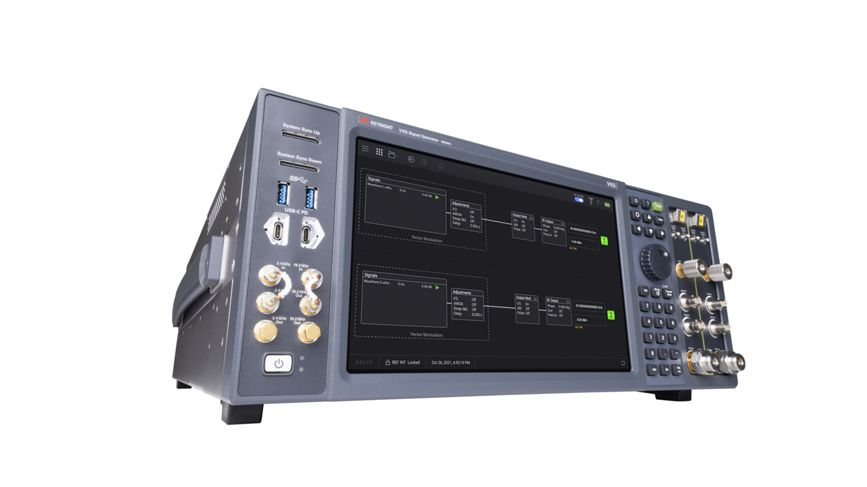
Arbitrary Waveform Generator
Automotive and EV. Millivolt ripple riding a 48 V rail or a 400 V bus is a small signal on a large offset. Some battery cell monitors, such as the Texas Instruments BQ79718-Q1, specify ±1 mV cell-voltage accuracy, but that is an absolute DC accuracy figure, a different characteristic from oscilloscope vertical resolution. The scope's job is to show the millivolt-level ripple and transients on those rails and correlate rail behavior with bus activity, which is where the HD3's high resolution and low noise floor are directly relevant. On the HD304MSO, HD300AUTA decodes the serial communication protocols (CAN/CAN FD/CAN XL/LIN/SENT) on the same 4+16 channels, so the rail event and the bus reaction can land in one capture.
Aerospace and defense. DO-160 Section 16 power-input testing includes fast transients and longer interruptions, run as separate test procedures. Fourteen bits across a deep memory record of up to 100 Mpts supports both captures, and HD300AERA decodes ARINC 429 and MIL-STD-1553 beside the rails. For MIL-STD-461 pre-screening, the FFT plus the HD3's low noise floor can help surface wideband conducted-emission candidates before accredited lab testing.
For the measurement mechanics behind these cases, related guides go deeper: the bode plot oscilloscope guide covers loop and PSRR sweeps, the DO-160 pre-compliance guide covers Section 16/17 screening, and how an oscilloscope works covers the fundamentals.
Why Do High-Resolution Measurements Still Go Wrong?
Why Do High-Resolution Measurements Still Go Wrong?
Most failed high-resolution measurements spend the bits in the setup, not the instrument. The most common causes:
- A 10:1 passive probe attenuates the signal toward the noise floor. For power-rail work, PDN measurement practice often favors terminated coax connections over standard probes (Istvan Novak's PDN probing guidance)
- V/div set too coarse: the signal uses only a small part of the ADC range, which wastes available levels
- Bandwidth-limit filters left off, which digitizes noise the measurement does not need
- Ground loops and long ground leads adding artifacts that the ADC records as part of the signal
- Outdated calibration making microvolt readings harder to defend
The fixes cost little: right-size the probe (the refurbished oscilloscope probes guide covers the options), fill the screen with the signal, engage the 20 MHz limit when the measurement allows, and keep the paperwork current per the oscilloscope calibration guide and the certificate of calibration explainer.
Building the full bench? See the used MSOX4154A listing for the value tier and request a quote.
Conclusion: Buy the Bits Your Signals Need
Three takeaways belong in the purchase memo. Judge instruments by ENOB and noise floor, not just the bit count on the box. Let the application map guide your tier, because 8 bits still earns its keep on logic and general debug. Use the certified used path to put native 14-bit resolution on the bench well below list price, with up to 5 years of warranty options.
Browse the certified used inventory and request a quote.
Select up to 3 instruments to compare
Select another instrument to compare
![]()
Starting at
Select another instrument to compare
![]()
Starting at
Select another instrument to compare
![]()
Starting at
In a hurry? Browse the certified used signal generators and request a quote.
Pulse Generator
A pulse generator produces electrical pulses with settable shape, width, period, and edge times. Pulse and pattern generators support high-speed digital timing tests, serial-data stress tests, and component characterization: the 81134A pulse pattern generator, for example, produces patterns and pulses to 3.35 GHz on 2 channels.
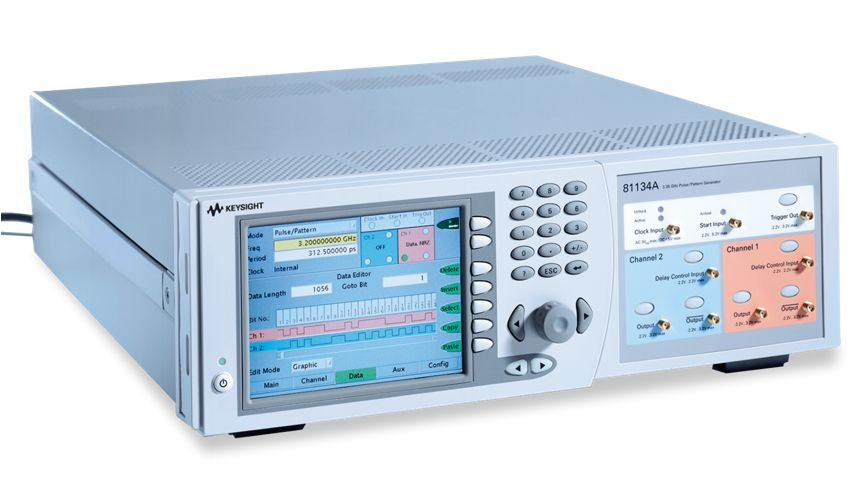
Timing accuracy is the key spec: check jitter and transition-time specs against your fastest signal, and keep the instrument calibrated, since a drifted pulse generator may report edges at the wrong time.
Radio Frequency Signal Generator
An RF signal generator creates continuous-wave and modulated signals at radio frequencies for testing and troubleshooting receivers, amplifiers, and RF modules in cellular, satellite, and general wireless work.
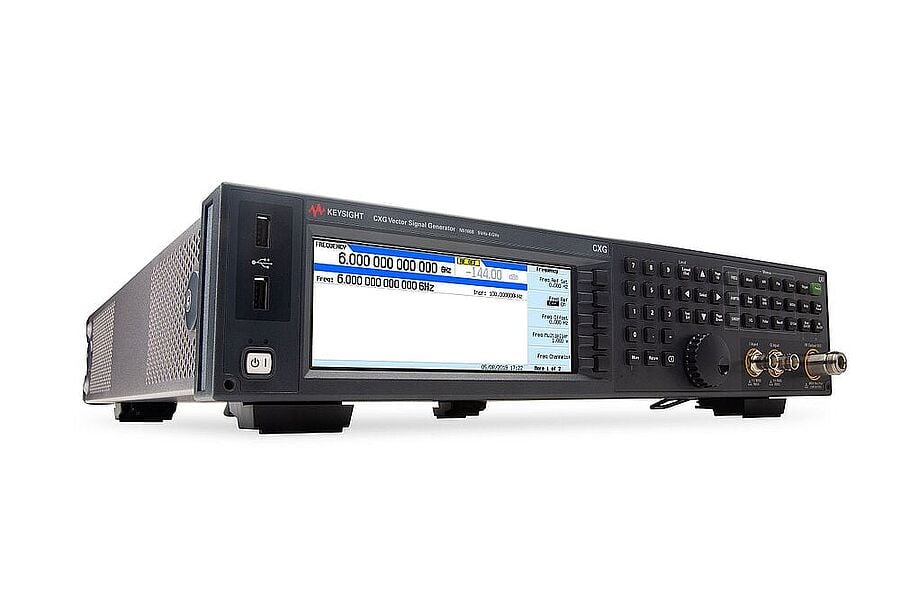
RF generators divide into analog and vector types. Analog generators provide CW (Continuous Wave) plus AM/FM/PM for local oscillator substitution, interference testing, driving an amplifier into compression, and level-calibrated receiver work. Vector generators add I/Q modulation. Phase noise is one of the key ranking specs in this class; at microwave frequencies, it can become the defining one.
Which Keysight Signal Generator Should You Buy?
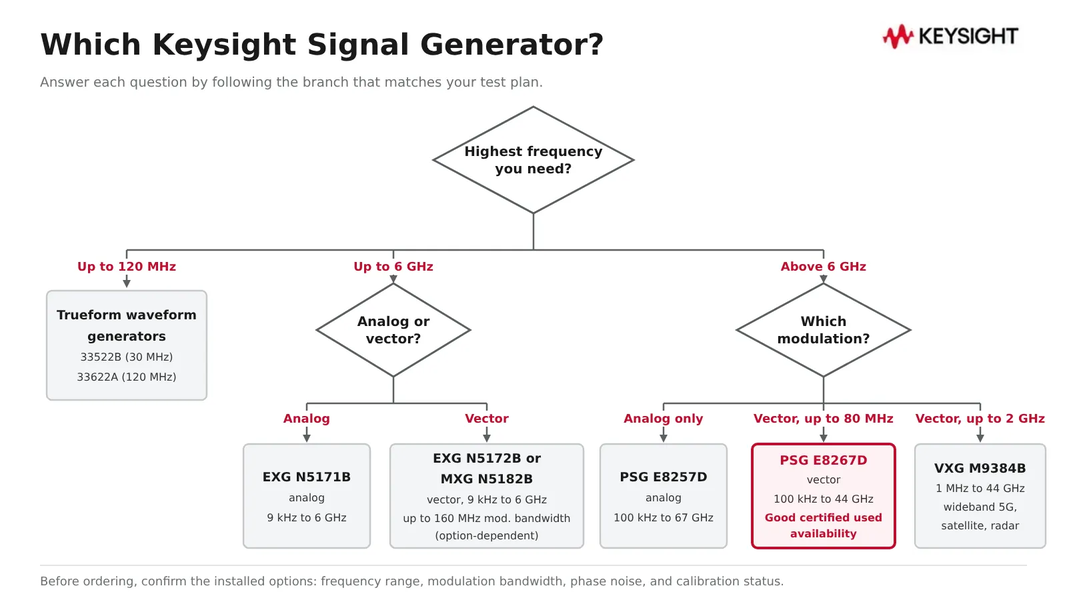
Match the tier to your highest frequency and your modulation needs; Keysight's current signal generators run from 9 kHz to 54 GHz natively, with frequency extenders reaching past 100 GHz. Every row below is verified against the official Keysight product pages.
| Job | Keysight model | Family | Range / bandwidth | Type |
| Bench and baseband work, 2 channels | 33522B | Trueform 33500B Series | 30 MHz, 250 MSa/s, 16-bit | Waveform/arb |
| Faster baseband and pulse work | 33622A | Trueform 33600A Series | 120 MHz, 1 GSa/s, 14-bit | Waveform/arb |
| RF analog, manufacturing test | N5171B | EXG X-Series | 9 kHz to 6 GHz | Analog |
| RF vector, general purpose | N5172B | EXG X-Series | 9 kHz to 6 GHz, up to 160 MHz mod BW (option-dependent) | Vector |
| RF vector, R&D-grade phase noise | N5182B | MXG X-Series | 9 kHz to 6 GHz, up to 160 MHz mod BW (option-dependent) | Vector |
| Microwave analog, up to 40 GHz | N5183B | MXG X-Series | 9 kHz to 40 GHz | Analog |
| Microwave analog, to 67 GHz | E8257D | PSG | 100 kHz to 67 GHz | Analog |
| Microwave vector, radar/EW/satcom | E8267D | PSG | 100 kHz to 44 GHz, up to 80 MHz mod BW | Vector |
| Wideband 5G/satellite, dual channel | M9384B | VXG | 1 MHz to 44 GHz, up to 2 GHz mod BW | Vector |
| Pulse and pattern timing test | 81134A | Pulse pattern generator | 15 MHz to 3.35 GHz, 2 channels | Pulse |
The certified used instrument we highlight is the PSG E8267D vector signal generator (100 kHz to 44 GHz, up to 80 MHz modulation bandwidth): the microwave vector source for radar, electronic warfare, and satellite test benches, with good availability certified used now, including Keysight Premium Used units. On the RF tier, note an important lifecycle fact: Keysight's product page announces that the MXG N5182B is to be discontinued, naming the N5186A as its successor. That makes certified used the practical way to put MXG-class phase noise (-146 dBc/Hz typical at 1 GHz, 20 kHz offset, with Option UNX; check installed options per listing) on a bench at a fraction of a current-generation price; confirm calibration support for your planning horizon when you request a quote. For high-volume 6 GHz work on a tighter budget, the EXG pair (N5171B analog, N5172B vector) covers manufacturing test in a rack-friendly form factor, and the vector signal generators category page shows the wider certified-used lineup.
Is a Used Signal Generator Worth It?
Signal sources can age well when maintained: performance depends heavily on the synthesizer design, and periodic calibration helps keep the instrument accurate over time. That makes the used-equipment question mostly a provenance question.
| Decision factor | Certified used from Keysight | New |
| Price versus new list | Up to 90% lower (Keysight Used), up to 70% lower (Keysight Premium Used) | Full list price |
| Warranty | Up to 5 years warranty options | Standard factory warranty options |
| Calibration | Keysight calibrated (Keysight Premium Used); calibration as listed (Keysight Used) | Factory calibrated |
| Inspection | 101-point checklist on Keysight Premium Used units | Factory final test |
| Installed options | Verified per listing, with more options addable on Keysight Premium Used | Configured at order |
| Support | KeysightCare access | KeysightCare access |
| Availability | Multiple units in stock across tiers | Lead time depends on configuration |
Buying certified used equipment direct from Keysight removes most of the usual used-market risk. Keysight Premium Used units are refurbished at the factory that builds new instruments, inspected against a 101-point checklist, fully calibrated, and pass the same final test as a new product. Keysight Used units ship in working condition with calibration as listed, at deeper savings. Both tiers offer up to 5 years of warranty options. Calibration is one detail to insist on for any signal source, because a generator with drifted level accuracy or degraded spectral purity fails quietly: your measurements move, and nothing on the front panel says why. Confirm the calibration status and installed options per listing before you order.
How to Narrow Down Your Choice
The buying decision comes down to four questions. What is the highest frequency your test plan needs? Do you need analog purity or vector modulation? What phase noise can your most sensitive measurement tolerate? For arbitrary waveforms, how much usable bandwidth and play time does the sample-rate math give you? Answer those questions, and the model table above should narrow the choice quickly: Trueform for the bench, X-Series for RF, PSG or VXG for microwave.
Certified used from Keysight brings these instrument families within reach of tighter budgets, with warranty options and Keysight calibration behind them. Browse the certified used signal generators and request a quote for the configuration that fits.
Whenever You’re Ready, Here Are
5 Ways We Can Help You
1
Browse our certified used signal generators and request a quote for current pricing
2
Call tech support US: +1 800 829-4444
Press #, then 2. Hours: 7am – 5pm MT, Mon– Fri
3
Contact our sales support team
4
Create an account to get price alerts and access to exclusive waitlists
5
Talk to your account manager about your specific needs
Frequently Asked Questions
A signal generator is an instrument that produces electrical signals with known, settable properties: frequency, amplitude, waveform shape, and modulation. Engineers use signal generators to drive circuits under test, substitute for missing signals during troubleshooting, and supply calibrated stimuli for receiver and component measurements.
Start with frequency range (your highest test frequency plus headroom), then decide analog or vector by whether you need digitally modulated signals. After that, rank candidates by phase noise at your working offsets, modulation bandwidth if you need vector capability, and practical bench features: channel count, external reference connectors, and remote control over USB, LAN, or GPIB with SCPI commands, so you can automate tests from Python or LabVIEW and make them repeatable.
A function generator produces standard lower-frequency waveforms, such as sine, square, triangle, and pulse, up to tens or hundreds of megahertz for general circuit work. An RF signal generator produces calibrated continuous-wave and modulated carriers at radio and microwave frequencies, with the level accuracy and spectral purity receiver testing often requires. The Trueform 33622A sits in the first camp; the EXG, MXG, and PSG families sit in the second.
Analog is enough when your tests use continuous-wave, swept, or AM/FM/PM signals, such as local-oscillator substitution, interference generation, and filter sweeps. You need vector capability when your device expects a digitally modulated signal. An analog generator cannot produce a 5G NR or Wi-Fi signal, or a complex radar waveform such as a wideband chirp, although its FM and pulse modulation cover narrowband chirps and simple pulsed-radar tests. Buying analog when you need vector capability can create a costly gap; buying vector when analog is enough may waste budget.
The frequency range is the span between the lowest and highest frequencies the instrument can produce. It varies by instrument class: Trueform waveform generators reach 30 to 120 MHz, X-Series RF generators span 9 kHz to 6 GHz, and PSG microwave generators run from 100 kHz up to 67 GHz, with frequency extenders reaching beyond that range.
A signal generator usually outputs an AC waveform: a time-varying signal at a set frequency, which includes audio-band signals. Many waveform generators can also apply a DC offset or output a DC level, so the practical answer is AC by design, with DC offset available on many bench instruments.
The price range is wide because frequency range and modulation capability drive the hardware: a bench waveform generator and a 44 GHz vector source are different classes of machine. Certified used pricing from Keysight sits well below new list across those classes; request a quote on a specific model and option set for a current figure.
A 2-channel benchtop Trueform waveform generator can cover many learning and hobbyist projects, from audio filters to the analog front end of an Arduino or Raspberry Pi project: standard waveforms, modulation, sweep, and arbitrary playback in one instrument for a beginner or a teaching lab. Keysight's certified used pricing puts lab-grade instruments inside education budgets, and Keysight offers an additional 15% education discount for educators and researchers on top of the standard certified-used savings.
Browse the certified used inventory and request a quote
Sources
- Keysight Technologies, How Signal Generator Spectral Purity Affects Measurements (application note, lit. 5952-2019): spectral purity, drift, and short-term instability.
- Keysight Technologies, The Essential Signal Generator Guide, Part 2 (white paper, lit. 5992-3619): single-sideband phase noise measurement and the analog-versus-vector distin
- Keysight Technologies, Understanding Phase Noise Needs and Choices in Signal Generation (application note, lit. 5991-1744): synthesizer architecture and phase noise trad
- Keysight Technologies, Know Your Top Arbitrary Waveform Generator Specifications (Keysight Knowledge Center): Nyquist, the 40% usable-bandwidth
- IEEE Standards Association, IEEE Std 1139-2022: Standard Definitions of Physical Quantities for Fundamental Frequency and Time Metrology.
- NIST, Time and Frequency from A to Z: Phase Noise.
- 3GPP, TS 38.101-1: NR User Equipment radio transmission and reception, Range 1.
- Keysight Technologies, PSG, MXG and EXG Microwave Signal Generators (brochure, lit. 5991-4876): portfolio overview (2017); current ranges and phase-noise figures come from th
- Keysight Technologies, PSG Signal Generators data sheet (lit. 5989-0698EN): E8257D phase noise, specified and typical, by option.
- Keysight Technologies, X-Series MXG Signal Generators data sheet (lit. 5991-0038EN): N5182B phase noise with and without Option UNX; baseband bandwidth options.
- Keysight Technologies, X-Series EXG Signal Generators data sheet (lit. 5991-0039EN): EXG typical phase noise; baseband bandwidth options.
- Keysight Technologies, M9484C VXG and V3080A Vector Signal Generator and Frequency Extender (data sheet, lit. 3122-1445.EN): VXG frequency range and
- Keysight Technologies, How to Generate Multi-Channel Phase-Stable and Phase-Coherent Signals (Keysight blog): shared 10 MH