
Tech Guides
How To Measure Antenna Gain Using a Network Analyzer



Introduction
Two engineers measure the same antenna and report gains 2.15 dB apart. Both measurements are correct. If you work with RF systems, antenna gain helps decide how far your link reaches and how much power that reach costs. Measuring it correctly is another matter: gain is a radiated quantity, so it typically takes 2 antennas, a known geometry, and a calibrated instrument to measure. A vector network analyzer (VNA) is a standard bench instrument for the job, because one calibrated S21 measurement captures the transmit-to-receive path. This guide covers what antenna gain is, the standard ways to measure it, and a step-by-step VNA procedure aligned with published methods.
Summary
- Antenna gain = directivity x radiation efficiency (per IEEE Std 145): how strongly an antenna concentrates power in its peak direction, accounting for internal losses. Units: dBi (relative to an isotropic radiator) or dBd (relative to a half-wave dipole), with dBi = dBd + 2.15.
- The standard methods: the gain-transfer (gain-comparison) method using a reference antenna of known gain, and the absolute two-antenna and three-antenna methods built on the Friis transmission equation. No reference antenna is needed for the absolute methods.
- A VNA measures gain through S21 (transmission between 2 antennas) after a calibration; it also checks the antenna's match through S11 before any gain number is meaningful.
- Measure in the far field: separation R of at least 2D²/λ (D = largest antenna dimension, λ = wavelength), and clean up reflections with absorber or time-domain gating.
- Certified used analyzers that fit the job: the ENA E5080B (options up to 53 GHz), the E5071C (options up to 20 GHz), the value E5063A for antenna and passive test, and the FieldFox N9952B for field work, with Keysight Used savings of 40 to 90% below new list and up to 5 years warranty options.
What Is Antenna Gain?
Antenna gain refers to how well an antenna converts an electrical signal into radio waves and can focus radio waves in a particular direction. The higher the antenna gain, the more focused the radio waves will be. This is important because the signal will be stronger and more likely to reach its intended destination, and will be less affected by interference from other sources.
There are two main types of antenna gain: directivity and beam width.
1. Directivity measures how well the antenna can focus its signal in a particular direction. You calculate the directivity by using the following formula:
(Prad/Ptot)
where Prad is the power radiated in the desired direction, and Ptot is the total power radiated by the antenna. The directivity is expressed in dB.
2. Beam width measures how wide the antenna's beam can be. A wider beam width means the signal will be less focused and cover a larger area. To calculate the beam width, use the following formula:
where c is the speed of light, lambda is the wavelength of the radio waves, and theta is the angle between the main lobes
of the antenna's radiation pattern. The beam width is expressed in degrees.
There are tradeoffs between directivity and beamwidth, and the best antenna for any given application will depend on the specific needs of that application.
How Do You Measure Antenna Gain?
There are several methods of measuring antenna gain. One standard way is to measure the signal strength at the antenna output port while taking a frequency sweep. This method is the gain-frequency curve. Another common approach is to measure the power received by an antenna and compare it to the power sent by the transmitter. This is the power-gain measurement.
Antenna gain is also expressed in terms of efficiency, which is the ratio of the radiated power to the input power. An efficient antenna radiates more power than an inefficient antenna for the same input power. The efficiency of an antenna depends on its design, material, and manufacturing tolerances. Factors such as the environment, or buildings that block its radiation pattern, affect the gain of an antenna.
When measuring antenna gain, there are two commonly used units: dBi and dBd. Both units express how much power an antenna can concentrate in a particular direction but use different reference points.
- dBi is relative to an isotropic radiator, a theoretical source of electromagnetic radiation that radiates equal intensity in all directions. The term isotropic radiator is often used in the context of antennas, describing an antenna that radiates equally well in all directions. However, it is important to note that actual isotropic radiators do not exist in practice. All real-world antennas will have some directional bias, meaning they will radiate more effectively in some directions than others.
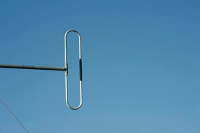
- dBd is relative to a dipole antenna, a real-world antenna. Dipole antennas consist of two metal rods that are perpendicular to the ground. The signal feeds into the middle of the two rods, causing them to emit electromagnetic radiation in all directions. While dipole antennas are not truly isotropic, they provide a good deal of directional flexibility and are used in various applications.
As a result, dBi refers to the absolute gain of an antenna, while dBd compares the gain of two antennas. For example, if one antenna has a gain of 3 dBi and another has a gain of 5 dBd, the second antenna will have more than twice (7.15 dB) the power of the first.
Let's look at two other antenna gain measurements, the direct comparison method, and the absolute gain method.
Direct Comparison Method
In microwave engineering, a direct comparison can measure an antenna's gain. This method, also known as the gain-transfer method, involves comparing the power received by two antennas in the exact same location, a reference antenna and the unknown one. The antenna with a higher gain will receive more power than the one with a lower gain. To carry out a direct comparison, you will need to measure the power received by each antenna.
The difference in power received between the two measurements is then used to calculate the gain of each antenna. This method is more accurate than other methods, such as the free-space method, because it considers factors such as reflections and diffraction that can affect the measurement.
You can use the direct comparison method on any antenna. It is most commonly used to compare the gain of a mobile phone antenna in different positions or the performance of two mobile phone networks

The direct comparison method is not without its drawbacks, however.
- It can be time-consuming, as you need to move the antenna location for each measurement.
- It can also be difficult to place the antennae in the exact location, particularly if they are different sizes.
Absolute Gain Method
This method involves measuring the power output of an antenna in a given direction and comparing it to the power output of a reference antenna. The reference antenna is usually an isotropic radiator, which emits equal amounts of power in all directions, and consists of two or three antennas. This method measures the gain of directional antennas, as they take into account the fact that most antennas are not perfectly omnidirectional.
The two-antenna method uses two antennas to measure the ratio of power received at one antenna to the power received at the other antenna. The three-antenna method is similar, except it uses three antennas and considers the tilt angle between each antenna. These methods are very accurate but are also more complex and require specialized equipment.
The absolute gain method is effective on directional antennas. Common directional antennas are Yagi-Uda antennas, used in TV and radio broadcasting, and parabolic dish antennas, used in satellite communications.
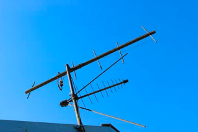
The absolute gain method also has drawbacks, such as
- The need for specialized software and equipment and a reference antenna.
- It can only compare antennas that operate at the same frequency.
- The absolute gain method does not consider power loss due to reflections of objects in the environment.
Regardless of the drawbacks, it is still an accurate and reliable method for measuring antenna gain.
Using a Network Analyzer To Measure Antenna Gain
A network analyzer measures the linear and nonlinear characteristics of active and passive electronic components, including antennas. One of the key parameters that a network analyzer can measure is antenna gain.
When measuring antenna gain, the network analyzer sends a signal into the antenna and then calculates the received signal strength. The received signal strength is then compared to the signal strength if the antenna were omnidirectional, and the difference is the antenna gain.
Network analyzers are essential tools for testing and characterizing antennas and can provide critical insights into their performance. To use a network analyzer to test antenna gain, follow these steps.
| Process | Explanation |
|---|---|
| Connect the analyzer to the antenna | Ensure the antenna is properly connected to the analyzer via a coaxial cable. The cable will run from the analyzer's output port to the antenna's input port. |
| Adjust the frequency settings on the analyzer | Turn on the analyzer and set the center frequency range for the antenna. This setting will depend on the antenna type and operating frequency. For example, if the antenna operates at 2.4 GHz, select a frequency band of 2.4 GHz. If you set it too high or too low, the analyzer will not be able to measure the antenna gain accurately. |
| Set the power level on the analyzer | This is measured in terms of dBm, which stands for decibels relative to one milliwatt. Aim for a power level that is high enough to get good readings without damaging the antenna or distorting the measurements. A power level between -10 dBm and -20 dBm is sufficient for most antennas. |
| Configure the parameter settings | Set the measurement type to "gain" and select the appropriate reference antenna. For example, if you are measuring the gain of a Yagi-Uda antenna, you would choose a three-antenna configuration and use an isotropic radiator as the reference antenna. |
| Carry out testing | Set the measurement type to "gain" and select the appropriate reference antenna. For example, if you are measuring the gain of a Yagi-Uda antenna, you would choose a three-antenna configuration and use an isotropic radiator as the reference antenna. |
What Are the Benefits of Measuring Antenna Gain Using a Network Analyzer?
You can also measure antenna gain using a spectrum analyzer or signal generator. Let's see how these two compare to using a network analyzer and the benefits of choosing a network analyzer.
- A spectrum analyzer can measure the performance of an antenna by sweeping a radio frequency signal across the antenna and measuring the antenna's gain at each frequency. You can use this information to adjust the antenna for optimal performance.
- A signal generator produces a radio frequency signal that can test the performance of an antenna. The signal generator is connected to the antenna, and the antenna's gain is measured at various frequencies.
There are downsides to using spectrum analyzers and signal generators to take measurements of antenna gain. They can be expensive and require a high level of expertise to use. They also tend to be slower than network analyzers and can take longer to set up.
In contrast, network analyzers are specifically used for measuring antenna gain and are much easier to use. Network analyzers can also measure other parameters, such as impedance and return loss, which is helpful in troubleshooting RF antenna problems.
Buy a Keysight Network Analyzer and Reduce Test Times
Do you work in the RF industry and need to measure antenna gain? Keysight offers a wide range of network analyzers used for this purpose. Our network analyzers are easy to use and offer a variety of features that make measuring antenna gain quick and easy.
Buy our premium used E5072A-285 vector network analyzer and get 15% off!
The E5072A delivers new standards in versatility, speed, and accuracy and is suitable for the full-performance characterization of passive and active components of antennas. This makes measuring antenna gain simple and hassle-free. That means less time testing, which equals increased productivity.
Closing Thoughts From Keysight
As we have looked at, measuring antenna gain is a complex process that requires specialized equipment. Network analyzers offer many benefits over other equipment, and Keysight's network analyzers are some of the best on the market. That means you can rely on Keysight when measuring antenna gain.
So if you are in the market for a network analyzer, Keysight can help you find the right one to fit your needs. We offer a wide variety of used equipment, including premium refurbished network analyzers trusted and used by engineers worldwide. For help finding the correct analyzer for your needs, contact us today.
Whenever You’re Ready, Here Are
5 Ways We Can Help You
Call tech support US: +1 800 829-4444
Press #, then 2. Hours: 7am – 5pm MT, Mon– Fri
Contact our sales support team
Create an account to get price alerts and access to exclusive waitlists
Talk to your account manager about your specific needs