













- Overview
- All Models
- Support
Replicate adversary behaviors across endpoint, network, and cloud layers
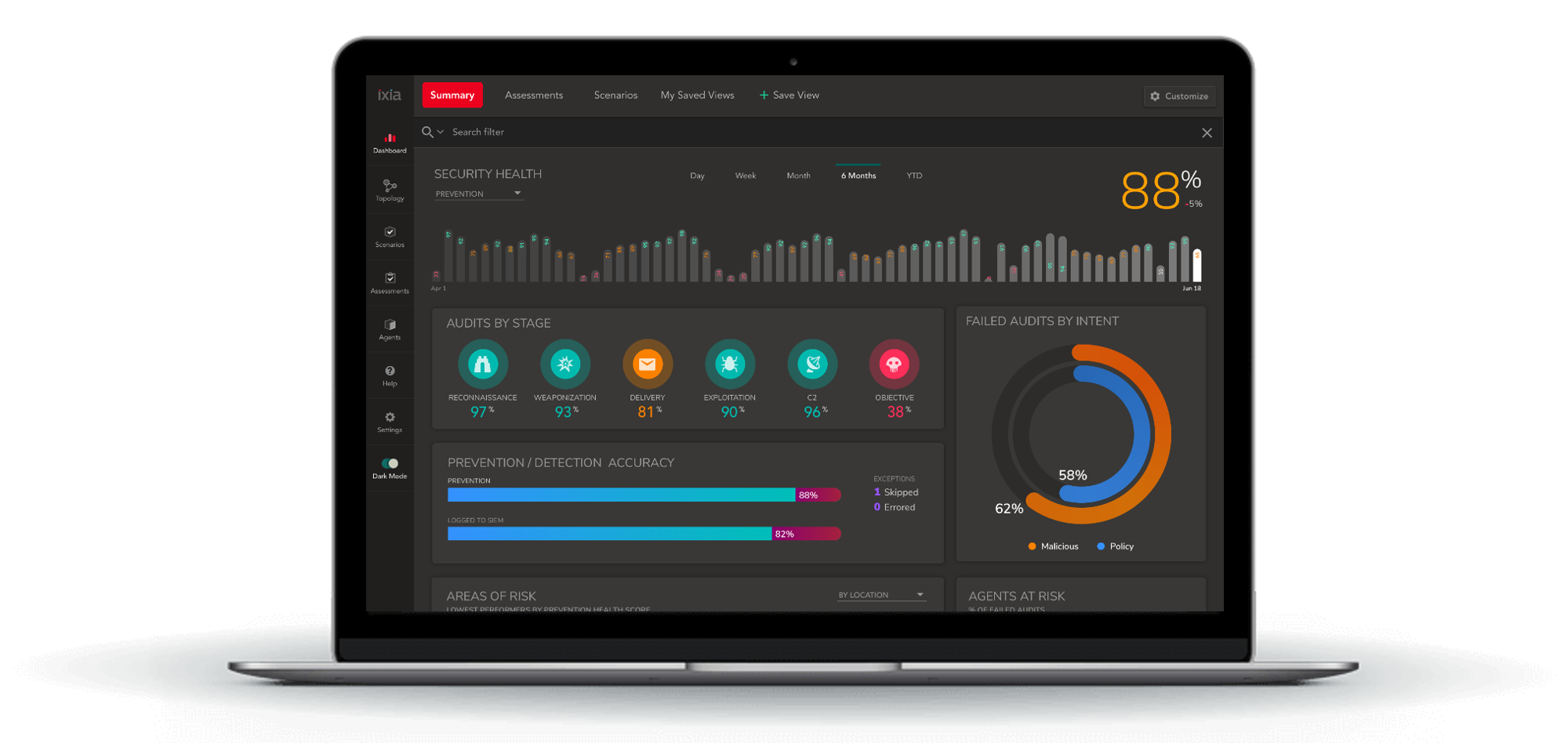
Keysight Threat Simulator software provides continuous breach and attack simulation (BAS) to validate the effectiveness of your existing cybersecurity controls. By replicating real adversary behaviors across endpoint, network, and cloud layers, it helps you proactively uncover weaknesses and reduce risk exposure. Threat Simulator operates safely in production environments and delivers actionable remediation insights mapped to frameworks like MITRE ATT&CK. Request a quote for one of our popular configurations today. Need help selecting? Check out the resources below.
TTP-based simulation engine
Emulate attacker tactics, techniques, and procedures (TTPs) using scenarios aligned with frameworks like MITRE ATT&CK.
End-to-end security stack validation
Test detection and response across endpoint, network, and cloud security controls with unified visibility.
Remediation guidance and reporting
Receive prioritized recommendations and risk metrics to help your team close gaps before attackers exploit them.
SIEM and SOAR integration
Automate test orchestration and results analysis by integrating directly with your existing security operations platforms.
Most popular configurations
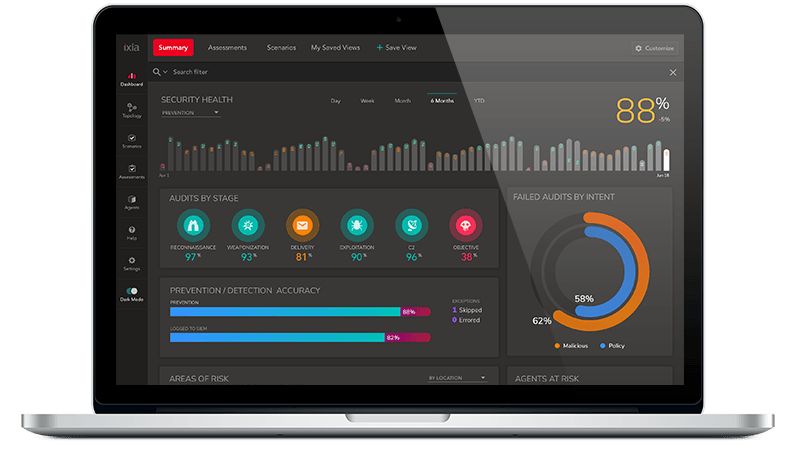
Threat Simulator Base Bundle, 5 Agents, 1-Year SaaS Subscription TAA
Threat Simulator Basic Bundle, 10 Agents, 1-Year SaaS Subscription TAA
Threat Simulator Standard Bundle, 25 Agents, 1-Year SaaS Subscription TAA
- Keysight Threat Simulator for MSSPs
- Keysight Threat Simulator for Healthcare Providers
- Achieving CMMC 2.0 Compliance in Defense
Services and support
Innovate at speed with curated support plans and prioritized response and turn-around times.
Get predictable, lease-based subscriptions and full lifecycle management solutions—so you reach your business goals faster.
Experience elevated service as a KeysightCare subscriber to get committed technical response and more.
Ensure your test system performs to specification and meets local and global standards.
Make measurements quickly with in-house, instructor-led training, and eLearning.
Download Keysight software or update your software to the newest version.
Frequently asked questions
Breach and attack simulation is the practice of continuously testing and validating the effectiveness of security defenses by safely emulating real-world attacker behavior in a controlled environment. Instead of waiting for an actual breach to reveal weaknesses, organizations can proactively simulate the same tactics, techniques, and procedures that malicious actors use, ranging from credential theft and lateral movement to phishing and data exfiltration. These simulations are not theoretical or static checklists; they mirror the constantly evolving strategies of cyber adversaries and are updated to reflect the latest threat intelligence.
This approach is critical for modern security teams because today’s IT environments are distributed across on-premises data centers, public and private clouds, and remote endpoints. Traditional, point-in-time penetration testing or red teaming exercises may provide valuable insights, but they are often limited in scope and frequency. Breach and attack simulation, by contrast, offers ongoing validation, ensuring that defenses are effective even as networks, applications, and threat landscapes change.
The benefits go beyond simply finding gaps. Security teams gain measurable, repeatable evidence of how their defenses perform against specific attack vectors. They can prioritize remediation based on business risk, improve incident response readiness, and demonstrate compliance with regulatory or industry standards. Most importantly, this proactive strategy enables organizations to shift from a reactive posture, responding only after a breach occurs, to a preventive one, where weaknesses are identified and addressed before they can be exploited.
Verifying endpoint detection involves simulating real-world adversarial techniques directly on or near the endpoint device without causing harm or system disruption. BAS tools like Threat Simulator install a secure test agent that runs controlled attack scripts mimicking common techniques such as credential harvesting, process injection, or fileless malware execution. These simulations use known techniques from adversary groups (e.g., APTs), ensuring they reflect actual threats your organization might face.
Once a simulation is run, Threat Simulator collects telemetry from the agent and checks whether your EDR/XDR, antivirus, or SIEM recorded the event, blocked it, or raised alerts. You get a detailed breakdown of what was detected, what was missed, and where the gaps are, enabling targeted improvements in detection rules, logging configurations, or agent deployments. This turns endpoint security from a black box into a measurable, tunable defense layer.
Proper network segmentation is critical for limiting the lateral spread of threats, but misconfigurations are common and often go unnoticed. With a BAS platform, you can validate segmentation enforcement by simulating intra-network attack paths. For example, agents can be deployed on different VLANs, subnetworks, or cloud VPCs to simulate port scans, lateral movement, or credential-based access attempts.
Threat Simulator mimics the behavior of attackers trying to traverse segments, testing firewall rules, NAC policies, and routing ACLs. It then reports on whether the access attempt was blocked or allowed, and whether any monitoring system flagged the behavior. Engineers can see in real time if the segmentation controls match their intent, and adjust policies accordingly. This is especially useful in complex environments like hybrid cloud, SD-WAN, or microsegmented data centers, where manual validation is nearly impossible.
Yes, BAS platforms are highly effective for validating the real-world efficacy of your SOC’s alerting and triage systems. Threat Simulator can trigger emulated attack sequences that should, in theory, be detected by your SIEM, IDS/IPS, firewall, and other controls. For example, it may simulate command-and-control beaconing, lateral movement attempts, or privilege abuse, all of which your detection logic is expected to catch.
Once these simulations run, your SOC team can review whether the appropriate alerts were generated, if they were escalated properly, and how fast the incident response process was initiated. This not only tests the tooling but also the people and processes behind your detection strategy. By running these simulations regularly, you create a feedback loop that sharpens detection rules, reduces alert fatigue (by tuning noisy signatures), and improves SOC response times, all while proving coverage against critical attack techniques.
Traditional penetration testing is typically manual, point-in-time, and scoped, conducted once or twice a year, often focusing on discovering vulnerabilities rather than validating existing defenses. While valuable, it cannot provide the continuous assurance needed to keep pace with today’s fast-changing threat landscape. Breach and Attack Simulation, by contrast, is automated, repeatable, and safe for production environments.
Threat Simulator can be scheduled to run daily, weekly, or on-demand across multiple vectors—endpoint, network, cloud—emulating real-world threats and verifying that your security stack responds as intended. Unlike pentesters who may only test a few paths due to time constraints, a BAS tool can execute hundreds of attack variations, simulate known adversary techniques (e.g., APT29, FIN7), and provide consistent, comparative reporting. This allows organizations to move from reactive, occasional testing to continuous, data-driven validation that feeds directly into SOC operations and risk management workflows.