


Why Use Photonic Integrated Circuit Simulation
Accelerate PIC innovation with scalable simulation, integrated workflows, and heterogeneous device modeling.
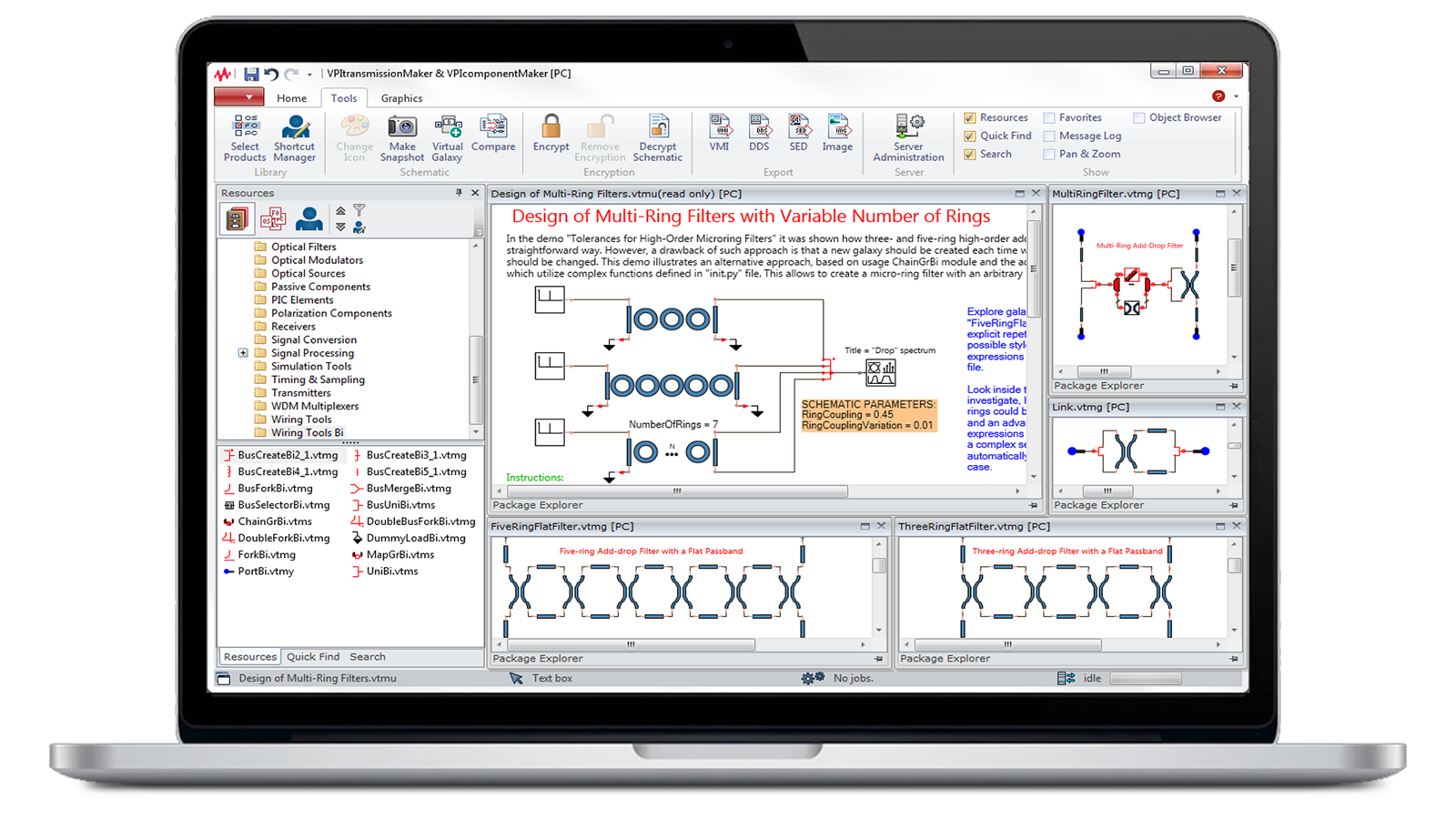
As photonic integrated circuits become larger, more complex, and increasingly heterogeneous, engineers need design environments that deliver both accuracy and scalability. This solution provides an advanced EDA-style workflow for modeling, simulating, and optimizing modern photonic integrated circuits containing passive photonic, active optoelectronic, and electronic components. Its unique simulation framework seamlessly combines frequency-domain and time-domain techniques, enabling accurate analysis of large-scale PICs with thousands of components while reducing simulation inaccuracies and runtime. Comprehensive libraries of photonic, electrical, and digital devices, combined with hierarchical design methodologies, scripting capabilities, and cosimulation support, allow teams to create highly sophisticated designs faster. Optimization, parameter sweeps, yield analysis, and custom model integration further streamline development, helping engineers improve performance, reduce design iterations, and accelerate time-to-market for next-generation photonic technologies.
Key Capabilities

Design active and passive photonic circuits.

Combine frequency- and time-domain modeling.

Simulate thousands of integrated components.

Access photonic, electronic, and logic devices.

Integrate Python, MATLAB®, C++, and COM models.

Perform sweeps, tuning, and yield analysis.
Resources to Get You Started
This brochure presents VPIcomponentMaker Photonic Circuits, a simulation environment combining time- and frequency-domain techniques for large-scale, heterogeneous photonic integrated circuits. Component libraries support the design of lasers, modulators, transmitters, receivers, and optical signal-processing circuits. Foundry-specific process design kits enable layout-aware simulation, fabrication tolerance analysis, and integration with external layout tools. Application examples include PAM4 transmitters, tunable lasers, neural network activation units, and optical coherence tomography, demonstrating workflows from device modeling to circuit and system evaluation.


blogs
Completing Keysight's End-to-End Photonic Design Workflow
Brochures
Photonic Design Automation for Components, Systems & Networks

Have Questions? We've Got Answers
The software is designed for modeling, simulation, and optimization of photonic integrated circuits, including active optoelectronic devices, passive photonic components, and electronic circuitry.
The platform combines frequency-domain S-matrix modeling for passive structures with time-domain simulation for active device interactions, improving accuracy while maintaining computational efficiency.
Yes. The simulation framework is specifically designed to support large and complex photonic integrated circuits containing hundreds or even thousands of components.
Yes. Users can incorporate custom models through cosimulation interfaces supporting Python, MATLAB®, C++, and COM-based integrations, enabling highly flexible workflows.
The software supports parameter optimization, multidimensional sweeps, interactive tuning, yield estimation, scripting, and hierarchical design techniques to accelerate PIC development.